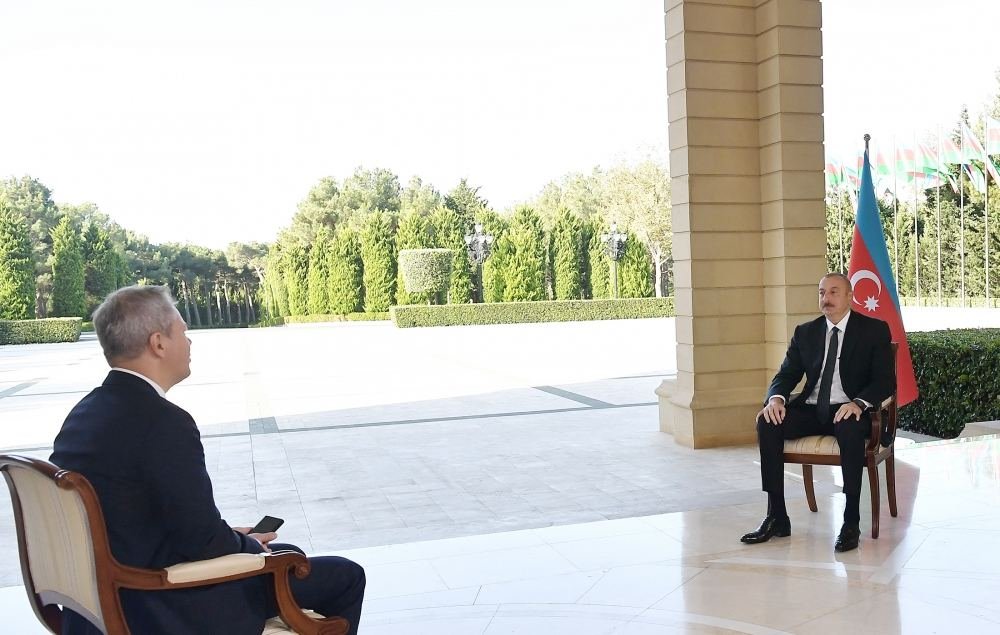
BAKU, Azerbaijan, October 10. As reported
earlier, On October 10, President of the Republic of Azerbaijan
Ilham Aliyev was interviewed by the Russian RBC TV channel. On
October 11, the TV channel broadcast the interview with the head of
state. Trend
presents the interview.
– First of all, thank you very much for agreeing to
speak with us. Before we start, I want to talk about the principles
of RBK. A few days ago, there was an extensive interview with the
prime minister of Armenia, and now we are here in Azerbaijan, in
Baku, to speak with President of Azerbaijan Ilham Aliyev. One more
remark, before I ask the first question, condolences to the
relatives of all the victims on both sides. I have heard a lot that
no-one needs war and the sides could have done without it. And now
the most difficult but also the most interesting task begins. The
negotiations have ended. How would you assess what happened in
Moscow? It is very important for us to understand what it all
means.
– In general, I have a positive assessment because the statement
circulated after the talks says that a ceasefire is being declared
for humanitarian reasons and – what is of fundamental importance,
this was the position of Azerbaijan and I am glad that this was
reflected in this document – substantive negotiations between
Armenia and Azerbaijan will begin and the format of negotiations
remains unchanged. These are the two positions the new Armenian
government tried to undermine. It is no secret to anyone that the
statements we heard from Yerevan were essentially aimed at
undermining the process of negotiations that had been developed
over the years, including its fundamental principles, at
undermining the format of negotiations. Therefore, it was extremely
important that the Armenian side – of course, this happened as a
result of what we have on the battlefield – was forced to accept
that the fundamental principles form the basis for a settlement and
they clearly state how the conflict should be settled and in what
sequence the occupied territories should be returned to Azerbaijan.
Secondly, the format of the negotiations remains unchanged. This
means that negotiations have been, are and will be conducted only
between Azerbaijan and Armenia. All attempts by the Armenian
leadership to shift this responsibility onto the puppet regime that
exists in Nagorno-Karabakh have failed. Thus, after that I am sure
that we will no longer hear from Pashinyan that “Karabakh is
Armenia”. Also, we will not hear his statements that Azerbaijan
should negotiate with the so-called leadership of Nagorno-Karabakh.
If he does make such statements, it will mean that he shows
disrespect both for the mediators and for his own delegation, which
agreed on this text in Moscow, and this will again undermine the
process of negotiations. What did it lead to this time? I think
everyone can clearly see that. I don’t think he can allow himself
to step on the same rake a second time.
– The ceasefire – how long will it last? How would you
assess the fragility of this truce? What will it depend
on?
– This ceasefire lasted for many years until the current
escalation, for decades. There were certain clashes on the line of
contact, there were provocations of the Armenian side on the state
border in July this year. But such large-scale action has never
taken place in the last almost 30 years. Therefore, everything will
depend on the Armenian side. First of all, whether it will observe
the ceasefire. Because this morning and yesterday, that in the
early hours of today and in the morning, I was informed about
attempts of a large-scale counter-offensive by the Armenian forces
in many directions – an attempt to recapture Hadrut, an attempt to
recapture the territories we have liberated in Jabrayil district
and an attempt in the northern direction. In other words,
understanding that the parties can come to an agreement in Moscow,
they tried as much as possible to get back what they had lost and
what never belonged to them. Therefore, the key factor for the
durability of the ceasefire will be that Armenia must come to terms
with the fact that we have these territories, that it will never
see them again and will not make any attempts to recapture it by
military means. The second equally important factor is exactly what
I have just mentioned. At the negotiating table, we must see a
constructive approach from the Armenian side, so that they stop
trying to imitate the process of negotiations, so that they refrain
from provocative actions and statements, and so that they are
committed to finding a settlement. All we have seen from the
Armenian side over the past year was precisely aimed at undermining
the negotiations and blaming Azerbaijan. So we will see. We are
committed to our statements. Azerbaijan is a country that has
always fulfilled its obligations. I have always said that our
signature has the same value as our word. But the ceasefire is not
a unilateral process, so we will see how the Armenian side will
behave now.
– In Azerbaijan, as far as I understand in the two days
I have been here, the public sentiment is that we must go to the
end. How can you explain to the Azerbaijanis now that Baku has
agreed to negotiations again?
– We are going to the end. We didn’t stop. If the Armenian side
is committed to the ceasefire regime, then, as I said yesterday,
the phase of political settlement will begin and the phase of
coercion to negotiations will end. Therefore, we will go to the end
anyway. Our goal remains unchanged. Restoration of the territorial
integrity of Azerbaijan, which is recognized by the entire world
community, the return of Azerbaijanis to the places of their
original traditional residence, including Shusha and other
settlements of Nagorno-Karabakh, and, of course, to all other
territories outside the administrative border of the former NKAO.
Therefore, our goal remains unchanged. The question is about how we
will move towards this goal? We have always tried to follow the
political path and have always heard that there is no military
solution. We have proven that this is not the case. We showed on
the battlefield that this is not the case and that these
negotiations would have lasted another 30 years without a military
component. What would have happened before that? Illegal
settlement. This is an international crime and a violation of the
Geneva Convention. Unfortunately, no-one ever reacted to this – the
Minsk Group, the European Union or the UN. The destruction of
Azerbaijan’s historical heritage, the destruction of our cultural,
historical and religious sites, the change of place names, the
change of administrative boundaries of our regions, the change of
the names of our mountains, rivers and cities. In other words, we
would have had to wait another 30 years and then we would have been
told that this is what the situation is like now, so put up with
it. We have already been told that. Therefore, I think that the
military component, or its first stage, has come to an end, we have
now reached a political settlement which will secure that we reach
the end and get what is rightfully ours. Therefore, I think that
Azerbaijani society will perceive what happened yesterday and
tonight correctly and continue to support our policy. Because we
have always told our people the truth. We have always defended the
interests of our people. What happened on the battlefield proved it
to everyone again.
– You have met with Armenian prime minister Nikol
Pashinyan several times before these events. After these events,
are you ready to sit down at the same table or talk with
him?
– You know, it is difficult to speak with a person who is very
trustworthy. I had to negotiate with his predecessors, whom I
consider war criminals because they have committed a bloody
genocide in Khojaly, they are responsible for the killing of
peaceful Azerbaijani population, for the destruction of our
historical and cultural heritage. But I had to negotiate because we
had to find a solution to this conflict. When the new government
came to power, of course, first contacts with the new leadership
were quite encouraging. I have already spoken about this once and
do not want to repeat myself. But then the opposite happened. In
other words, we felt deceived. We understand that we are
negotiating with the enemy, but we must remain honest even with the
enemy, honest at least to ourselves. We must respect our word. When
this happened, we lost any desire to continue this senseless
activity, of course. What can you talk about with your opponent if
every word is a lie, if their lies are circulated in the world
media and if lies are broadcast all over the world? They are
probably used to lying in their own country. But when you lie about
history and about the essence of the conflict in the Internet age,
it is very quickly exposed. Therefore, I do not rule out such a
possibility but this requires certain conditions. At this stage, I
don’t think it would be productive. On the contrary. The Armenian
leadership should finally understand that it is impossible to speak
to Azerbaijan in the language of ultimatums, insults and blackmail.
I have never allowed myself such a tone of communication with
anyone – neither within the country nor abroad. But when Pashinyan
put forward seven ultimatums to us, when he insulted the feelings
of the Azerbaijanis, he should have been punished for this. And we
did that! Let him thank Putin for the fact that Russia has once
again come to Armenia’s rescue.
– You have mentioned the role of Russia. That is, it
really was decisive in these negotiations.
– Russia as a co-chair of the Minsk Group, of course, has the
same rights and powers as the other countries of the OSCE Minsk
Group. But, of course, as our neighbor and a country that has a
common history with both Azerbaijan and Armenia, Russia plays a
special role, of course. This role is based both on history and on
the interaction of our peoples, as well as the weight and role of
Russia in the world and in our region, of course. Therefore, due to
these objective reasons, the possibilities of Russia to influence
the settlement of the conflict are incomparably greater than those
of any other country. Therefore, we have repeatedly appealed to the
Russian leadership, so that the Russian leadership would engage the
levers of political influence on Armenia and urge the Armenian side
to end the occupation. This topic has been discussed many times,
and I can tell you that in all of the numerous meetings I have had
with my Russian colleague, this topic was discussed in one form or
another, either in detail or not very extensively, but this did not
happen. It is no secret that Armenia fully depends on Russia today.
Security is provided by Russia, free weapons are provided by
Russia. We have destroyed Armenian hardware probably worth billions
of dollars. Right now, in a matter of two weeks. Where did they get
this money? They don’t have it. These are all free deliveries from
Russia. Gas supply at preferential prices from Russia, electricity
to some extent too. Railways, communications, a military base. Even
the Armenian border with Turkey and Iran is guarded by Russian
border troops. If it wasn’t for this, it would be empty. What other
country has so many levers to influence Armenia? None! And there
are probably no other two countries in the world, one of which
would be so completely dependent on the other. Therefore, of
course, I am convinced that if there is insistence on the part of
Russia, given that we have changed the status quo, broken the line
of contact and brought Yerevan to its senses, I think that Russia
certainly has a lot of tools to quickly convince Armenia that the
only way out of the situation – and not only in terms of military
confrontation but also for the future of Armenia in general – is to
find a solution together with Azerbaijan. And it is quite simple –
leave the territory, withdraw the troops, our people will return
there and we will try to live side by side again.
– I will now ask you about another country – Turkey.
Azerbaijan and you personally have been repeatedly accused these
days of the fact that everything, including this conflict, is
controlled by Turkish authorities. Yesterday and tonight, we did
not see Turkey at the negotiating table. Why?
– This shows that all these opinions were false and that it was
deliberate media speculation. There were several goals. First, to
further demonize Turkey and this, unfortunately, is becoming almost
a norm in the so-called modern political fashion. This is
completely unfounded. Turkey is defending its interests, defending
its right to live its own life. Under the leadership of President
Erdogan, Turkey ceased to be an obedient ally of the West. It
dictates its will in its region and in the world. Turkey is
reckoned with now. Turkey’s authority has grown. The Turkish army
is the second biggest army in NATO and it can solve any
military-political problems. Therefore, of course, there is such
open pressure from the West. It is even fraught with some very
strange and negative emotional background in relation to Turkey. So
this is the first reason – the demonization of Turkey. The second
reason is the underestimation of Azerbaijan’s potential, including
military-technical, an attempt to introduce things in such a way
that it was Turkey or someone under the influence of Turkey that
solved a military issue. No! We have liberated our lands ourselves.
The myth about the so-called victorious Armenian army has
collapsed. It never existed. Those who know the history of the
conflict are well aware that our lands were occupied also by the
366th motorized rifle regiment of the Soviet army, which was
stationed in Khankandi and I think 70 percent of its servicemen
were of Armenian origin. So it was Soviet weaponry and Soviet
command with an Armenian composition, and they took an active part
in both ethnic cleansing and genocide.
– When … the events of the early 1990s
…
– Of course! Without the support and active participation of the
366th regiment, Armenia would not have seized our territories.
Therefore, a myth was created afterwards that the Armenian army was
victorious and the Azerbaijani one would not be able to resist it.
This was why it was necessary to preserve this myth. Apparently,
acknowledging a bitter defeat at the hands of Azerbaijan is beyond
the capacity of Armenian society and leadership. Third, it was
necessary to belittle the role and importance of Azerbaijan in the
world arena. This is very difficult to do because Azerbaijan today
has very extensive economic and political ties with countries of
the world. Today we chair the Non-Aligned Movement, which brings
together 120 countries, and we were elected unanimously. If our
country did not have an independent potential, would we have won
such respect? Therefore, all the insinuations that Turkey is
directing Azerbaijan and that we are acting upon its will are
absolutely wrong. This is also aimed at disrupting or undermining
the Turkish-Azerbaijani brotherhood, but it will not succeed. By
the way, if all this information hype around Azerbaijan and Turkey
had a basis, then there would not have been today’s statement. This
statement was agreed with me and no-one else. If we were controlled
by someone, this issue would probably not have been resolved so
quickly. Therefore, Turkey plays a stabilizing role in the world
and in the region. The active and very clear position of the
Turkish leadership, personally its President and other officials
during the escalation, essentially prevented the intervention of
third countries in this conflict. Therefore, I believe that the
role of Turkey is extremely positive, and it should play an even
greater role in our region, including the settlement of the
conflict.
– Many in Russia will hear the phrase that “Turkey
should play an even greater role”. What is hidden behind these
words? What do you mean?
– I think it is too early to talk about this, because I am
expressing the position of the Azerbaijani side. But I said in one
of my recent interviews that the Minsk Group was formed many years
ago, in 1992, with completely different geopolitical realities. And
if we were to form a contact group of mediators today, the
composition would be different. The composition should reflect the
intentions and wishes of the parties to the conflict but the
composition of the Minsk Group practically does not reflect that.
The composition of a new contact group or a working group, whatever
you call it, should reflect the existing balance of power in the
region, the existing interests of the countries of the region and
should be focused on results. Otherwise, what is the point? It
doesn’t make any sense. If we want to resolve the conflict, then it
must be resolved within the framework of a new format. Notice how
many new formats of cooperation – trilateral, quadripartite – have
been set up recently to coordinate the positions of countries on
many hot spots. After all, they are being created now, they are not
created on the basis of any dogmas, on the basis of the real
balance of power. Therefore, of course, there can be no doubt that
Turkey should and will play an important role in the settlement of
the conflict. In what form – legal or de facto – this is already a
technical question.
– About the role of Russia. When I walked around Baku, I
saw a lot of Azerbaijani flags and slightly fewer but still quite
many Turkish flags, but I did not see a single Russian flag. Does
this mean that Russia’s influence in Azerbaijan has decreased or
has the attitude of people in Azerbaijan changed towards
Russia?
– I don’t think it has changed. The fact that there are many
Turkish flags is natural. We are fraternal peoples. Today there is
such a level of trust, mutual support and relations between Turkey
and Azerbaijan that, in my opinion, cannot be found between any
other countries of the world, even the closest allies. This is a
reality. And this reality was created by us – the leadership of
Turkey and Azerbaijan. And it is not about our common roots and our
common history. There are also peoples with close ethnic roots in
the world, like Turkey and Azerbaijan, who are at war with each
other. And you know that very well. Or they are engaged in
intrigues against each other. Therefore, the presence of Turkish
flags in Azerbaijan is a reality. Also, if you go to Turkey, you
will see Azerbaijani flags in many places. As for the attitude
towards Russia, I can give you one fact. Before the pandemic, the
annual growth of Russian citizens visiting Azerbaijan was in the
region of 15-20 percent. Last year it approached a million people.
I have always said that Russians are attracted to Azerbaijan not
only by the cuisine, not only by the beaches, not only by history,
but also by the fact that they feel comfortable here, they feel at
home, they speak Russian with our people. You probably know that
nowhere else are there as many schools in Russian as in Azerbaijan
– more than 300. There are Russian universities and branches in
Azerbaijan. Russian musical and theater groups were here almost
every week before the pandemic. Therefore, the attitude towards
Russia and towards the Russian people inhabiting the Russian
Federation is extremely positive in Azerbaijan. But you have
already spent several days here and you know how the factor of the
Armenian occupation influences the mentality of the people. People
catch every word, people catch every gesture, every facial
expression. But I will tell you quite frankly, during this time,
during these days of the week when some Russian channels run rabid
anti-Azerbaijani propaganda, falsification, manipulation, provide
an unbalanced composition of talk show participants, when the
Azerbaijani people are insulted, when the President of Azerbaijan
is insulted on leading Russian channels, this, of course, does not
add credibility to Russia. I brought this issue to the attention of
the Russian leadership. Not in terms of the fact that we are
concerned about it – the Azerbaijani society and public opinion are
formed within Azerbaijan. But in terms of the fact that this may
someday lead to certain difficulties in our plans. We have plans
with Russia for the further development of cooperation. We are now
actively working on five roadmaps for economic and other
cooperation, there are very good issues politically. But the
information attack we encountered in the Russian media during this
time, of course, caused great harm to the public perception of
Russia. I think it will take time and effort for the leadership of
both sides to correct this situation.
– I will ask two more questions. 27 September, night or
morning. Do you remember how the decision was made that you need to
start responding, you need to start this war?
-Well, in practice decisions are made automatically. There are
certain instructions for the servicemen of the Azerbaijani army. I
think every army has that. What your actions should be in case of
threat, in case of attack. That is, we had no hesitation on how to
act. Moreover, we were expecting this attack. I spoke about this
from the UN platform a few days before the escalation. You can see
the text of my speech – I said that Armenia is preparing for war.
Armenia must be stopped. There were a lot of arguments in favor of
that. First of all, the statement of the Armenian defense minister
he made in America last year when he said that Armenia is preparing
for a new war for new territories. Then Pashinyan’s statements such
as “Karabakh is Armenia” and so on. Further provocative actions in
the form of demonstrative settlement of Armenians from Lebanon to
Shusha, which is a war crime. Further, the insult of the
Azerbaijani people by holding the so-called “swearing-in” ceremony
in Shusha – in fact, for the first time in the entire existence of
the occupation regime there. An attempt to move the parliament of
the so-called “Nagorno-Karabakh republic” from Khankandi to Shusha,
and much more. All this was a provocation against us. Then July. An
unprovoked attack on military positions, and we lost four
servicemen and then a civilian in the very first hours. Then
August. A sabotage group penetrating Goranboy district on the line
of contact. The leader of this group is now giving evidence. We
waited. We were ready. Naturally, the decision was made
automatically, including myself, without any hesitation. We had to
put the aggressor back in its place. In July, Azerbaijani society
demanded a continuation. You probably know about this.
– Yes, there was a rally.
– Yes. In July, the main slogan at the rally was
“Commander-in-Chief, give us weapons!” This is what people were
saying. In July, we could have easily crossed the state border with
Armenia and seized vast territories of the Armenian Republic. But
we didn’t.
– …This did not happen in Karabakh.
– Quite right. We did not do that. There were no difficulties
there. We showed this now when we broke the defense that was deeply
echeloned for 30 years. The local terrain there is defense in
itself. We were going from bottom up, we were breaking these
concrete slabs thanks to the incredible efforts of the Azerbaijani
Army, the heroism of our soldiers and officers. What would it have
cost us to move into any point in Armenia? But I stopped it, I said
that no, we will not go for that, we are not them. We will not
enter the internationally recognized territory of Armenia. We
reached the border, drove out the invaders who entered our
territory and stopped there. In other words, after that we had to
punish the aggressor and discourage it from even looking in our
direction. And we did that. Look at what a miserable situation
Pashinyan is in now. He humiliates himself, calls, begs. There is
hardly anyone left he hasn’t called yet. Heads of government of the
European Union. And what does he demand? He demands that they
recognize Nagorno-Karabakh. It speaks of a complete inadequacy of
the Armenian leadership. There is an agreement between Azerbaijan
and the European Union, one of which was initialed two years ago.
It states that the European Union respects the territorial
integrity, sovereignty and inviolability of Azerbaijan’s borders.
We have documents on strategic partnership with seven EU member
states. All of them recognize the territorial integrity of
Azerbaijan. Only a person who is completely far from politics and
devoid of any knowledge in the international sphere can demand
recognition for Nagorno-Karabakh. This is where they are now. And
we had to punish them. We had to put them in their place. They
should know that they can’t talk to us like that and they won’t get
away with it. And they didn’t. He will be held accountable for the
tears of mothers, for the deaths of innocent young citizens of
Armenia they are sending to the frontline.
– What will happen to the territories Azerbaijan has
returned? What will they do there now?
– We will return our refugees to their homes. You can imagine
the joy of these people, the joy of the inhabitants of Jabrayil,
the villages of Fuzuli, the inhabitants of Tartar district, Hadrut,
who will return to their lands after almost 30 years. There is
nowhere to go back to now. The video footage we show from the
liberated territories shows that everything there has been
destroyed. We knew that it is worse than Stalingrad. Everything
that was not destroyed was plundered. They even stole window
frames, stole toilets. This is just looting elevated to public
policy. Therefore, we will restore these territories.
– Will you rebuild them?
– We will rebuilt them. Of course. We will help. This year,
according to our construction program for internally displaced
persons, we are commissioning 7,000 apartments. Can you imagine? If
we multiply that by five people on average, we accommodate 35,000
people a year. in other words, even by our standards it is a fairly
medium-sized city. We have already accommodated more than 300,000
people. Every year we allocate huge funds from our budget to create
good conditions for refugees. Each refugee receives a monthly
allowance from the state. We will do it there. We will rebuild
Jabrayil. We will rebuild all the villages. People who will live
there will be involved in construction work. They will receive a
land parcel to rebuild their homes. Life will return there,
children’s laughter will return there. People will heave a sigh of
relief. People will feel that they have regained their dignity. Can
you imagine what it is like for Azerbaijanis to live in such a
situation for so many years? Imagine my feelings when, on the line
of contact, I looked at our destroyed cities through binoculars.
Let the Armenian side give this a thought. They will not understand
what it is like. But they should have thought about it earlier.
They should not have hurt the feelings of the Azerbaijanis. We are
a kind people, a peace-loving people but we will not allow our
dignity to be trampled and insulted. When Pashinyan, in a drunken
stupor, danced in Shusha on Jidir-Duzu, he signed up for what
happened today.
– Are you going to visit these territories
yourself?
– Of course! When we liberated Jojug Marjanli from occupation in
2016, I told our State Committee for Refugees and IDPs that they
should ask the residents of this village if they would like to
return. Because many years have passed, many of them are in Baku,
many have jobs, children, schools, many live in other regions of
Azerbaijan. Changing your place of residence, especially where
everything is destroyed, is not so easy. You know, after some time
I was informed that there was a queue. Even young people who had
never been there, who were born afterwards. They all asked to be
returned there as soon as possible. And in less than a year we
rebuilt a village of 150 houses, built a school, a medical
facility, a mosque, all the infrastructure, installed gas lines and
roads there. This has become a symbol of our return. When I arrived
there and saw the faces of these people, their joy, tears of joy in
their eyes, I said to myself again that we would definitely return
to our homes. And, of course, we will restore these places so that
these people who suffered for so many years, many of them did not
live to see this happy day, they died longing for their homes, so
that those who have survived them live happily and those who did
not live to see this day have their souls in paradise.
-Thank you very much!
-Thank you!