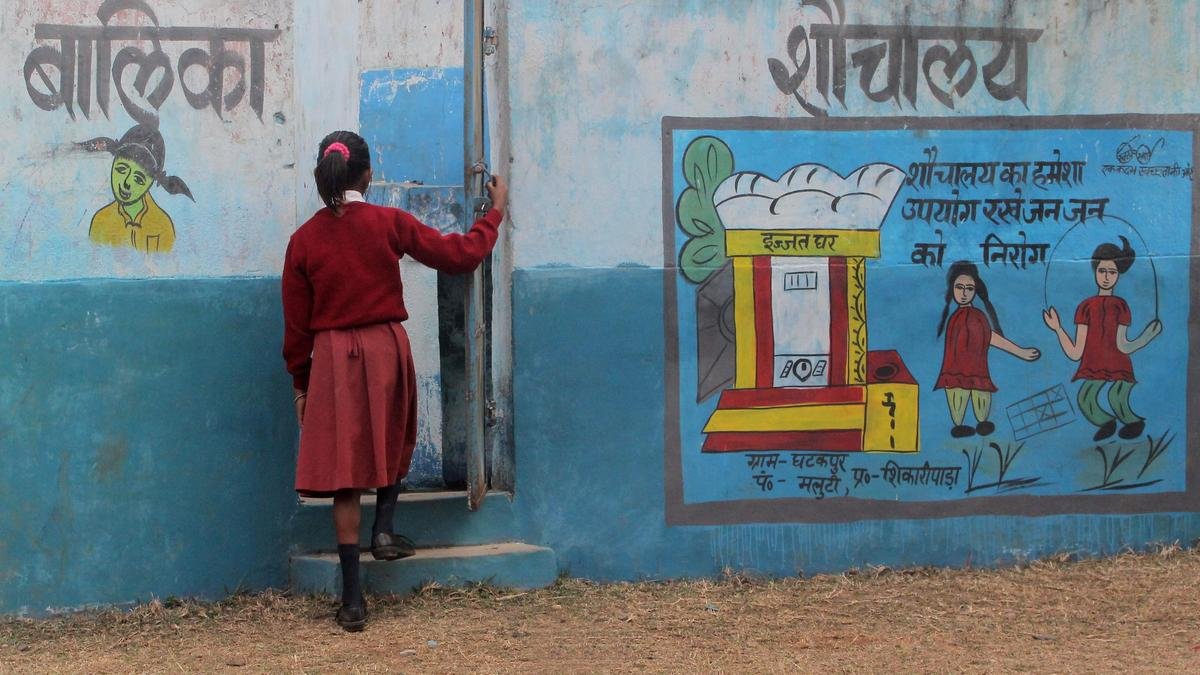
At the time when the Swachh Bharat Mission was launched on October 2, 2014, schools were included in its commitments. The Swachh Vidyalaya scheme meant that each government school should have separate toilets for boys and girls. 12 years on, the figures indicate that the promise has generally been fulfilled.

According to the most recent figures from the WHO/UNICEF Joint Monitoring Programme (JMP), the proportion of schools in India that have access to basic drinking water increased from 55% in 2015 to 97% in 2025. Out of the 164 countries for which estimates are available, only five showed a faster improvement. During this period, the level of basic sanitation in schools went up from 62% to 81% and the percentage of schools with no sanitation at all was reduced from 27% to 14%. In both cases, India is now above the world averages. The data from the Ministry of Education’s UDISE+ 2025-26 also support this trend, showing that of the 14.56 lakh girls’ and co-educational schools in the country, 98.5% have a girls’ toilet.

Figure 1: A decade of progress. Share of Indian schools with basic drinking water and basic sanitation, 2015–2025, compared with the world average in 2025. Source: WHO/UNICEF Joint Monitoring Programme, WASH in Schools 2026.
It is a remarkable achievement for a school system of India’s size. But a toilet is only as useful as the way it is maintained, and that is what comes next.
A toilet is an educational facility
It is easy to regard school toilets as merely a health issue, but they are also an educational issue. When economist Anjali Adukia examined India’s school latrine programme, in a study published in the AEJ: Applied Economics in 2017, it showed that increased construction of toilets had a substantial effect on adolescent girls’ enrollment, especially when separate toilets for girls were built. At puberty, questions of privacy and safety can determine whether a girl remains in school.
India’s present record supports this claim. According to UDISE+ for the 2025-26 period, girls in Classes 9 to 12 are now dropping out at a lower rate each year than boys, the figure being 5.7% against 8.3%. The National Family Health Survey (NFHS-6, 2023–24) shows that the proportion of women with ten or more years of education has increased from 41% to 46.4% since NFHS-5.

Figure 2: Girls are gaining ground. Selected indicators for girls and women in India, NFHS-5 (2019–21) and NFHS-6 (2023–24). Source: National Family Health Survey.
Although these improvements are real, they are not evenly distributed: 39.7% of rural women have ten or more years of education, as against 61.5% of urban women. Of young women aged 15 to 24, three out of four in rural areas use hygienic menstrual protection, whereas nine out of ten in cities do. For a rural adolescent girl, the presence of a clean toilet with running water at school can make a difference in whether she attends class during her period.

Figure 3: The rural–urban gap. Education, menstrual health and early marriage indicators for rural and urban India, 2023–24. Source: National Family Health Survey (NFHS-6).
The maintenance gap
The act of constructing a toilet only needs to be done once, but ensuring it remains usable is something that has to be dealt with every day. UDISE+ shows that there are 38,994 schools in which a girls’ toilet exists but is not working, and an additional 22,366 schools that have no girls’ toilet at all. Taken together, this amounts to over 61,000 schools, or about 4% of the total. Although this figure is small, in such a large system it still means a large number of girls.

Figure 4: Out of every 100 schools. Girls’ and co-educational schools by status of the girls’ toilet, 2025–26. Each square represents 1% of schools. Source: UDISE+ 2025–26, Ministry of Education, Table 7.4.
The gap is not uniform. In 24 of the 36 States and Union Territories, at least 95% of schools have a functioning girls’ toilet. The north-eastern region is much behind. In Meghalaya, the figure is 72.4%; in Arunachal Pradesh, 74.4%; in Tripura, 74.7%; and in both Mizoram and Nagaland, it is below 80%. The difficulty in keeping them in good condition is due to the hilly landscape, the scattered schools, and seasonal water shortages.

Figure 5: Near-universal in most States. Share of girls’ and co-educational schools with a functional girls’ toilet, by State and Union Territory, 2025–26. The tile grid is schematic, not to scale. Source: UDISE+ 2025–26, Ministry of Education, Table 7.4.
In the larger states, the issue is one of magnitude. Rajasthan has 7,726 schools with girls’ toilets requiring repair, and Madhya Pradesh has 6,188.

Figure 6: From building to maintaining. Share of schools with a girls’ toilet available and with one that works, in the 14 States and UTs with the largest gaps, 2025–26. Figures on the right show the number of schools where a girls’ toilet exists but does not work. Source: UDISE+ 2025–26, Ministry of Education, Table 7.4.
Two data systems, two stories
There is also the problem of measurement. The UDISE+ figures show that 97% of schools in India have at least one working toilet, while the JMP states that the level of basic sanitation is 81%. Although both figures count schools, there is a 16-percentage-point difference between them.
It is not easy for definitions to show the difference; in fact, UDISE+ is stricter about maintenance. A toilet is considered functional only if it has a seat, water, an intact seat, working drainage, is cleaned regularly, has minimal odour, is accessible, and has closable doors. The more plausible explanation is the method of data collection. The figures for UDISE+ are based on yes-or-no responses from head teachers, then certified by the same authority to back up the schools, with no independent survey conducted.

Hygiene shows an even greater discrepancy. While UDISE+ reports that there is a handwashing facility in 96.9% of schools, the JMP, which accounts only for facilities with both soap and water, estimates basic hygiene at around 53%. Even though the census covers nearly 15 lakh schools each year, the JMP has not been able to locate sufficiently up-to-date data in order to revise India’s hygiene estimate. A data system of this magnitude should be visible to the world’s benchmark.
What the next chapter needs
The main concern should be funding for ongoing expenses, not just for building the schools. A certain portion of the total school grant could be reserved for maintenance, including repairs, cleaning, water and soap, starting in Rajasthan and Madhya Pradesh, since it is there that the backlog is greatest.
Secondly, the communities should take part in the inspection process. The School Management Committees and parents could use UDISE+’s seven-point inspection criteria each month, and the results should then be included in each school’s annual report. A toilet that is actually checked by parents is much less likely to be ignored than one that only appears on a form.
Thirdly, the hill States need designs that are appropriate to their particular conditions, for example those involving rainwater harvesting, low-water toilets and durable materials, rather than simply having more construction.
Lastly, menstrual health must be at the heart of school sanitation. Since UDISE+ already collects information from schools regarding incinerators and pad vending machines, this information should be used to determine which schools require support first.
The Swachh Bharat campaign has proven that India can achieve improvements in sanitation within ten years. The first stage of the programme focused on constructing toilets; the following stage should be concerned with keeping all of them clean, in good working order, and safe, and with the ability to demonstrate this. A girl should not have to decide between her dignity and her education.
(Raunak Maitra is an Academic Associate at Azim Premji University, Bhopal. Karan Babbar is an Assistant Professor of Economics at XLRI Jamshedpur)