Digital fair brings almost half a million people on their feet
A robot pours coffee. Nearby, humanoid robots run after a ball or have a boxing match, while dozens of phones go up simultaneously to capture the scene. A few halls further there is a vertically taking off plane as if it were the most normal thing in the world. Visitors put on smart glasses, step into a flight simulator or watch with fascination as a robot processes clothing. A robot dog walks through the corridors among the people.
Text and image Ivan Cairo
When you walk through the immense Hangzhou Grand Convention and Exhibition Center, you sometimes get the feeling of having stepped forward in time a few years. At times the event looks more like a technological amusement park than a trade fair.
The fifth Global Digital Trade Expo is officially an international trade fair. But once the general public pours in, part of the complex transforms into something that resembles a technological amusement park. Families, students and business people move from demonstration to demonstration. Children crowd around robots, adults pull out their phones and some attractions require waiting to try the technology for themselves.
The scale is enormous. The fair covers 170,000 square meters. Ultimately, 2,008 companies participated and 428,000 visitors came during the five days of the fair. Exhibitors, buyers and representatives from 163 countries and regions attended. The dominance of artificial intelligence is particularly striking: 996 AI companies presented themselves, approximately three times as many as during the previous edition. And AI is everywhere.
Not exclusively on screens or in presentations about algorithms and large language models. Here artificial intelligence gets arms, legs and eyes. She drives, flies, translates, analyses, makes coffee and helps people learn to walk again.
But the massaging robots from the company SuuHuu also attracted a lot of attention and were tried out by numerous visitors. Business development manager May Chen indicated the True Time detailed explanation of how these machines can be used. “You can just buy them as a consumer and have them at home as your private masseur. They are always ready and never get tired like people,” she says, laughing. This one runs on AI intelligent massage robots According to Chen, they can also be placed in shopping centers so that customers can also get a massage while shopping. They are also already being used in hotels, airports and outpatient clinics. They aim to relieve daily stress in the neck, shoulders and back during a 15 to 20 minute session.

Robots steal the show
The robots as known from popular science fiction films were constantly busy. Humanoid machines walk, move their arms and compete against each other. During the Embodied Intelligence Robot Challenge, humanoid robots even play football. Every unexpected movement — and sometimes every clumsy fall — immediately produces dozens of new videos on smartphones.
Other robots have more serious tasks. A clothing robot demonstrates how machines can process flexible fabrics. Elsewhere, robotic arms move with great precision. Four-legged robot dogs walk between stands and visitors.
One of the experiences seems straight out of science fiction. A visitor is put on a headband with electrodes and then tries to get a robot arm to pick up an object without using his hands. Brain signals are measured and converted into commands for the machine.
It is exactly the kind of demonstration that makes the philosophy behind this edition visible. The organizers wanted to present technology that is “touchable, interactive and marketable.” Much technology that a few years ago was mainly found in laboratories or scientific publications is here ready for the public to try.
It makes the atmosphere different from a classic trade fair. Of course, business cards are exchanged and business people sit around tables to negotiate. But a few meters away, children are pressed against a barrier because they want to see what a robot is doing.
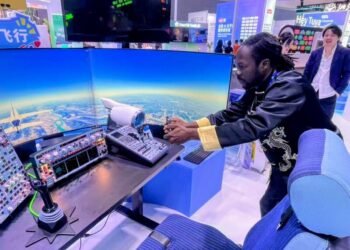
Be a pilot for a moment
In the intelligent transport zone, the decor changes again. Autonomous vehicles stand next to drones and electric devices that can take off and land vertically. According to representatives of the companies, the vehicles can eventually be used as air taxis. This way, travelers can avoid traffic jams on the road and still reach their destination on time.
Visitors walk around the machines, photograph cockpits and ask questions about speed, range and safety. Some devices still look like prototypes from a futuristic film, but are presented here as solutions for urban transport, logistics or emergency medical transport.
If you continue, you will move from flying vehicles to space travel, from space travel to quantum computers and then to medical technology.
A model of the Zhuque-3 launch vehicle attracts photographers. Elsewhere it focuses on computer systems in space and a Chinese neutral-atom quantum computer is on display.
The exhibition therefore sometimes feels like a walk through different versions of the future.
Glasses that watch
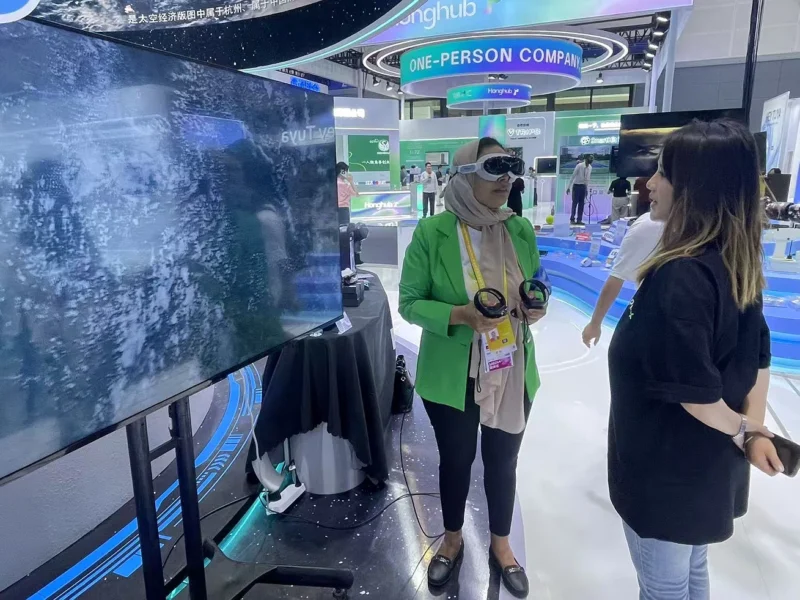
Visitors queue up for smart glasses. The latest models can project information into the field of view, recognize objects, navigate and translate languages.
It is striking how naturally visitors deal with it. Put on your glasses, look around, try a few functions and then grab your smartphone to record the experience.
Technology also comes close to the human body in the medical hall. There are surgical systems, exoskeletons and applications of brain-computer interfaces. Technology that sounded mainly futuristic a few years ago is presented here as a tool for diagnostics and rehabilitation.
In addition, there is a remarkable combination of ancient Chinese medicine and modern technology. AI systems are used for, among other things, tongue and pulse diagnostics.
The contrast could hardly be greater: one moment a visitor is watching robot football, a few minutes later at equipment that uses brain signals to control machines.

But who benefits from that future? Amid all this technological wonder, however, a much bigger question hangs over the stock market: who will ultimately benefit from this revolution? Representatives of international organizations spoke about exactly this during the opening.
WTO Deputy Director General Zhang Xiangchen pointed to the speed at which digital trade is growing. The volume of digitally delivered services has almost quadrupled since 2005. According to calculations by the World Trade Organization, artificial intelligence can greatly accelerate this. Under various scenarios, AI could increase global trade by 34 to 37 percent by 2040.
But technology alone is insufficient for this, he warned. Policy and regulations partly determine the size of the final economic return. That message takes on special meaning when you walk through the halls in Hangzhou. Here are companies that have enormous amounts of data, computing power, capital and highly trained technicians. For other parts of the world, access to precisely those resources is much less obvious.
Pedro Manuel Moreno, Assistant Secretary-General of UN Trade and Development (UNCTAD), therefore warned that the benefits of AI are not automatically distributed fairly.
New technology can help small and medium-sized businesses find international customers, reduce logistics costs and produce more efficiently. But this requires internet connections, digital infrastructure, knowledge and financing.
Without those conditions, Moreno warned, new technologies could actually widen existing differences between countries, companies and people. According to him, progress should therefore ultimately be judged on what technology delivers to people.
Gerd Müller, Director General of the UN Industrial Development Organization (UNIDO), also emphasized that digitalization and AI offer enormous opportunities, but it must be ensured that everyone can benefit from them. According to him, international standards, trust and practical support for companies are necessary to give smaller companies in particular access to the new digital economy.
One big world market
And that makes it clear what this fair was ultimately about: trade.
Among the robots and flying vehicles were international pavilions where countries and companies presented their products and sought partners. Malaysia and Hungary were host countries, while Kazakhstan and Peru also presented themselves.
Foreign business people try out Chinese smart glasses, delegations follow guides and commercial conversations are held at stands while a robot shows off its skills a few meters away.
Even finding a business partner has been digitized. An AI exhibition assistant can link visitors to relevant exhibitors based on their question and indicate where they are located in the enormous complex.
There perhaps lies the real meaning of all robots, glasses and flying vehicles. They are not solely intended to amaze visitors. They represent products, services and technologies with which companies try to conquer new markets.
During the fair, 226 new products and applications were presented for the first time. More than a hundred AI applications showed how widely the technology is now being used.
The future as a day out
For the ordinary visitor, what remains is the experience. Here, artificial intelligence is no longer something abstract that performs calculations in a data center somewhere. The technology looks through glasses, controls a robot, helps a patient walk, translates conversations, analyzes trade data, makes coffee and allows driverless vehicles to move.
The visitor is literally in the middle of it. That explains why so many families made a day out of the expo. The fair became a trading platform, technology laboratory and attraction at the same time.
People stop, point, ask questions and try out devices. Children run to the next robot. A robot dog walks by. Further on, another demonstration begins and a new group of spectators immediately forms. There are robots that massage and massage
Above all this hustle and bustle hangs the message with which the fair attracted visitors to Hangzhou: ‘Meet the AI Future at the Digital Trade Expo.”
After walking around for hours, that sounds less like an advertising slogan. The much more difficult question was asked by the international organizations during the opening: if this is indeed the future, how do we ensure that as many people and countries as possible can participate?
In any case, Hangzhou showed how quickly that future is approaching. She is standing behind an exhibition stand here. And sometimes you could just touch her. The fair ended on Sunday (today).