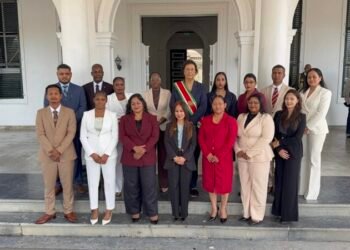
CARICOM HAS ITS expressed support for India as a candidate for a non-permanent seat on the United Nations (UN) Security Council for 2028-2029. The commitment was made during consultations in New York between the foreign ministers of Caricom and India. Minister Melvin Bouva also chaired Caricom’s foreign and community relations council.
There is nothing wrong with this support in itself. India is an economic power and an important partner for the Caribbean. Moreover, a broader distribution of global power is actually desirable. But the new world order does not make international politics any clearer.
In a world with more and more centers of power, navigating is inevitable, but without a moral compass it quickly becomes wandering
In the past, the dividing lines were clearer: the free West versus the communist bloc, democracy versus dictatorship. Now those boundaries are blurring. China is a world power, India is advancing and the United States is following its own course under Donald Trump. Regional powers such as Brazil and Turkey are also more emphatically demanding a place on the international stage.
India illustrates how complicated this new world order is. The country is a multi-party democracy and Narendra Modi is serving his third term as prime minister. At the same time, there is increasing international criticism of the treatment of minorities, journalists, civil society organizations and political opponents.
No one wants or can afford, economically or diplomatically, to kick a superpower in the sore leg. This forces small countries like Suriname to navigate cautiously. Today China is needed, tomorrow India, the day after tomorrow the United States. A world with more and more economic and political power centers can ensure a better distribution of influence, investments and prosperity. The intended prosperity must ultimately benefit all layers within those societies, but must not be at the expense of human rights and freedoms.
It is precisely there that the compass is in danger of being lost. Human rights violations are easier to condemn when one isolated despot stands against the rest of the world. It becomes more difficult when economic and strategic partners are themselves under fire for their dealings with democracy and human rights. The UN is therefore increasingly becoming a diplomatic minefield. This became apparent when dozens of delegations left the room in protest or stayed away during Israeli Prime Minister Benjamin Netanyahu’s speech. It is alleged but not confirmed that Suriname also took part.
Support for a new superpower should mean more than what is best economically or geopolitically at that moment. The essential question is which values survive when interests conflict. In a world with more and more centers of power, navigating is inevitable. However, without a moral compass it quickly becomes a matter of wandering. This also threatens to further undermine the support of the UN and is certainly not to the advantage of small, vulnerable economies. Walking away during Netanyahu’s speech is nice symbolism, but is that also daring – when it comes down to it – with Xi, Trump, Modi or Putin?