NMA points to negligence of entrepreneur for repair of elaborated areas
“This is the area where we are supposed to hunt, fish and plant. If you look at it now, none of those things can happen anymore. This forces the community to go further and deeper into the forest for their livelihood. But that can’t just happen.” Angelique Palmtak, village head of Grancreek, expressed this concern in conversation with the True Time about the sand excavation in the home and habitat of the indigenous community of approximately five hundred inhabitants on the Saramacca River.
Text and image Edwien Bodjie
The villagers want the sand mining permit issued by the Ministry of Natural Resources (NH) to be revoked. Palmtak tells the newspaper that a large part of the area has been affected by sand extraction. There are fears that if excavation continues, villagers’ opportunities for hunting, fishing and planting will be further limited.
“I warned him that he would have problems with the village. He didn’t listen.”
Village head Angelique Palmtak
Summary proceedings and bailiff
One entrepreneur received a permit for sand excavation under the previous government and started doing so about a year ago. After about five months, the community took action, after which the government shut down activities. However, they appear to be about to resume.
The entrepreneur recently attempted to have the measure to stop work be lifted by means of a bailiff’s writ. He previously filed summary proceedings against the government.
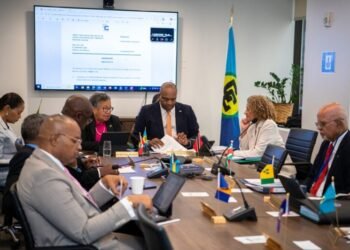
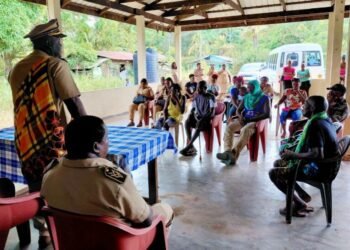
The villagers are not deterred by this and continue to work to have the permit revoked. They even held emergency consultations on September 3 and as a result, the Association of Indigenous Village Heads in Suriname (Vids) on behalf of the traditional authority and the community, with the support of surrounding villages, presented a letter of objection to the district commissioner of Saramacca, Aniel Ramautar. Vids had previously sent a delegation to the scene to be informed about the situation and on that occasion assured Grancreek of its support.
About the summary proceedings that the entrepreneur has initiated, village head Palmtak says: “It will be a back-and-forth. On the one hand, the government has granted permission, on the other hand, the entrepreneur has gone to court. But we are not going to allow entrepreneurs to destroy our living environment. The only thing we expect is that the entrepreneurs’ permits will be withdrawn.”
Developed areas not restored
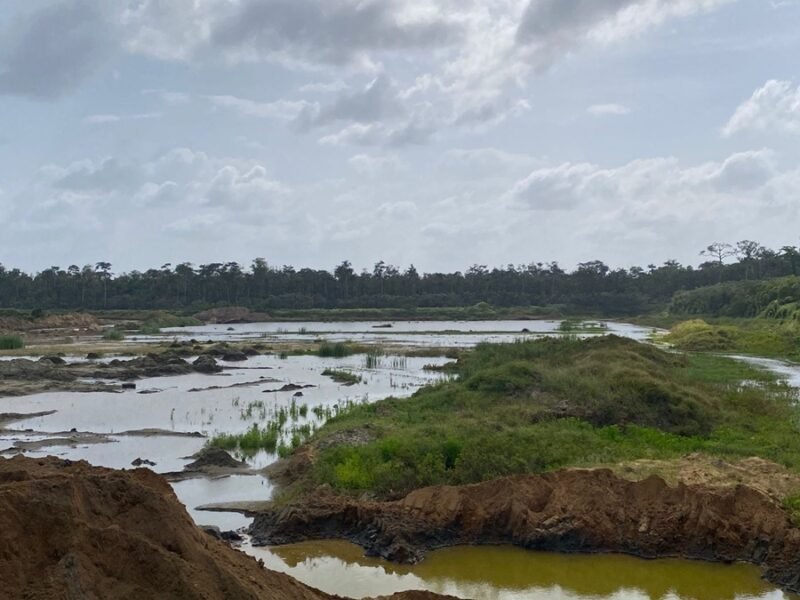
Accompanied by Palmtak the True Time visited one of the areas where the entrepreneur has excavated sand. The work has left visible traces. In several places large excavated sections are visible, which have not been restored and cannot be used. There are plastic oil barrels and car tires. Some holes are partly filled with water, giving the appearance of small lakes.
In other places there are dams and mounds of soil. The village head fears that the excavated parts will fill up during the main rainy season and that this could cause flooding. “Do you see this behind me? It’s almost a river. This is what our entire area will look like if we don’t make our voices heard,” Palmtak predicts, clearly concerned and gesturing with her hand what she means.
Although the village head is happy that the work has been stopped, she does not intend to rest on her laurels. “We are of course not going to stop standing up for our rights. We are not going to stand and watch how the ground is literally being dug away under our feet. Then tomorrow we will no longer have a village and our children and grandchildren will no longer have a future.”
Palmtak says that after the protest seven months ago, she sent letters to NH and the Ministry of Land Policy and Forestry, the president, the National Assembly and the National Environmental Authority (NMA). Only the NMA has responded. She sent an investigation report to the village last month. It states that the entrepreneur has not complied with the permit conditions, including the obligation to restore the area after the work.
(read more below the photo)

More than just Gran Creek
Palmtak warns that this issue affects more than just Grancreek. “If we preserve this nature reserve, it is not only in the interest of Grankreek, but in the general interest. So for all of Suriname. We have lived here for so long. Our future lies here and so does the future of our children and grandchildren. We will not allow our future to be destroyed at the expense of economic interests.”
What is also surprising is that the village was in no way involved in the decision-making process regarding sand extraction. “No one from the government consulted with us in advance. They did not come to talk to the village management. When the entrepreneur contacted me about his plans, I told him that he would destroy the people’s homes and habitat with the excavation work and I warned him that he would have problems with the village. He did not listen.”
She does not understand how the entrepreneur ultimately received permission to excavate sand in the area. He told her that he had received permission from “higher up”. According to the village head, this was during the Santokhi government. No new permission would have been granted under the current Geerlings-Simons cabinet.
“We are not going to stand and watch the ground being literally dug away at our feet. Then we will no longer have a village tomorrow.”
Village head Angelique Palmtak
Support Vids
Vids director Cylene France says otherwise the True Time to continue to support Grancreek in the pursuit of legal certainty and protection of the traditional territory and ensures that its organization closely monitors developments. The interest group focuses, among other things, on rights, advocacy and the sustainable management of residential and habitat areas of indigenous villages.
France says that the strength of the Vids lies in supporting villages to take stronger action towards the government, companies and other actors that influence indigenous territory. Within a new project, villages are supported in protecting and managing their traditional territories, natural resources and collective rights. In addition to Grancreek, the villages of Columbia, Pikin Poika and Korhopa Matta participate in the project. According to France, the support should contribute to a stronger position of the villages in the recognition and protection of their collective rights and traditional habitats.