Family law, council regulation, banking and financial files kept secret, “What the Government knows, the Council must also know” and the country
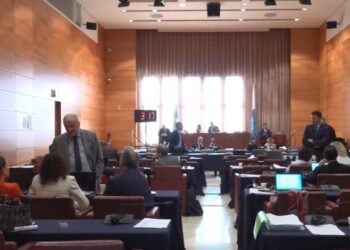
From San Marino information (by Antonio Fabbri) – “A political Frankenstein” and a “two-faced government”, with one part of the less important activity publicly exposed and trumpeted by some government members and another, of other government members who really command, on the most delicate economic and financial dossiers, conducted according to Repubblica Futura in conditions of excessive confidentiality. This is the reading proposed by the opposition group at the end of the council session, during which the law on the family and the reform of the Council Regulations were also addressed.
RF coordinator Marco Podeschi used the image of the “political Frankenstein”, who contested the method of the current majority and the management of relations with the opposition. Podeschi contested in particular the new council regulation, linking it to the difficulties encountered by the majority in approving the laws. “These people don’t govern, but they are controlling politics in a bad way,” he said, maintaining that “nobody talks to anyone” and that the Government is building tools intended to limit the opposition’s ability to express itself.”
The reference is above all to the so-called “trap”, which allows, in the event of the conditions set out in the new Regulation, to interrupt the examination of the amendments after 25 hours. Podeschi interpreted the measure as a response to the difficulties encountered by the majority during legislative activity. A purpose deemed antidemocratic.
On the transparency front, Nicola Renzi spoke of a situation in which “everything is becoming extremely secret”. The reference is to the banking and financial system, to decree 134, to the management of NPLs and to the information discussed in the Finance Commissions.
Renzi also recalled the case of an agenda that remained secret for a long time: “The majority voted on the agenda and then demanded that it remain secret. Only thanks to our constant insistence did it become public”. The agenda is the one relating to the economic and banking situation.
According to the councillor, the problem concerns the relationship between the Government and the Council: “What the Government knows, the Council must also know”.
The same question is asked about NPLs and dossiers relating to the financial system. Renzi underlined that the Finance Commissions deal with “news which is also deeply alarming and which we cannot speak about publicly”. Hence the question addressed to the Executive: “Who cares so much about the secret?”.
For Rf, confidentiality may be necessary for some sensitive information, but should not prevent the Council from exercising its supervisory role. “Independence and autonomy exist, but self-referentiality is not acceptable,” said Renzi.
The councilor also recalled the events that have affected the San Marino banking system in recent years and the numerous hypotheses on the future of the institutions. “We don’t lend ourselves to the game of jackals,” he said, adding: “If there is support we won’t retreat, but we want to do it right. And know.” Also in the crosshairs are the so-called plans A, B and C evoked by the Government for the Bank of San Marino. “We know nothing”, observed Renzi, asking for greater clarity on the prospects of the system and on the management of assets linked to the banking and financial sector. Among the dossiers cited is also that of the safety deposit boxes, on which clear public information is still lacking. Renzi then used the expression “two-faced government” to describe what he considers a contradiction between public communication and management of the most delicate dossiers. On the one hand, he observed, there would be “front page headlines, amazing announcements, magic tricks, fireworks”; on the other, “the secret part of the Government that manages the most important economic-financial dossiers, investments inside and outside the territory, sales”.
Sara Conti also spoke on the council regulation, recalling the strong doubts expressed by RF on the first version of the reform. “When we said that we wanted to gag the opposition, that intent was actually there,” he said, referring to the provisions initially envisaged on the timing of speeches and the filing of amendments.
Conti claimed the role of obstructionism as a tool available to the opposition: “It is a tool that the opposition has at its disposal and which we can say we have not abused, but used where necessary.” Some of the contested rules have been modified, while the “trap” and the possibility of carrying out the examination of some laws in the drafting stage have remained.
On the family bill, Matteo Casali finally clarified that RF is not against support interventions: “We are in favor of subsidies and greater comfort for families”.
The councilor also supported the proposals put forward by the party, including the family caregiver, but contested the timing and method of the legislative process.
The point, according to Casali, is that “the issue of the birth rate cannot ignore a more complex and overall vision”. Home, work, school and services should be addressed within a coordinated strategy, avoiding presenting the measure as a definitive solution to a phenomenon that concerns the entire Western world.
af