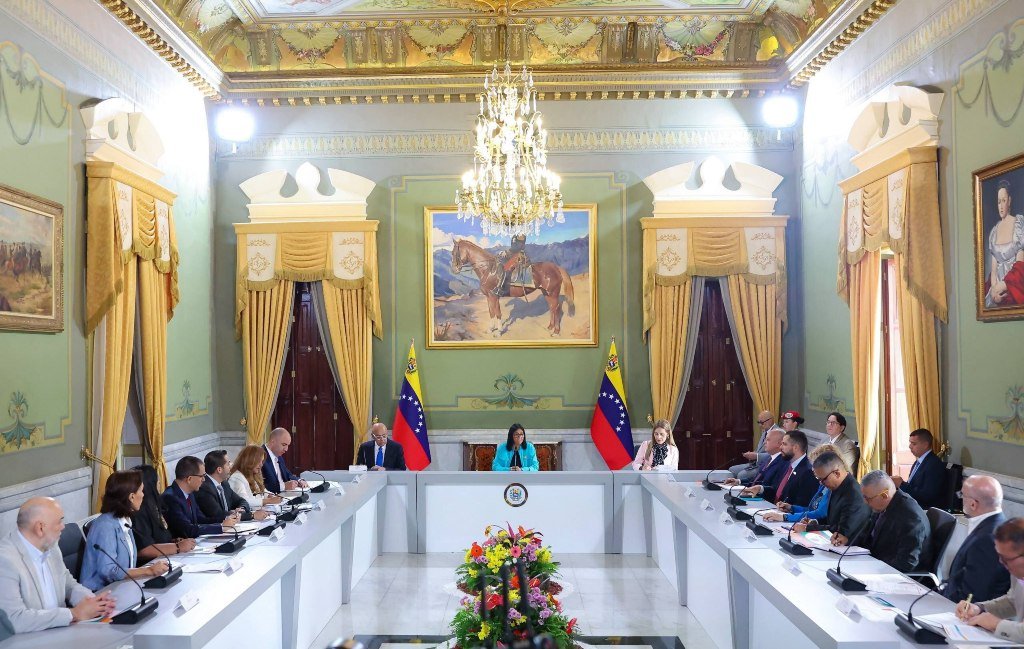
The ruler in charge, Delcy Rodriguezinstalled a special commission that will carry out a national consultation for the judicial reformafter the April 19 announcement.
The interim, recognized by the United States, focused on criminal justice to point out that it maintains “vices and deviations“that have not been able to be overcome over the years and that the daily complaints of citizens demonstrate it. He said he aspired to “impartial” justice in Venezuela.
He indicated that the national consultation It will be based on the concept of “everyday justice, especially in the criminal field and warned that it is not only to listen to experts and academics, but to the people.
“Access to justice is a human right and criminal justice involves deprivation of liberty, which is the most serious. I hope that criminal justice can have the characteristics contemplated in our Constitution in its article 26 (…) The debt cannot be postponed and we have to address it,” he said.
He added that also in the citizen security forces defects persist that must be corrected.
“Venezuelans aspire to maintain a relationship of respect with their citizen security agencies to maintain peace, tranquility, they aspire to go to court and have good treatment. I know how badly someone can be treated in court. Progress has been made, but there are evils that persist that we have not been able to overcome,” he said.
There is already a commission
The president of the National Assembly (AN), Jorge Rodríguez, spoke at the meeting to point out that everyone, especially those who lack economic resources, must have access to justice. He said a person in poverty is at a disadvantage in court compared to those who have resources.
“It has to end once and for all with the criminalization of poverty”he urged.
Present in Miraflores, as part of the commission, were the attorney general Larry Devoe; the ombudsman, Eglée González Lobato; the president of the Supreme Court of Justice (TSJ), Caryslia Beatriz Rodriguez. Likewise, the deputy and president of the AN commission that monitors the Amnesty Law, Jorge Arreaza, as well as members of the Program for Peace and Democratic Coexistence, such as its president Ernesto Villegas and the Minister of University Education, Ana María Sanjuan.
Devoe was appointed by Delcy Rodríguez to assume the secretariat of the commission. Devoe is highly questioned by NGOs and defenders of human rightsfor denying crimes against humanity in Venezuela before international organizations, as an alternate agent of the State.
The Minister of the Interior and Justice is also a member, Diosdado Hair. Delcy Rodríguez referred to Cabello to remember that there is already a “special commission” for criminal justice reform –appointed by Maduro in 2021 and chaired by Cabello – and asked him to talk about what was progressed there.
Cabello assured him that there are a “number” of prosecutors and judges who have been dismissed and detained for being alleged participants in the procedural delay, as well as 12,000 police officers involved in crimes such as corruption. He highlighted the implementation of telematic hearings as a tool to expedite judicial processes.
Amnesty Law
Delcy Rodríguez also mentioned the Amnesty Lawsanctioned on February 19 in the AN, to affirm that “it has gone very well” compared to other countries where the mechanism has been applied, such as Spain. He endorsed figures from the monitoring commission headed by Arreaza, according to which 8,616 people have benefited.
“For those cases who were excluded expressly in the Amnesty Law there are other spaces where they can be channeled. “This law is based on forgiveness and national reconciliation, even with those who are outside the country,” he stressed.
This April 22, Foro Penal assured that, according to its records, less than 25% of the releases that have occurred this year are due to the Amnesty Law and that this percentage corresponds to only 186 releases out of a total of 786 documented by the NGO since last January 8, when the president of the AN announced the release of a significant number of people.
The NGO Justicia Encuentro y Perdón points out that there are more than 600 political prisoners imprisoned arbitrarily and unjustly.
At the same time as the announcement of the interim, the AN began the process of choosing new judges for the TSJ with the designation of the preliminary commission that will appoint the Judicial Nominations Committeemade up of deputies and ten representatives of civil society to be chosen in the coming days.