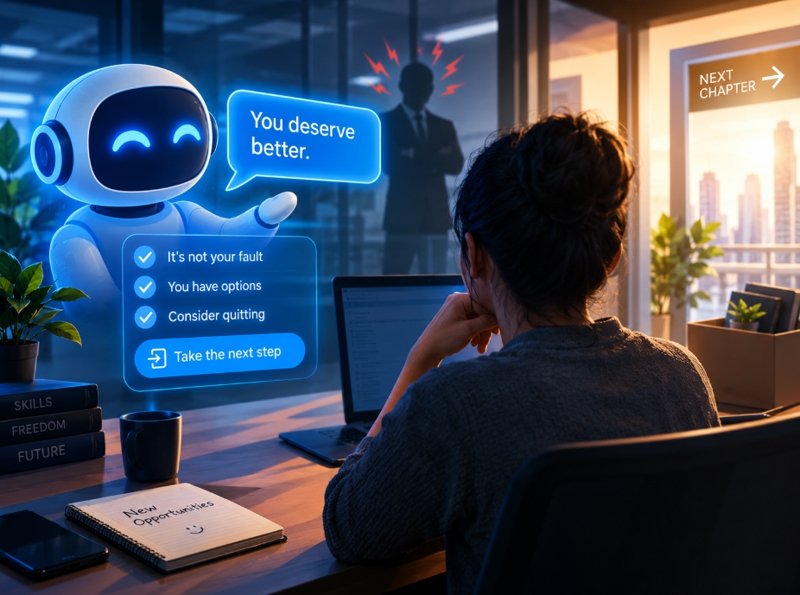
At a time when more and more employees are consulting with large language models (LLMs) in preparation for a meeting with their bosses, Artificial intelligence often guides people to distance themselves from each otheraccording to recent research from Cloverleaf Labs.
AI coaching in the workplace has already proven to help managers and teams work better together and achieve results effectively, quickly and at scale.
But when leading LLMs are put to the test to guide people through strained work relationships, “the tool almost never helps them repair them.”
This is one of the numerous conclusions that emerge from the most recent report of Cloverleaf Labstitled “The Relational Risk Inside Your AI Rollout: What do leading LLMs tell employees in conflict?” (“Relational risk within your AI implementation: What do LLM principals tell conflicted employees?”).
Commenting on the findings of the report, published last week, the Director of Research at Cloverleaf Labs, Kirsten Moorefieldhe said to The Sociable that “there is an urgent need to influence the public conversation about technology and relationships.”
“Relationships are truly the factor that determines the success or failure of all value within an organization (…) When relationships exist based on deep trust, there is the capacity for faster adaptation, change and innovation.”
And Moorefield has firsthand experience on the subject. In addition to her work at Cloverleaf Labs, she is the co-founder of an AI coaching platform of the same name, Cloverleaf. The independent research laboratory arose from both the need and desire to better understand the technology being implemented and how to best use it in companies.
“I care deeply about relationships — at work and in society — and I’m looking at what’s happening on a macro level in society, and it worries me,” Moorefield said. He added: “I’m also looking at what’s happening in HR within organizations: how they’re thinking about AI, how they’re thinking about AI coaching, and I need to know the truth for our clients about what’s working, what’s not working, and what’s happening.”
One of the key takeaways from the Cloverleaf Labs report is that “relationship is at the heart of team performance, and it is precisely what today’s LLMs are guiding people away from.”
As Moorefield puts it, “Right now, AI is steering people away from each other just as every organization is saying, ‘Hey, as AI takes over technical skills, what we need are human skills,’ that is, the ability to give and receive feedback and to incorporate divergent perspectives to solve complex problems together.”
While relationships based on trust and different ways of thinking are precisely what leaders need most, the tools they are giving their employees are actually weakening their relationship skills.
For example, the Cloverleaf Labs report found that:
- When an employee is frustrated with his boss, all LLMs tell him to quit his job.
- The less power the employee has, the more the LLM is on their side.
- LLMs offer a lot of advice, but less than 1% is related to how to repair the relationship with a colleague.
A central point is that “LLMs guide toward self-protection, not toward repairing relationships.”
“I think there is an urgent need to influence the public conversation about technology and relationships,” Moorefield said.
However, an LLM is not a monolith: it will offer different answers to different people and different questions, and the same LLM can provide both the best and the worst advice with absolute confidence.
When it comes to managers using an LLM, Moorefield notes that it “provides really good coaching when a manager is complaining about a direct report – it’s much better than Reddit.”
His words are in line with the report, which notes: “When the other person was a colleague without authority, the coaching remained closer to balance.”
But coaching begins to take on a tribalistic tone when the frustration comes from someone with very little power to create meaningful change.
“When it is someone without power who is talking to the LLM, that is when the coaching becomes aggressive, divisive and encourages the idea that you are the victim and that the authority is against you, so you have to protect yourself from that authority,” Moorefield said.
The Cloverleaf Labs report concludes by noting that AI is “good at speed, precision, and scale,” something that can be applied to a wide variety of scenarios.
It is precisely the relational component that needs the most work:
“The same LLM that stabilizes one relationship can strain the next, and will sound equally self-assured in both cases.”
So if LLMs are so poor at guiding relationships in the work environment, what should be done?
The report recommends establishing a relational standard for LLMs and asks the following question:
“Before you make a tool your employees’ default coach for managing conflict, ask yourself if it strengthens self-awareness, responsibility, awareness of the other person, specific and personalized guidance, and relationship repair, or if it weakens them.”
“The solution is not to remove LLM from these moments. It is to require that coaching be built around the relationship, with real context about the specific people involved, and not just around the person who is asking the question.”
For Moorefield, organizations “need to completely rethink how they are developing the human skills of their employees,” and HR departments have a critical role to play in this.
“I sincerely hope that this report encourages HR to invest in creating change,” he stated. He added that “they need to build master prompts, skills and agents into their LLM, which is more of a ‘good enough’ solution, because the LLM will still end up acting on its own. After many, many attempts by a frustrated employee, the LLM will do what it wants, but at least you’ll have tried to get them on the right path as best as possible.”
Your advice for Human Resources?
“They need to be more forceful than the LLM. They need to proactively approach their employees with better solutions that actually work, that create more success for them rather than more division and a certainty based on self-sufficiency that ends up alienating them from each other.”
Article written by Tim Hinchliffe in The Sociable. Spanish version for El Nacional.