The Caribbean is not short of infrastructure needs, project ideas, or available capital.
What continues to hold back investment is the ability to turn those ideas into well-prepared, bankable projects that can withstand economic shocks, political transitions, and decades-long investment horizons.
That was one of the central messages emerging from the Caribbean Infrastructure Forum (CARIF) session, “The Mechanics of Bankable Projects: How To Best Use the Tools Available”, where regional banking, development finance and advisory leaders examined what it will take to attract private capital to Caribbean infrastructure at greater scale.
Kemar Polius, senior director, head of corporate banking and sustainable finance at CIBC Caribbean, said bankability ultimately comes down to confidence.
“Capital follows confidence: confidence in sponsors, confidence in cash flows, confidence in regulatory frameworks, and confidence in contracting,” Polius said.
CIBC Caribbean operates across ten markets in the Caribbean and, according to Polius, has led or arranged more than $1.5 billion in infrastructure transactions over the past decade, supporting ports, airports, hospitals and other critical strategic infrastructure assets.
Drawing on that experience, he said projects frequently encounter difficulty well before they reach a bank for financing.
“Where we see projects stall or fail is long before they come to us for financing for a term sheet. It’s really on the project preparation side,” he said, pointing to incomplete feasibility work, outstanding regulatory permits, and gaps in regulatory frameworks among the issues that can undermine investor confidence.
“We’re not short of ideas, and we’re certainly not short of capital, as evidenced by the attendance here today at CARIF. But it’s really that project preparation.”
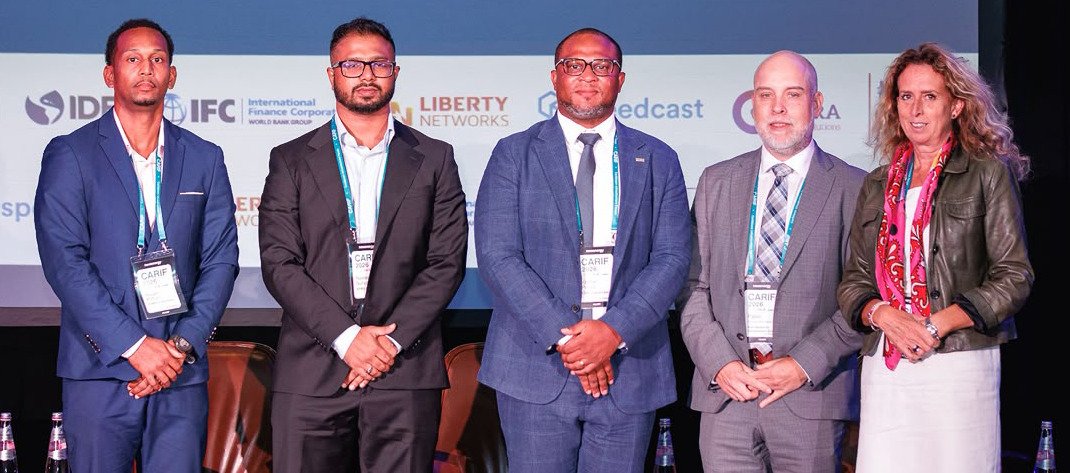
The panel brought together Polius; Roger Kirton, director, deal advisory, KPMG in Barbados and the Eastern Caribbean; Naweed Nuhuman, director, deal advisory, KPMG in CARICOM; and Pablo Pereira dos Santos, principal, public-private partnerships at the Inter-American Development Bank (IDB). It was moderated by Victoria Miles, founding partner of ImpactA Global.
Panelists explored public-private partnerships, blended finance, guarantees, risk allocation and other mechanisms available to governments seeking to mobilize sprivate investment. Across those approaches, however, they repeatedly returned to the importance of preparation, predictable cash flows, credible regulatory and contractual frameworks and allocating risk to the party best positioned to manage it.
Polius also cautioned against developing long-lived infrastructure around short political timelines.
“Many projects stall out because they’ve been designed around the life cycle of one administration, whereas infrastructure assets, by their definition, are long-lived assets,” he said. “The contractual frameworks which underpin those really do need to stand the test of time and political transitions.”
As an example, he pointed to the approximately $300 million redevelopment of Prince George Wharf in The Bahamas, noting that the project maintained momentum across political administrations and was constructed during the COVID-19 pandemic, despite the unprecedented disruption to Caribbean tourism.
At its opening ceremony, he recalled, three Bahamian prime ministers were in attendance.
It was an illustration, he said, of the type of continuity that can help establish investor confidence in major infrastructure projects.
Pereira dos Santos similarly identified political and institutional continuity as critical, given the time required to develop and operate major infrastructure. A complex project, he noted, can take between three and six years to prepare before reaching the market, while the resulting agreement could extend for 30 years.
“When you sign that agreement, it’s not that the project is over; it’s just getting started,” he said.
The discussion also examined the growing use of blended finance and the role of multilateral development institutions in helping projects reach financial close.
Polius described concessional financing and partnerships with multilateral institutions as potential “accelerators” that can support project preparation, strengthen institutional capacity, and provide guarantees and other risk-mitigation solutions.
However, he stressed that development finance should complement rather than replace commercial capital.
He outlined three considerations: additionality, or whether concessional support is necessary for a project to proceed; targeting, or whether the intervention addresses a specific risk; and proportionality, or whether the level of support is appropriate to the need.
Pereira dos Santos echoed the point, explaining that blended finance is most effective when used to address residual risks after a project has already been properly prepared and structured.
“The finance cannot remedy all the original sins that the project has. That’s a recipe for failure,” he said.
Scale remains another challenge for the Caribbean. The panel discussed aggregation and repeatable project pipelines as potential ways of addressing the issue, particularly in renewable energy and other sectors where individual projects may be relatively small.
Kirton emphasised that governments need more than lists of infrastructure ambitions.
Investors need to see prioritised projects, adequate preparation, clear procurement and regulatory frameworks and a visible pipeline that allows them to plan the deployment of capital.
The discussion also highlighted growing investment interest beyond traditional infrastructure such as airports, ports, and tourism assets. Renewable energy, water, climate-resilient infrastructure and digital infrastructure were identified among areas attracting increased attention.
For the Caribbean, panelists said, unlocking that capital will depend less on demonstrating that infrastructure is needed and more on consistently presenting projects that investors can confidently finance for the long term.
As Polius put it, the building blocks are straightforward but essential: credible sponsors, predictable cash flows, durable contracts and regulatory environments capable of standing the test of time. (PR)