More than 300 troops attached to the 128th Infantry Battalion will travel to Lebanon next month in what will be the final operational missions for Irish soldiers under the UN in the country.
The United Nations Interim Forces in Lebanon (Unifil) have been operating for nearly 50 years and will begin drawing back at the end of this year.
In recent weeks, five peacekeepers – three from Indonesia and two from France – have died in attacks blamed on both the Israel Defence Forces (IDF) and Hezbollah.
Lieutenant Colonel Damian Carroll, who is leading the 334 Irish troops, acknowledged the situation in the area remains volatile.
He also said there was a poignancy to it being the last operational mission involving Irish troops, while expressing his condolences to the families of the UN peacekeepers who had died.
“Conflict zones are difficult. We wouldn’t have soldiers in south Lebanon if it wasn’t complex” he said.
“I have no real concerns because we trust our training, we trust our equipment and we trust our people.
“The training we have been doing recently has built up on all the experience of previous missions.
Yes, we’re going into a complex situation, but this is not unheard of in the history of Unifil
“Yes, it is a dynamic environment, yes it is complex. However, we have to believe that we can trust our training and trust our people.
“Yes, we’re going into a complex situation, but this is not unheard of in the history of Unifil, or in the history of Lebanon. So it is not a new situation, it is just an ever-changing situation.”
He added that while it is the last operational mission, there may be future missions in the region as part of the drawn-down plan to pull back from the area.
“From a poignancy point of view, absolutely, the Defence Forces has been there for 50 years. Soldiers have lost their lives in Lebanon,” he added.
“I think Ireland and Lebanon will be intertwined, irrespective of what happens in the future.”
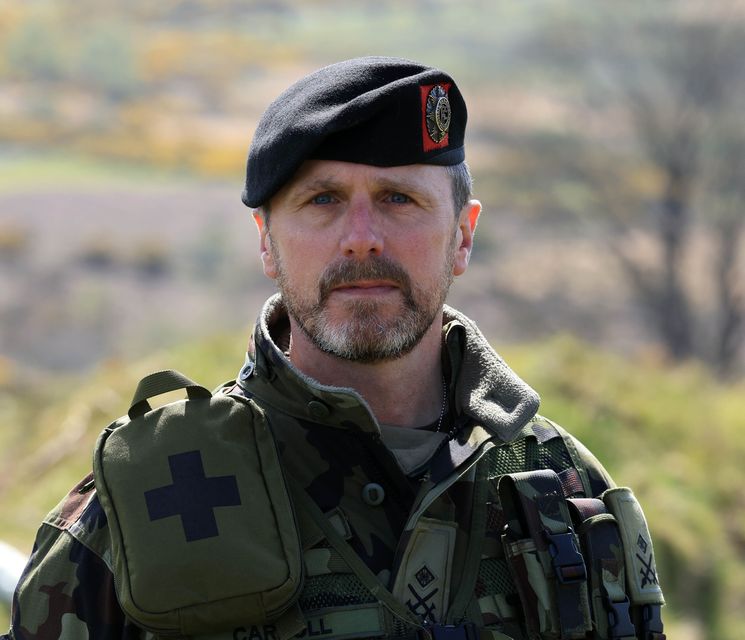
Lieutenant Colonel Damian Carroll. Photo: Colin Keegan/Collins
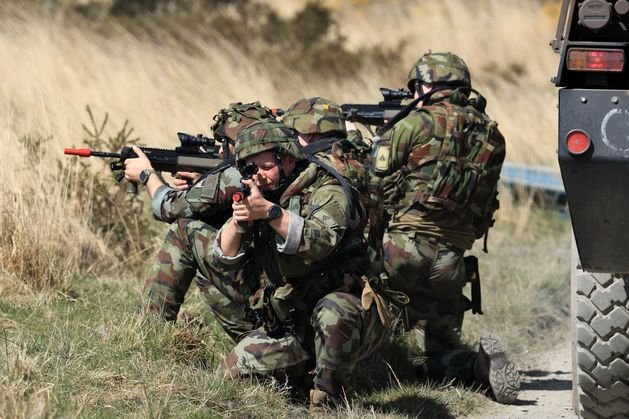
Members of the 128th Infantry Battalion’s Quick Reaction Force took part yesterday in an intense training exercise in the Glen of Imaal to prepare their response to an improvised explosive device (IED) attack.
The exercise simulated a Mowag armoured personnel carrier being targeted by an IED and being recovered by other vehicles in the convoy.
The test was all the more relevant as recent fighting in their area of operations will mean they may have to deal with unexploded munitions while on patrol.
Captain Ciaran Feeney, Quick Reaction Force commander, spoke about the mission-readiness exercise and said they wanted soldiers to be prepared for instances of IED attacks.
“We’re assessing our cavalry troops in their reaction to IED threats, so we had a troop patrol along the Blue Line, reacting to an IED and then going through the recovery drills, then extracting from the situation,” he said.
“We want our troops to be prepared for these scenarios, so if it does happen overseas they’re prepared and well trained.”
You train it so much and so frequently you don’t have to think, you just act, that’s the difference sometimes
Last August, the UN Security Council voted unanimously to end the peacekeeping force at the end of this year.
Corporal Darragh O’Boyle, based in Galway, is deploying on his fourth mission to Lebanon and has previous experience of operating in a complex time.
“I was there with 123rd battalion. The kinetic activity over there at the time was huge, and we were well prepared, we were well trained and we all came back,” he said.
“You have to go through your drills and your training and take whatever comes in front of you. Intense rapid training, you train it so much and so frequently you don’t have to think, you just act, that’s the difference sometimes.”
Cpl O’Boyle also described the Unifil mission as the pinnacle of the Defence Forces and said he was proud to be part of the last operational mission.
“You’ll always be able to say I was the last one in Lebanon doing the trip with Unifil, so that’s something to be proud of and something I’m looking forward to say at the end of the trip,” he said.
“It’s the pinnacle – it’s why most people join, to serve overseas, and for a mission as long-standing as Unifil, to be a part of that and a part of history is monumental.
“It’s great to say that I’ve been three times, this is going to be my fourth, and I can say I was the last person there as well.
“And hopefully we leave it in a better state than we found it.”