by Steven Seedo
PARAMARIBO — The Dutch world music ensemble Fulani Blues will be in Suriname from October 2 to 11 for a special cultural exchange project that brings together musicians from Suriname and West Africa. The focus is on the shared musical heritage of Suriname and West Africa. The organization speaks of “a cultural reunion”, in which music is used as a bridge between different cultures, histories and rhythms.
Urvin Robinson loves the True Time that this project is “very important and special” for him. “As a musician, I can participate in a unique project, where I can let Suriname and colleagues experience what has inspired me in music. I also want to give a broader picture of Afro music and culture. In addition, as an organizer, I am happy that we can carry out our first project with the WHI-Cari Foundation.”
‘The melodies changed shape, but never lost their soul’
Urvin Robinson
The exchange will conclude on October 10, Maroon Day, with a main concert at the Bastion Event Center in New Amsterdam, Commewijne. During the performance, Fulani Blues led by Senegalese and Surinamese musicians will be on stage together with the Surinamese artist Jason Eduwaiti.
From October 3 to 5, the company will be in the village of Nieuw-Aurora, also known as Tutu Buka called, on the Upper Suriname River for inspiration, meeting and reconnection. Educational music sessions for young people and a concert for residents of a senior home are also on the programme. In addition, there are plans for a documentary and the recording of new joint musical work, which may result in an album.
To arise
Fulani Blues originated in Rotterdam from a shared passion for music and cultural discoveries. The ensemble combines Fulani rhythms from West Africa with influences from the Caribbean, creating its own global musical sound.
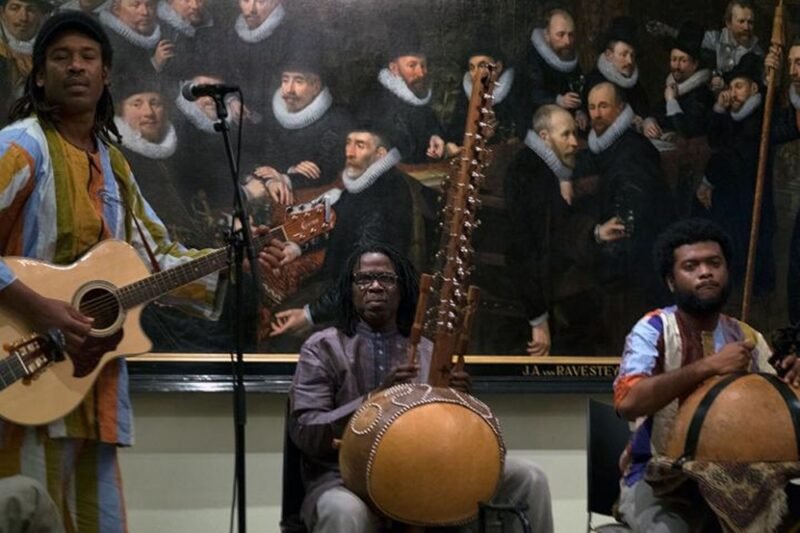
The group consists of Omar Ka (vocals and guitar), Urvin Robinson (percussion and drums) and Bao Sissoko (kora). The cultural and musical backgrounds of the band members are an important part of the sound of Fulani Blues. Sissoko is of Mandingo background from Senegal, Ka is of Fulani descent and Robinson has Afro-Caribbean roots.
Robinson and Eduwaiti
For Robinson, the project also has personal meaning. He and Jason Eduwaiti grew up together in Suriname and started their musical career around the same time. Robinson later left for the Netherlands to study at the conservatory, but the musical bond with Eduwaiti remained.
In 2023, Eduwaiti traveled to the Netherlands for the North Sea Jazz Festival. Robinson worked with him again there and invited him to perform with Fulani Blues during his stay. This collaboration gave rise to the idea to further investigate what musical possibilities arise when different backgrounds and styles come together.
Robinson tells the True Time that this led to the plan to jointly develop a new musical style. Eduwaiti is therefore not only a participant in the Surinamese project, but is also one of the initiators.
The visit to Suriname should ultimately result in an artistic encounter in which musicians from different generations and backgrounds inspire each other. Fulani Blues not only wants to make music heard, but also to show how music can make historical and cultural connections visible and tangible again.
Connectedness
Central to the project is the historical and musical connection between Suriname and West Africa. Robinson says that centuries ago, West African melodies crossed the Atlantic Ocean and found new life in the forests, rivers and communities of Suriname. “The melodies lived on in the sound of the drums, in the song of generations and in the power of a living spirituality. They changed form, but never lost their soul.”
The organization behind the project is the WHI-Cari Foundation, a non-profit cultural organization committed to strengthening cultural heritage, identity and social connection through artistic, educational and intercultural initiatives.