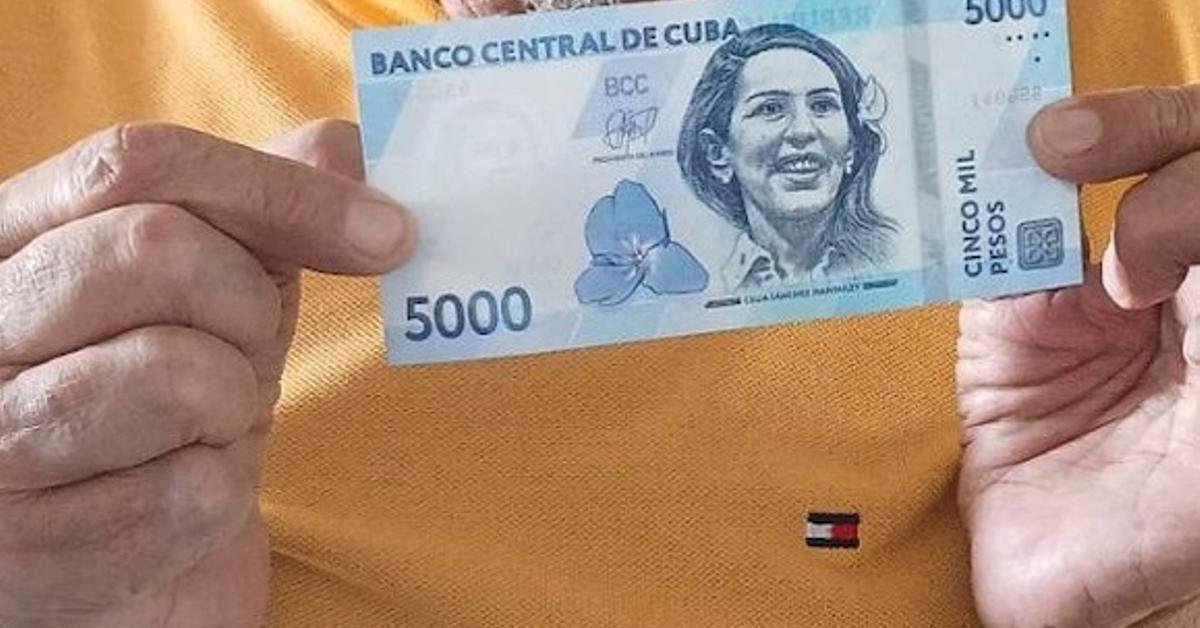
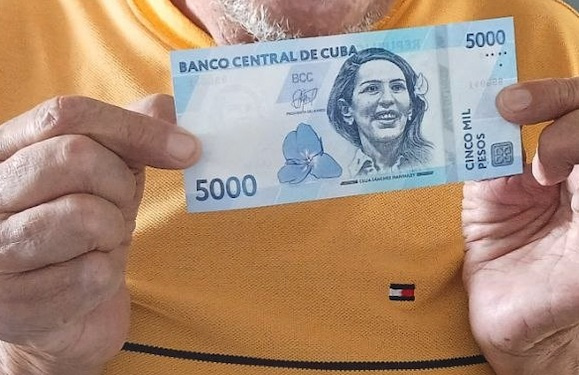
Madrid/The Cubans have outgrown the 2,000 and 5,000 peso bills that began to circulate less than half a year ago and that in the midst of rampant inflation they already have an older brother. The guerrillas Haydée Santamaría and Vilma Espín will be the faces of the new denominations of 10,000 and 20,000 pesos that will begin to circulate starting this Wednesday, as announced by the president of the Central Bank of Cuba, Juana Lilia Delgado Portal, in a Round Table in which other changes were reported to “recover the role of banks in the economy.”
The official said that with the new banknotes “the modification that we had announced in our monetary cone is completed” to adapt to the “price conditions and the needs of monetary circulation.” In Marchwhen the previous ones were presented – with the faces of Mariana Grajales and Celia Sánchez – there was no mention that it was planned to print higher denominations, so it can be assumed that it is more of a reaction to the unstoppable rise in prices (officially 25% year-on-year, but much more in the informal economy) and the collapse of the national currency.
The television space addressed the main reforms that the State aspires to incorporate into the system, grouped into four axes by the Central Bank: opening and capitalization; credit, savings and financing; innovation and new channels; and exchange market and remittances. The most popular announcement was the confirmation that The first private exchange house is now operating of the Island, whose imminent implementation the prime minister spoke Manuel Marrero in July. The establishment is in Santa Clara (Villa Clara) and, according to Ian Pedro Carbonell Karell – director of the BCC – there are several requests for the creation of similar entities.
Once again, details were lacking about the exchange rate that is applied and it was barely mentioned that “it provides very relevant information”, since “it does not respond to publications on networks or to purchase or sale intentions”
Once again, details were lacking on the exchange rate that is applied and it was barely mentioned that “it provides very relevant information”, since “it does not respond to publications on networks or to purchase or sale intentions, but rather to real, settled and confirmed exchange operations, which allow the official exchange rate to be better substantiated” for natural persons and the private sector.
Carbonell Karell reviewed some of the measures that are already underway and whose operation is uneven. Among them is the extension of the transfer threshold, which at the end of July went from 120,000 pesos per month – the limit imposed in 2023 – to 2,500,000 or more, as long as they are declared. This solves the inconvenience of having to go to branches to carry out operations that currently involve a very small amount of money. The official assured that the printing of new banknotes is essential in this case, since it puts more money into circulation and resolves the cash shortage.
Although this remains to be verified, Carbonell stated that it will move from a cash rationing model to another of planning to meet delivery. Entities must adapt to their clients, accompany them, advise them and agree with them on the financial cycles most appropriate to their case. “Attention must be different for a natural person and for a company, because they are not the same needs,” he stated.
The manager also reviewed the latest resolution which allows private individuals to operate accounts abroad without prior authorization – although they must be informed of their opening – or to deposit foreign currency in cash, a package of reforms presented last week and which comes into force this Thursday the 17th.
Another of the well-known topics that was emphasized was the outsourcing of pension payments to the private sector. The solution, adopted months ago as a solution to the banks’ lack of liquidity, talready has a model representative: The Olympian. It is a private enterprise – which the official press calls box, that is, a food sales point – that is paying retirees in Santiago de Cuba through an agreement with the bank. Its owner is, neither more nor less, Eriel Sánchez, former player and manager of the Cuban team who has less honorable episodes in his history, such as directing the U-23 team. from which half the team fled during the 2021 Mexico World Cup or the suspension for five years in 2025 of the National Baseball Commission, after hitting sporting glory Miguel Rojas Rodríguez with a bat.
The officials also talked about giving more discounts –reducing commissions, especially– on digital payments, since there is still the conviction that it is possible to modernize banking. on-linewhich would allow the number of branches to be reduced while operations and service are increased. All this despite the previous failure of the so-called banking system. The flexibility of credits, particularly to finance renewable energy sources, was another of the novelties mentioned, although the experience is not turning out to be very positive in practice either, as the official press itself has warned. In addition, there was talk of the imminent update of regulations related to the use of cryptocurrencies.
“One of the central objectives set by the Central Bank is to recover the functionality of the national currency and return greater usefulness to the Cuban peso within the economy,” said Delgado Portal, an analysis that clashes head-on with the opinion of Cuban economist Pavel Vidal. The expert sent, in the previous hours, a bulletin from the Observatory of Currencies and Finance of Cuba (OMFi) in which he points out, precisely, that “the new regulations expand the dollarization of wholesale transactions between companies (state and private) and, to a lesser extent, consumer markets.” The phenomenon, he adds, is not new, but the current changes “represent another step in the reversal of the de-dollarization process that began in 2004 and also deviate from the purpose of the Monetary Regulation in 2021 of reestablishing the Cuban peso as the only monetary sign of the economy.”
“One of the central objectives set by the Central Bank is to recover the functionality of the national currency and return greater usefulness to the Cuban peso within the economy”
Vidal considers it difficult for the Cuban regime – forcefully or negotiated – to achieve another international partner other than the United States, which is why the dollarization of an economy that is already, de factodependent on the northern neighbor. Washington’s sanctions have limited imports, travel and all types of investments from any other country, so the generalization of the currency seems “natural” and “logical.”
However, this could be very useful in a first phase of stabilization – as the Cuba Transformation document points out – to facilitate the entry of capital and financing while the national currency gains strength and confidence. But it is recommended that it not be extended unnecessarily, since it generates distortions and inequalities between those who have and those who do not have access to foreign currency. Furthermore, the single exchange rate is important, which does not favor these processes. “Dollarization provides monetary stability, but limits responses to international or internal shocks, and increases the economic and social cost of economic adjustments.”
Vidal believes that although the Cuban peso has lost value in an extraordinary way and the rise in prices has been unstoppable, hyperinflation has not been reached, which allows the national currency to recover its functions over time and relying on some reforms already carried out and others that should be added. Among its proposals is the further reduction of the fiscal deficit, the unification of all exchange rates, the increase in interest rates, the formalization of the exchange market and the transfer to the BCC of the international reserves that the military conglomerate Gaesa currently controls.