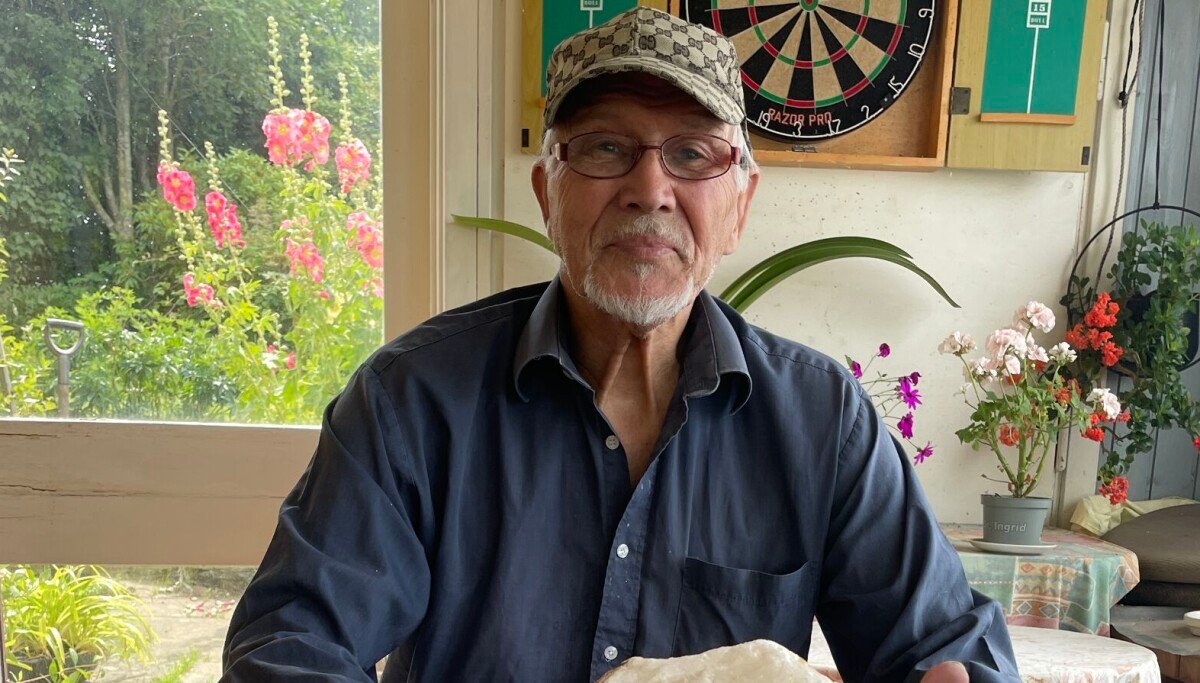
Some artists stay familiar faces.
Others are known through what they leave behind.
Christian “Nuunu” Rosing belonged to the last group.
His son, Nikolaj Rosing, points to a paradox in his father’s life: Christian Rosing was “the well-known, unknown artist” – the man behind some of Greenland’s most recognizable public works of art, but with a name that far fewer people knew.
This did not mean that the recognition was unimportant to Christian Rosing.
On the contrary, the son, who is named after his grandfather, the artist and politician Nikolaj Rosing, says that a large part of his father’s life was a struggle to be recognized for his artistic work. A recognition he fortunately managed to experience.
– The biggest part of his life was a “fight” to be recognized, and for the last – fortunately – many years he enjoyed deserved admiration and recognition, says Nikolaj Rosing.
What remains are works that many have encountered without necessarily knowing the name of the artist behind them: primarily Sassuma Arnaa – Mother of the Sea in Kolonihavnen in Nuuk, but also the halibut fisherman in Sisimiut, the fisherman with his kayak in Qasigiannguit, the bust of Jørgen Brønlund in Ilulissat and the granite sculpture Aasiveeraq at Nordre Mølle in Kongens Lyngby. A modest sample of his more than 100 works he managed to make.
Christian Rosing died on 30 August in Vester Skerninge on Funen. He lived to be 82 years old.
Worked until the end
Age had not made Christian Rosing put down the tool.
Gallery owner Frederik Thordal can tell you about that. He is the initiator of the large art exhibition with the theme of the Commonwealth of Nations, which opens in Vejle on 1 October, and which includes works by Christian Rosing. In connection with the exhibition, the two were in constant contact.
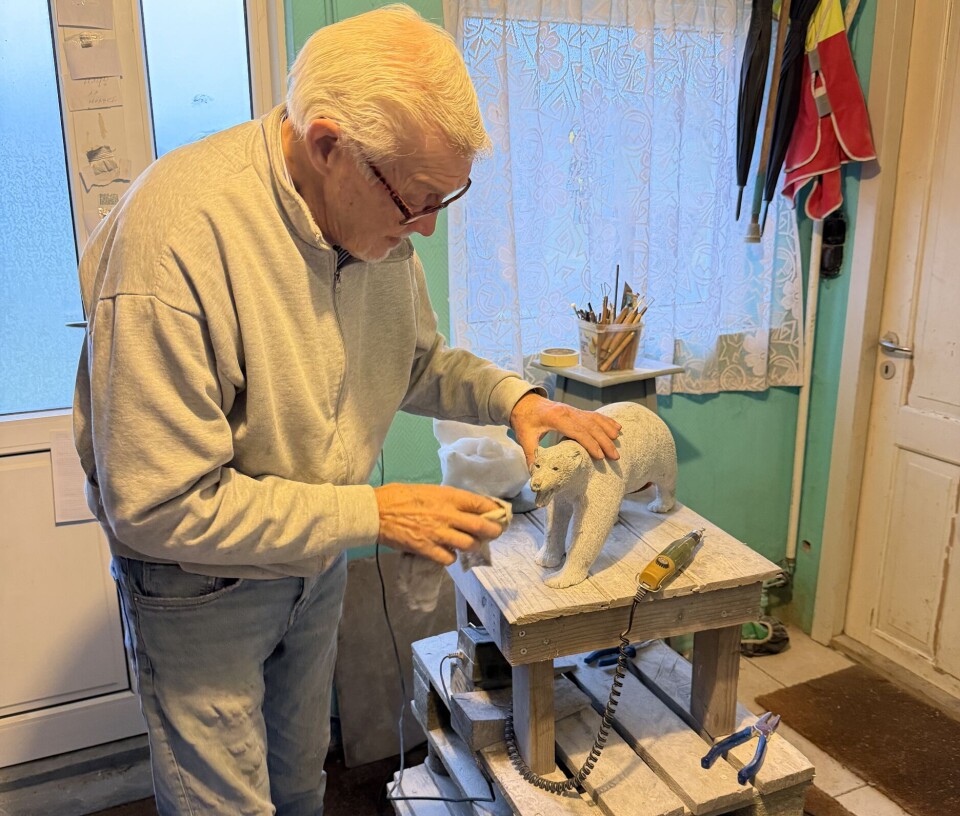
Christian Rosing continued to work on new works – even on the last day of his life.
According to Frederik Thordal, shortly before his death he was in contact with a customer about a job he was doing. Christian Rosing said that he needed to take a break. About a quarter of an hour later he died.
For Frederik Thordal, the episode tells something fundamental about Christian Rosing: Art was not something he ever withdrew from. He kept creating.
And Thordal has no doubts about how, in his opinion, Christian Rosing should be placed in Greenlandic art history: He counts him among Greenland’s greatest artists.
When the large exhibition with the theme of the Commonwealth opens in Vejle on 1 October, his works will be present – by agreement with Rosing’s family.
Art ran in the family
The fact that Christian Rosing had to deal with images, materials and Greenlandic stories was no stranger to the family in which he grew up.
Art and culture existed on both sides of the family.
The father, Nikolaj Rosing, was a teacher and lecturer at Ilinniarfissuaq, but also an artist and politician. He was chairman of the municipal council in Nuuk and later became a member of the Folketing.
On the mother’s side, the connection to art was at least as significant. The mother, Marie Rosing, née Lynge, was the sister of the poet and artist Hans Lynge.
Christian Rosing thus grew up in a family where art, culture, education and social life were closely connected. But his own artistic vision was also shaped by something far more personal.
Lost hearing – sharpened sight
Already from childhood, Christian Rosing’s life was marked by serious health problems.
He lost his hearing at an early age and for most of his life had to do without the hearing that others took for granted. It also left its mark on schooling.
As a child, Christian Rosing could be perceived as inattentive because the teachers did not necessarily understand his disability. He therefore had to learn to orient himself in other ways – through faces, movements and visual impressions.
Only in 2001 did he get a cochlear implant (electronic hearing implant, ed.).
The hearing loss became a great challenge, but at the same time came to shape his artistic development. Christian Rosing himself said that it sharpened his other senses – not least his vision and visual memory.
He developed a special ability to quickly fix a subject and form an inner image of what he wanted to create.
When the world of sound was difficult to access for many years, the visual became all the more important. Already at school, Christian Rosing found himself most at home in the subjects where eyes and hands could work together: drawing, painting and embroidery.
Chose his own path
When the family moved to Denmark, Christian Rosing was 14 years old.
He did not choose the classic path into the art world. He first trained as a machinist and later as a technical assistant. He also completed a pedagogical education as a subject teacher and trained as a study counsellor.
The craft came to follow him into art.
Christian Rosing considered himself self-taught and consciously wanted to find his own artistic expression. According to the family, he refused to attend the Art Academy because he did not want others to change his idea of how his works should be performed.
However, a decisive development came in 1986.
With the help of the artist Bodil Kaalund, he attended a course with the sculptor Ole Christensen on Bornholm, where he learned to work with professional tools for stone carving.
After this, granite in particular became one of the materials that came to define his artistic life.
With usual humor – according to Nikolaj Rosing – he could then refer to himself as “stone-rich”.
From jewelery to ton-heavy sculptures
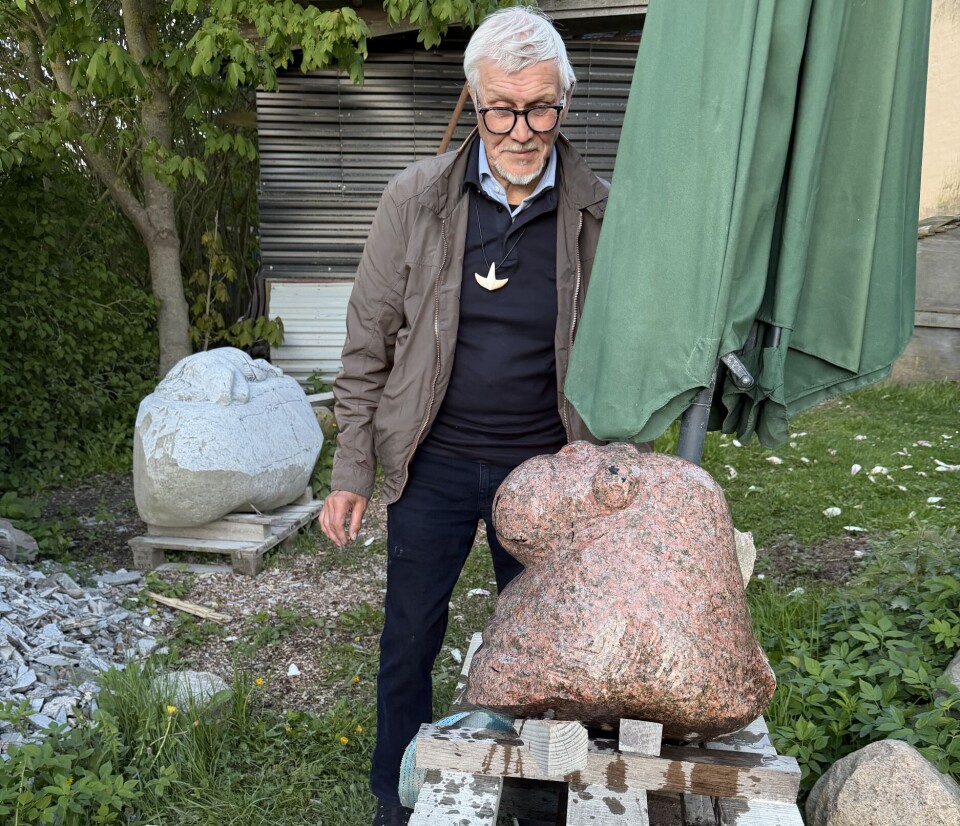
Christian Rosing was difficult to place in one artistic category. He drew and painted, made jewelery and small figurines and worked in a multitude of materials – including wood, bone, horn, amber, reindeer antler, soapstone, marble, brass and bronze. But not least the stone became characteristic of his work.
The span was large. Some works could be held in the hand, while others weighed several tons. He found the motifs especially in Greenland: in the wildlife and landscape, among trappers and fishermen, in historical figures and in the stories that have been handed down through the generations.
At the same time, a significant part of his art was given a permanent place in the public space. In Ilulissat there is, among other things, his bust of the polar explorer Jørgen Brønlund and a representation of a halibut fisherman. In Nuuk he created a relief of the psalmist, teacher and cultural figure Rasmus Berthelsen and the large stone sculpture of a seal in front of Pinngortital reef. In the town hall, his portraits of former mayors and municipal board chairmen also hang – including his own father, Nikolaj Rosing.
In other places too, he set people from history and everyday life in stone. In Ikerasak stands his bust of the prisoner and municipal politician Johannes Therkelsen, while in Maniitsoq he created a relief of Kristine Donadussen.
Together, the works draw a geographical trace through Greenland – and at the same time an artistic portrait of the country’s people, nature, history, industry and culture.
Mother of the sea
One work, however, rises above the others: Sassuma Arnaa – The Mother of the Sea in the Colony Harbor in Nuuk.
The monumental granite sculpture is based on the Inuit story of the Mother of the Sea, who rules over the animals of the sea. Christian Rosing worked for about three and a half years on the work, which was unveiled in 2007.
The location is part of the work. The sculpture stands in the sea itself, where the tide alternately hides and exposes the Mother of the Sea, the animals of prey and the spirit man.
It has since become one of Nuuk’s well-known landmarks – and perhaps also the strongest image of Christian Rosing’s own history.
Because while the Mother of the Sea became known to almost everyone, the man who carved her out of the granite remained to many the known, unknown artist.
Now he’s gone. The Mother of the Sea remains standing.
Source: The article is based on email correspondence with Nikolaj Rosing and factual information about Christian Rosing from Lex.dk.