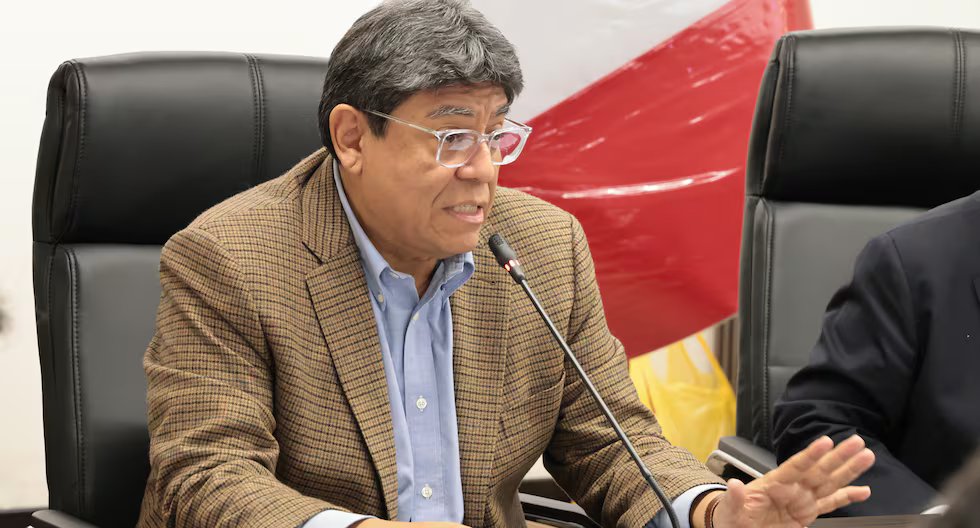
He Minister of Economy and Finance, Elmer Cubapointed out that the Executive plans to approve this Friday, in the Council of Ministers, a temporary subsidy for motorcycle taxi drivers who use regular gasoline. The aid would be equivalent to approximately S/2 per gallon and would have a limit of S/100 per month per beneficiary.
During his presentation before the Senate Economy CommissionCuba explained that the measure seeks to incorporate this means of transportation into the massive systems used in cities such as Iquitos, where the motorcycle taxi has a significant presence.
When asked about the return of the subsidies and its impact on public accounts, the minister specified that the targeted aid for transportation would last three months and would require, together, S/100 million.
The head of the MEF defended this mechanism against the generalized subsidies previously applied. He pointed out that the Fuel Price Stabilization Fund He demanded around S/5,000 million and added that the State still maintained a debt close to S/1,000 million with the participating companies.

Fuels. (Photo: GEC)
/ LUIS GONZALES
Cuba also announced that this week the four presidential commissions aimed at promoting economic reforms would be formally presented.
The commissions would address labor formalization, the functioning of financial markets, the efficiency of public investment and the reduction of non-compliance in the payment of VAT and Income Tax.
The commission on financial markets would seek to expand companies’ access to credit for longer terms and at lower rates. Another commission would evaluate changes in the public investment system to improve the use of resources assigned to works.
In labor matters, Cuba maintained that Peru could reduce informality from around 70% to 50%, a level close to the regional average. However, it did not specify the period in which this result would be achieved or the measures that would allow it to be achieved.
During his presentation, Cuba also confirmed that the Government was considering moving the holidays that were celebrated during the week to Mondays. The measure would be in force from 2027 and would seek to avoid interruptions in productive activity.

Holidays 2026: check the calendar with official holidays | Photo: Pinterest
He specified that the proposal would not include New Year’s, Christmas or National Holidays. He added that the eventual boost to tourism would be an additional effect and not the main objective of the change.
The head of the MEF reiterated that Failure to pay VAT and corporate income tax represented around 9% of GDP, compared to 6.7% in Latin America and the Caribbean.
He indicated that the Government would seek to increase collection by an amount equivalent to two points of GDP without raising tax rates. He indicated that additional resources could be allocated to infrastructure, social policies and strengthening public finances.
Regarding public investment, Cuba stated that Peru invested close to 5% of GDP, but estimated that inefficiencies reduced its effect to a level equivalent to approximately 3.5% of the product.
The minister pointed out that the MEF projects a growth of 3.4% for the Peruvian economy in 2026, despite the impact of the El Niño phenomenon, and an expansion of 4% in the coming years.
He warned that uA more severe than expected El Niño phenomenon could affect growth during the last quarter of this year and the first quarter of 2027. He also mentioned among the risks the increase in the international price of oil, a possible increase in interest rates by the main central banks and the impact of citizen insecurity on smaller companies.