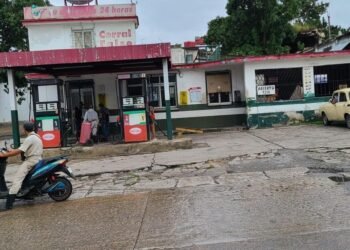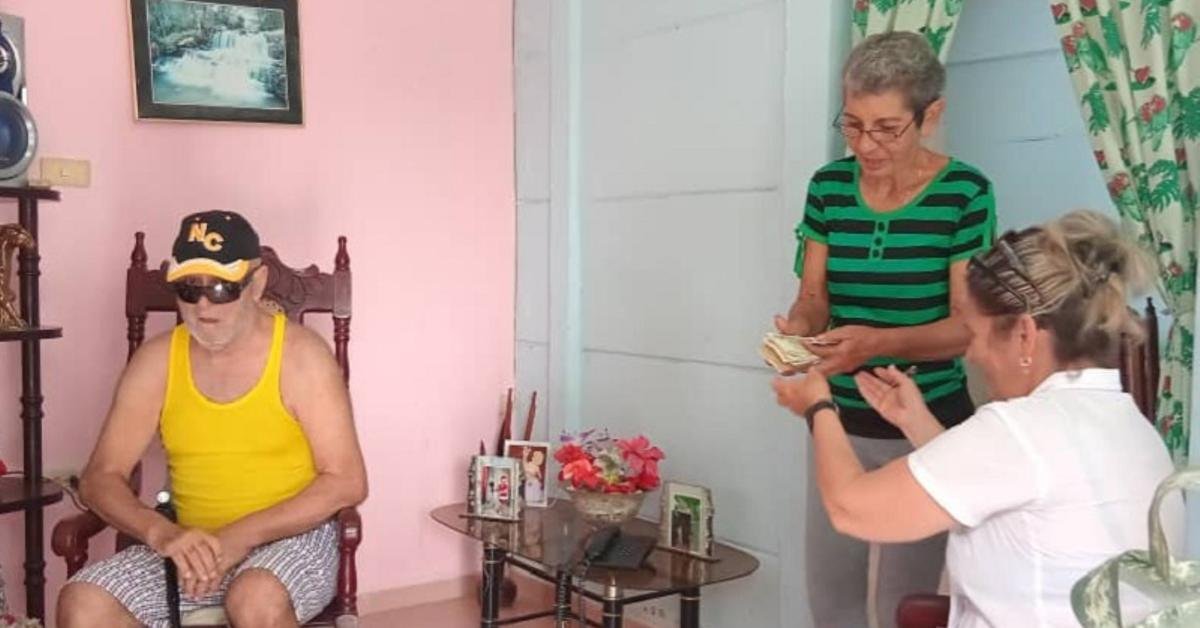
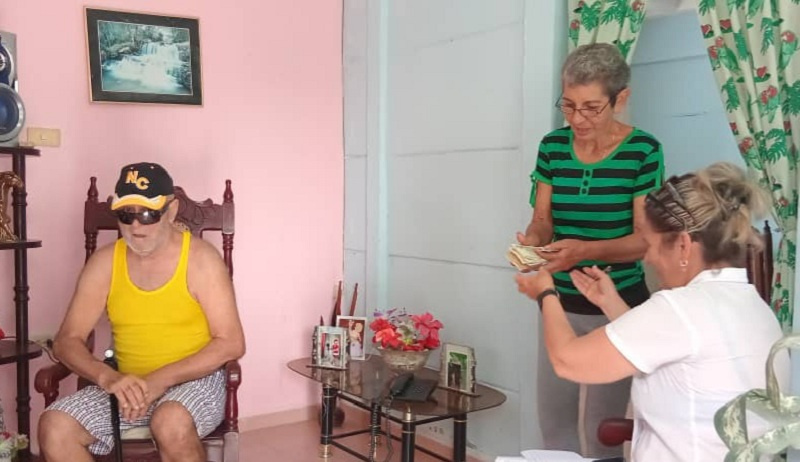
Sancti Spíritus/The Cuban Government’s experiment to have private businesses deliver in cash the pensions that banks cannot pay has begun to spread throughout Sancti Spíritus, although for now its scope is minimal. Eight self-employed workers and two MSMEs participate in the program and between them they serve less than one hundred retirees, compared to the around 27,000 registered by the Banco Popular de Ahorro (BPA) in the province.
But accessing the alternative is not as easy as the official press suggests. A resident of the outskirts of Sancti Spíritus, whose identity 14ymedio reservation due to a privacy issue, account that tried to incorporate an elderly relative and that those interested had to register in advance and meet certain requirements.
In addition to being retirees, he explains, priority was given to people over 65 who had difficulties going to the bank and who did not have someone who could do the management for them. After writing them down, “they made an evaluation of those who classified or not.”
Many private businesses complain of having a large balance in their bank accounts, but little cash available to operate.
“It is still a very small number,” he also acknowledged this Saturday to Escambray Yeney María Ceballos Hernández, head of the Personal Banking Department of the Provincial Directorate of the BPA. The official newspaper presents the initiative under the touching title Hands extended in solidarity and ensures that the formula aims to reduce long lines at bank branches and make it easier for the elderly to access their money.
In practice, the mechanism turns businesses, MSMEs and other economic actors into a kind of banking window. The business gives the pensioner the bills from its own income and the business subsequently receives the amount in its account.
The mechanism also has an additional paradox. Many private businesses complain precisely of having a large balance in their bank accounts, but little cash available to operate. The banknotes are especially necessary to buy foreign currency, an operation that a good part of MSMEs and self-employed workers continue to carry out in the informal market to be able to import goods, acquire inputs or pay suppliers. In this context, giving cash to retirees means giving up one of the resources most coveted by the private sector itself, although in exchange the bank will replace the amount through transfer.
“We pay the money in cash from our income and Bandec replaces it in a transfer”
The state Security and Protection Company (Esprot) has also been incorporated into the system, which since August has been paying the pensions of dozens of other beneficiaries selected for their proximity to the entity and according to the criteria of the authorities of the popular council and the constituency delegates. “We pay the money in cash from our income and Bandec replaces it in a transfer,” he explained to Escambray a company manager.
The test has also not always managed to eliminate the same problem it aims to solve. According to the testimony collected by this newspaper, there were days when some beneficiaries finally had to go to the bank because at the alternative point there was not enough cash to give them.
The measure is part of the 176 economic and social transformations announced in June by the Government. Among them, it was established that state and private economic actors would participate, as part of their so-called “social responsibility”, in the pension payment through agreements with banks. Manuel Marrero then assured that participation would not be mandatory, although he asked to “raise awareness” among all economic actors so that they would join.
“When he heard that, he saw the heavens open.”
Cuban legislation had already prepared the ground. Decree-Law 100 on the Payment System, published in January, recognizes the figure of the “non-banking correspondent”, a natural or legal person authorized to provide basic services on behalf of a bank, including the delivery of cash through debit cards.
To attract establishments, the Central Bank offers a bonus of 0.25% of the amount delivered, plus one peso for each transaction reconciled, priority for withdrawing cash and preferential treatment in access to the exchange market. Until this week there were 544 registered establishments throughout the country.
The source’s relative believed that he could finally collect money near his home, without having to go to the bank or endure long lines. “When he heard that, he saw the heavens open,” he says. But the quota was already closed, and he was left out.