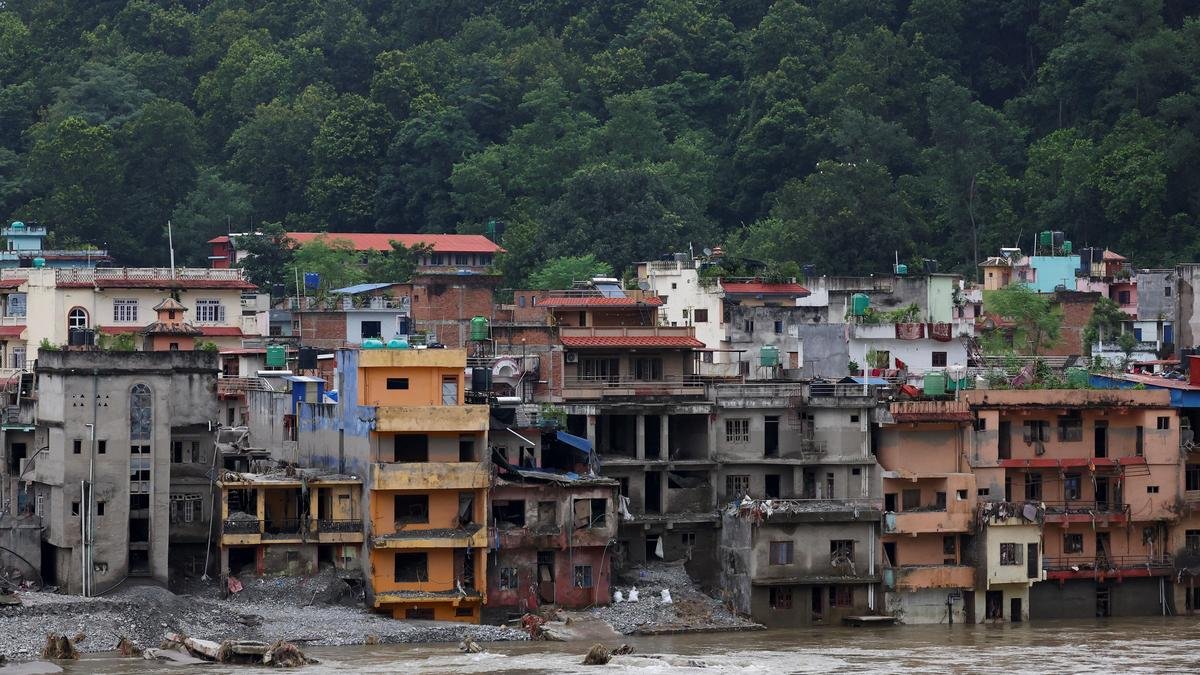
The Himalayas have recently unleashed a whole series of flash floods that are beginning to create their own alphabet — in Kedarnath, Chamoli, and Sikkim on the India side and now in Rasuwa on the Nepal side. As many as 1,356 people have been confirmed dead in Nepal as on September 7, while 4,994 remain missing. Scientific terms such as “hazard cascades” and GLOF (glacial lake outburst flood) or dramatic epithets such as “Himalayan tsunami” sit uneasily alongside older, forgotten words such as bhisyari, rooted in the oral histories of mountain flash floods, and mahapralaya, the Hindu mythology on apocalypse.
We have become accustomed to translating catastrophe into the language of accounting that churn out numbers on losses and compensations. But mountains have their own alphabets and memories. Communities have long carried knowledge of how narrow valleys should never have been crowded with permanent settlements, and how slopes should not have been cut haphazardly to build infrastructure. Such wisdom had surfaced during the pandemic lockdowns, and now the killer waves of the Lhende Khola remind us of the mythologies of the Ganga descending directly from heaven.
As Nepal has struggled to make sense of the disaster, its leaders have increasingly spoken the language of global climate compensation. Prime Minister Balen Shah is set to address the United Nations General Assembly later this month, and his associates are already at work: popular intellectuals, activists, and some of the Gen Z icons of last year’s youth revolution are publicly demanding that Nepal’s losses be recognised within the larger architecture of global climate injustice.
The demand is legitimate. But the political moment is a difficult one. This is precisely the time we see multilateral governance being pushed aside by unilaterally minded leaders. Even on issues of genocide and war, the global order appears to have been taken hostage, and it seems impossible to translate moral consensus into collective action. Even when ardently demanded by its own youth, Euro-America has not acted on global humanitarianism. On global warming, the Paris Agreement appears ineffective as the news about global temperature rise exceeding the target of 1.5 degrees Celsius has failed to make headlines even as mainstream global media endlessly streams apocalyptic reels from Nepal.
Reaching out to polar communities
Can the Global South, especially South Asia, still hope to reshape the balance between Euro-America and the rest of the world? The risks before us are no longer about territorial or imperial power games; what is at stake is the evolutionary geographies of ecology where cycles of water, ice, and temperature are creating new frontiers and generating new alliances.
The nation-state model, anchored in the Westphalian imagination of sovereignty and later reproduced through the nationalisms of the New World, was contested by postcolonial countries earlier but is now seen riding into Global South psyches. The new urgencies of this Himalayan tsunami must indeed come as a wake-up call to correct our courses and bring South Asia together as a post-nation-state and civilisational entity and place ecology at the centre of diplomacy.
The Himalayan region should build solidarities not only with plains and oceanic shores downstream but also with the scientists, policymakers and dreamers working (and living) at the polar regions of the North and South Poles. The Arctic, Antarctica, and the Himalayas are distant ecological worlds, but they are brought together by the existential challenge of global warming. The Himalayas must assert its own location as the Third Pole of Earth — not as a rhetorical flourish but as a political and scientific proposition. A polar solidarity could connect mountain communities, researchers and climate institutions around a shared agenda of ice, water, adaptation, and survival.
Partisanship at home
The trauma of the 2015 earthquake, which killed 8,000 people, lingers for Nepal. Still, it produced a rare national unity which brought rival political forces to negotiate a constitutional settlement and complete the decade-long transition following the Maoist insurgency. But the promised “peace dividend” never became the economic take-off many had hoped for, and an additional decade of stagnation brewed profound generational disillusionment that eventually exploded into the Gen Z uprising of last September.
The 2015 rhetoric of rescue, relief and reconstruction — however shaky it became in the subsequent years — had brought of age a generation that had gained a foothold in Euro-American aid institutions and networks, who used them to mobilise resources and bargain an entry into national politics. The politics of disaster relief in Nepal is inseparable from the politics of legitimacy. As the new Finance Minister rattles off numbers about the Prime Minister’s Relief Fund, and the Home Minister inserts himself into the corporeal mechanics of rescue and relief distribution scoring social media brownie points, the political parties find themselves performing the anti-politics of disaster aid. These have not gone unnoticed as criticisms are surfacing about delays in rescue operations. Desperate social-media appeals from people searching for loved ones trapped beneath collapsed buildings or inside flood-struck tunnels have been met, at times, with inhuman trolling and abuse on Facebook and X. The Prime Minister himself has had to call publicly for an end to such cruelty.
We must also remember that Nepal is a nation of many revolutions. The Maoist revolution, the constitutional revolution of post-war state-building, and finally the Gen Z revolution have each promised a new beginning. Yet every new beginning has inherited unresolved failures from the previous one, keeping the country hostage in an unresolved, and unending transition.
The floods now present a different kind of ultimatum. Rebuilding cannot mean simply reconstructing infrastructure; it must mean a new imagination of earth and ecology, and a new way of being. Of course it must translate that into an implementable set of actions that brings a meaningful conclusion to the country’s protracted political transition.
Can South Asian civilisation reach out to the wounded Himalayas of Nepal and lead new global alliances around ecological governance? Not only that the scale of devastation is too large for partisan ownership, but South Asia’s organic anatomy is laid bare by the melting glaciers, flash floods in the Chure and Shivalik ranges, and the poisoned waters of the rivers on the Gangetic plains.
The alphabet being written by the flash floods in Nepal remains incomplete. We can choose to read it merely as a record of disaster, or we can see it as a warning and a calling. The Himalayas are telling us that the old political map is no longer sufficient, and that the communities cast out to opposite poles may, ironically, be the closest of our kin in survival.
Mallika Shakya is a Senior Associate Professor at South Asian University
Published – September 08, 2026 12:06 am IST