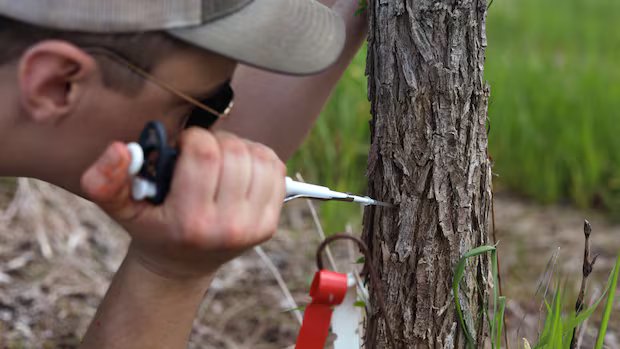
Scientists in the state of Vermont have spent the summer spreading Dutch elm disease to thousands of trees.
You read that correctly.
Researchers with the U.S. Forest Service and the Nature Conservancy want to see if a new generation of elms — bred from survivors of the disease — might have resistance to the fungus spread by bark beetles that has been decimating elm populations in the U.S. and Canada for decades.
The goal is one day repopulating areas where towering elms were once ubiquitous, lining city streets and thriving along river banks.
“The loss of the trees over the years has been devastating,” Gus Goodwin, a senior conservation planner for The Nature Conservancy, told The Associated Press.
Time will tell if the Vermont experiment will result in a strain of trees resistant to Dutch elm disease (DED). Researchers working on similar efforts here in Canada hope science will offer solutions at a time when the disease is becoming a threat in new areas.
“We’re not losing our elm population,” said Alison Morrison, a manager at the University of Guelph arboretum which operates the Elm Recovery Project. “What we’ve lost is our elms’ ability to grow old.”

In the shadow of Parliament Hill, stately elms fall victim to Dutch elm disease.
The Elm City that lost its elms
Fredericton was once known as the “City of Stately Elms” until the disease spread there and elsewhere in eastern Canada in the 1960s and 70s, leading to the loss of an estimated 10,000 trees. Now there’s only about 1,000 mature trees left standing.
University of New Brunswick forest management professor Anthony Taylor has several elms on his property outside Fredericton, ones that survived the first wave of DED.
“But now I see there’s another wave of the disease killing some of the trees on my woodlot,” he said, “which is sad to see.”
When bark beetles carrying the DED spores colonize a hospitable elm, the disease attacks its vascular system and blocks the water-conducting tissue, depriving the foliage and branches of water, preventing photosynthesis and eventually killing the entire tree.
That can happen within one to four years of infection.

The beetles further spread the fungus by laying eggs in an infected tree, creating a new generation of carriers that can then fly to the next healthy tree. The fungus can also spread through roots.
In order to control DED, Taylor says, infected elms are immediately cut down and disposed of.
In decades past, however, other nearby elms would also be removed even if they were healthy.
“It’s called sanitization, where we try to eliminate the pest by eliminating the plant that’s carrying,” explained Morrison.
But that may have “unintentionally” had a detrimental effect when it came to DED-tolerance, she says, by taking trees that could withstand the disease out of the population.

Edmonton, once free of Dutch elm disease, has seen increasing instances since 2024. CBC’s Sam Brooks explains why some experts caution the city is taking the wrong approach to fight the fungus.
A nightmare for elm-lined streets
Where cities from Manitoba to the Maritimes watched their elm trees disappear in the 1960s and 70s, the disease has become a threat in new places in recent years.
Edmonton has confirmed 17 infected trees since it was first detected in the city in 2024. Saskatoon recorded 23 cases so far in 2026, 11 years after DED was first found there.
“It is a considerable threat to Saskatoon’s urban forest,” said Nolan Ramler, a park superintendent. The city has approximately 26,000 elms, he said.
City foresters act fast to remove infected trees, he says, but there’s also an onus on local residents to stop the spread — including respecting the annual four-month ban on pruning elm trees, and not storing or burning the wood.
“We have officially transitioned … to more of an active management strategy because the fungus is now considered unavoidable and it’s widespread in the community,” he said.

Residents say more trees should be planted in place of those removed due to Dutch elm disease. The city has confirmed nearly two dozen cases of the disease this year.
While the disease may be here to stay, the concern is which trees it kills.
Losing the mature trees, says Morrison, means losing their shade canopy and ability to absorb storm water.
She says they are “another tool in our toolbox” when it comes to mitigating and adapting to the effects of human-caused climate change.
“If we can bring elms back into our communities with confidence,” she said, “that adds another species … to build a complex ecosystem. And those are the ones that are the most resilient.”
Saskatoon Morning4:58The City of Saskatoon removes memorial tree stricken by dutch elm disease
A test of time
Scientists and foresters across North America, including at the Elm Recovery Project in Guelph and a city-run project in Fredericton, have been working toward improving resiliency against DED by crossbreeding and cloning trees that did not succumb to the disease.
In Guelph, Morrison says, they have been working toward this goal for almost 30 years.
“We have 109 trees that we have essentially tortured with Dutch elm disease, and multiple strains of it that persist, in a gene bank here,” she said.
Those trees, she says, have gotten to the point where they can now produce seed and the next phase will be “seeing what these seedlings are capable of.”
That’s where the Vermont experiment is at now — the seedlings of resistant trees — and at much larger scale, with some 6,000 trees.
Starting in the spring, the U.S. Forest Service and Nature Conservancy researchers began injecting them with thousands of fungus spores to test which ones survive and which ones ultimately die.

Because this kind of breeding program means generations of trees, it takes time.
“We … will grow and love those trees for about 15 or so years, at which point they should produce seeds, and that seed can be used for restoration,” Leila Wilson, a research ecologist with the U.S. Forest Service, told The Associated Press.
Taylor says if it works, it could mean elms here could coexist with DED, as elms in Europe have evolved to do, with only minor negative impacts from the disease.
Elms in Canada, he says, could also evolve naturally but it could take centuries considering the disease only arrived in this county just under a hundred years ago.
“We’re just sort of [expediting] that co-evolution process,” he said.

A Toronto researcher who recently saw his first elm may have a cure for Dutch elm disease.