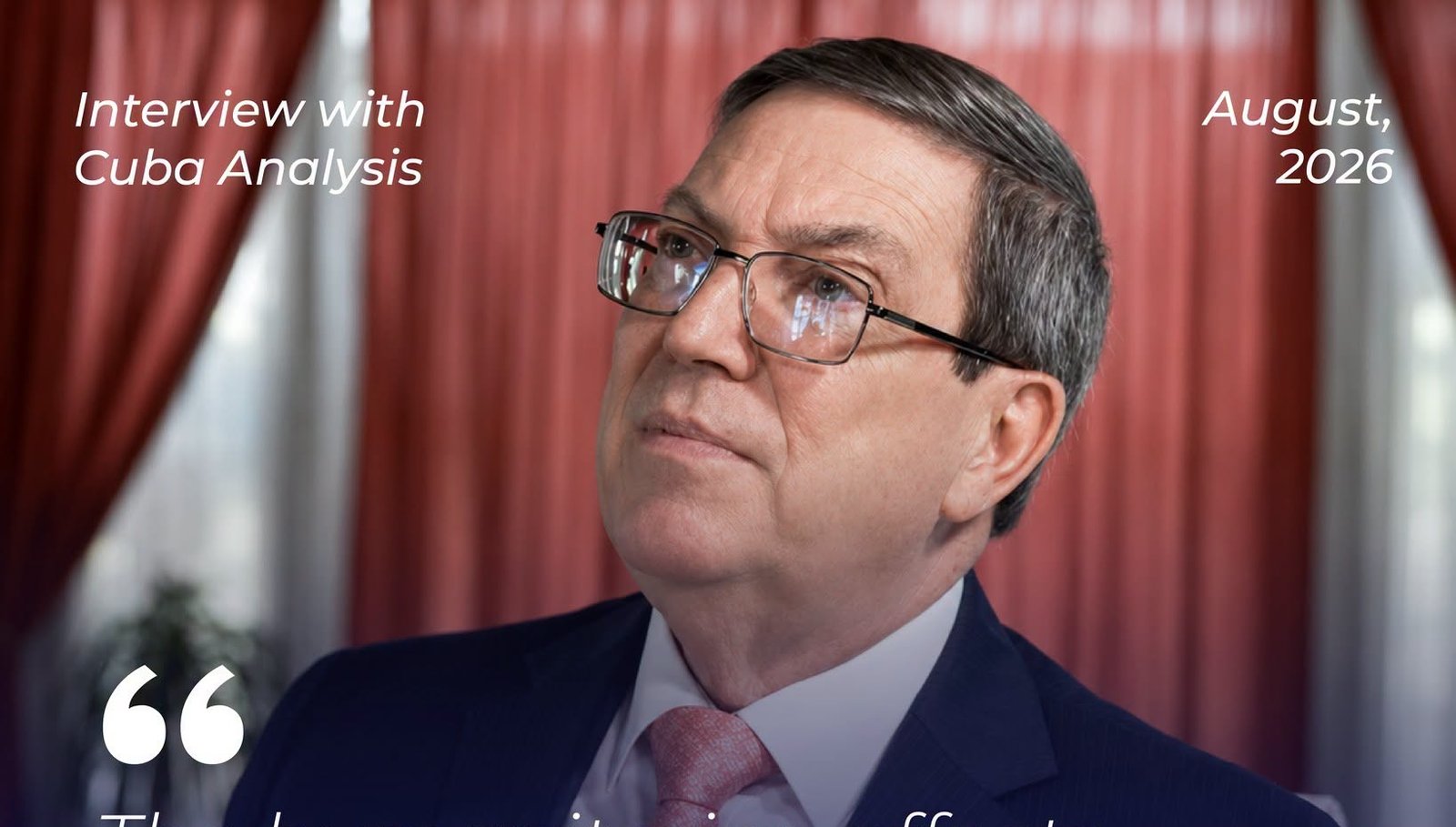

Cuban Foreign Minister Bruno Rodríguez Parrilla discussed relations with Washington, the impact of U.S. sanctions and the possibility of future bilateral dialogue in an interview with the Cuba Analysis Podcast, hosted by researchers Helen Yaffe and Nina Blodau. The Cuban Embassy cited the interview in a press release.
Rodríguez said he has spent his entire life under U.S. sanctions, as have several generations of Cubans. Describing their reported impact, he said: “The suffering experienced by our people—by every Cuban—the hardships and anguish, are extreme.” He argued that the measures amount to collective punishment and said their effects had intensified since 2019, particularly following measures introduced in 2026.
Rejecting claims that Cuba’s economic problems are primarily the result of its political system or domestic decisions, Rodríguez said: “They’re lying; they’re lying systematically.” He attributed significant shortages and economic pressures to U.S. trade, financial and energy restrictions.
Among the figures he cited were more than 7,000 containers containing food, medicine and medical equipment that he said were unable to enter Cuba because of pressure on shipping companies. He also linked what he described as a rise in infant mortality to the effects of the sanctions.
Energy supplies were a particular focus. Rodríguez characterized the 2026 measures as effectively creating conditions comparable to a naval blockade. “If Cuba were able to acquire even minimal amounts of fuel today, power outages could be reduced to two or three hours a day,” he said, adding that additional fuel would also improve water and food supplies.
He rejected claims that Cuba had received fuel free of charge: “That’s completely false; it’s a lie,” explaining that hydrocarbons had been acquired through commercial transactions, barter arrangements and purchases made under more difficult conditions.
Rodríguez also addressed U.S. military threats, describing them as a serious concern: “It is a threat that we take seriously—very seriously—and it is of the utmost gravity.” He warned of casualties and broader instability in the Caribbean and Gulf of Mexico. At the same time, he said Cuba was preparing to defend itself while seeking to prevent escalation. “Our people would undoubtedly defend their independence, their sovereignty, and the territorial integrity of our homeland to the very end,” he said.
On U.S. humanitarian assistance, Rodríguez discussed previously announced amounts of $3 million, $9 million and $6 million, saying only limited portions had materialized. Regarding the announced $100 million, he said assistance received so far had reached about 700 families.
He also defended Cuba’s international medical cooperation, saying the country remains a major provider of South-South medical assistance. He argued that sanctions can also affect access to Cuban medicines and technologies used to treat cancer, diabetes, diabetic foot and neurodegenerative diseases.
Rodríguez said decades of U.S. policy had failed to achieve its stated political objectives in Cuba. “No matter how extreme its measures may be, it’s not going to work,” he said.
He pointed to previous periods of improved bilateral relations as evidence that dialogue is possible. Cuba, he said, remains willing to negotiate “on the basis of international law, sovereign equality, on an equal footing, mutual respect, and mutual benefit,” without interference in internal affairs or preconditions.
He concluded: “In the end, a civilized, productive, and respectful relationship between our two peoples will prevail.”
Full interview available on YouTube.