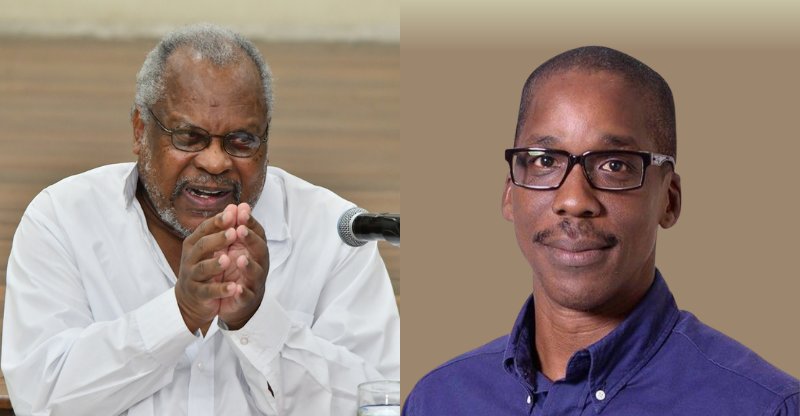
The DLP’s new leadership has drawn sharply contrasting assessments from two leading political analysts, with Peter Wickham calling the election a “shocking” failure to read voters after three successive 30–0 defeats, while Dr George Belle said president Dr David Estwick must now prove he can unite and stabilise the party.
The medical doctor and former Cabinet minister secured a decisive victory over the weekend, but his elevation has reignited debate over whether the DLP is relying too heavily on established figures at a time when it needs renewal, younger talent and a clearer route back to electoral relevance.
Noted pollster Wickham warned that the party had plunged into a severe crisis by retaining its “old guard” leadership rather than embracing long-overdue reform. He said the contest exposed a stubborn refusal by the DLP executive to modernise or listen to signals voters have sent over the last decade.
“I was shocked, but the truth is my surprise started when the nomination was made,” he said. “It was glaringly obvious that two of the old guard contenders were going up against each other, and the obvious person that should have been included was Ryan Walters, who is for all intents and purposes the political leader of the party. He’s the only one with a parliamentary presence, and he was not included.”
Widespread speculation had tilted towards a decisive break from the past. Instead, the return of familiar figures to key posts has left many commentators on social media questioning whether the opposition party possesses the political will — or the vision — to rebuild its standing.
The decision to sideline younger, active representatives in favour of veteran figures who presided over previous electoral defeats has drawn criticism. For many observers, the leadership contest exposed a reluctance within the organisation to create space for fresh perspectives, even as public confidence in the traditional party structure continues to erode.
“It sends a signal that the Democratic Labour Party does not understand what the public has been saying to it,” Wickham said. “There’s this constant effort to go back to the old state and try to resurrect them. It was a shocking outcome… I’m surprised that the Democratic Labour Party can so easily miss a message that is being sent.”
But Dr Belle rejected the notion that experienced DLP members should simply be discarded. He argued that a dynamic political organisation needs continuity as well as recruitment and retirement.
“I don’t agree with any statement by people that they want to get rid of the old guard. A very dynamic political party has three elements in it: retention, recruitment, and retirement. Otherwise, it would be a dead party. You have to have retention because there must be continuity, a history of the party, and a culture. There must be recruitment to get fresh members who will provide vision for the future, and there will be retirement as part of the natural progression of human existence.”
Now, Dr Estwick faces an immediate test of whether he can reconcile competing factions and stabilise the opposition party after his decisive weekend election victory.
According to Dr Belle, Dr Estwick’s stated intention to heal internal rifts must now translate into action, arguing that a president who cannot unite the party cannot sustain effective leadership.
“He said his intent was to unite the party, and the success of any political leadership is to be able to unite.
“An effective leader will be able to do that. If he does not do that, he will not be an effective leader, and he will not be able to sustain his leadership. The only way to unify a party is to speak to its factions and bring them together. Right now he says: ‘I am elected decisively,’ and that’s a fact. It is now left for him to demonstrate what he said was his intent.”
The former minister in Stuart’s 2010-2018 administration won the DLP presidency amid renewed public debate over the influence of the party’s “old guard” and whether the organisation has created sufficient room for younger and emerging leaders.
Addressing whether the trend stems from a lack of emerging talent or an attachment to past eras, Wickham argued the problem stems from a combination of internal talent stagnation, misread election figures, and what he termed a persistent refusal by older politicians to accept electoral rejection.
“I feel it has a lot to do with a selfish determination by some of the older politicians to prove a point that we did not listen, not that they did not listen. They believe that these last years are a result of them not explaining and us not listening to their explanations, as opposed to a situation where we simply reject the medicine.”
He noted that modest vote counts achieved by certain individual candidates in recent constituency races were being mistakenly interpreted by party insiders as evidence of a comeback. According to Wickham, using localised figures to justify bringing back the old guard represents a fundamental misreading of the national political climate.
“It’s a complete misunderstanding of the overall tone of elections and the messages that are being sent at that level,” he added. “One of the best ways to attract new talent is to demonstrate that there are vacancies. If the Democratic Labour Party demonstrated a willingness to clear the decks and to open up, I think that we may very well have a situation where more young people may come up.”
Dr Belle said recruitment of younger members would follow if Estwick succeeds in restoring organisation and unity, rather than through a stand-alone appeal to youth.
“If you unify the party, you will have recruitment, and it is necessary that young people will be a part of that recruitment. The DLP has not been stabilised up to this point. All the people that have been leaders before have not been able to stabilise it. If he can stabilise it, then the party, having been stabilised, would be able to engage the mass electorate, and that is when the test of whether the party has recovered will be made.”
The decision by notable figures, such as Senator Ryan Walters and General Secretary Corey Greenidge, not to contest the top presidential post was also highlighted as tactical. Rather than entering a contest dominated by retrogressive dynamics, Wickham suggested that rising figures chose to distance themselves from a flawed process to protect their long-term credibility.
“My expectation and my hope is that they have both opted to stay out of a presidential race because they were concerned that they could legitimise what was a clearly flawed strategy.
“Once you get into a race and you think the strategy is flawed, you legitimise that race by participating, and then if per chance you lose, your credibility has been even further impacted. I think that they’ve both correctly read that this was not a serious race.”
The party conference featured appearances by former Prime Minister Freundel Stuart and former political leader Ralph Thorne. Dr Belle pushed back on the notion that their attendance carried negative symbolic weight for the party’s future.
“I see nothing unusual or spectacular or significant about that,” Dr Belle said regarding Stuart’s appearance. “He is a member of the Democratic Labour Party, he is a former prime minister, and he attends the annual conference. That is simple and straightforward. You operate on a scientific basis of engaging the issue… A prominent member in the history of the DLP was at the conference. That’s all that is saying.”
The turmoil comes at a delicate moment for the DLP, which has struggled to retain the interest of younger voters. While recent years saw brief surges in youth engagement – particularly during transitional periods involving figures such as former president Dr Ronnie Yearwood – recent leadership reshuffles and internal disputes appear to have derailed that momentum.
Wickham warned that the continued dominance of the older faction threatens to permanently alienate a generation of voters who demand modern solutions, active engagement and forward-looking governance.
“Young people are attracted most of all to success and opportunities, and the DLP doesn’t appear to be presenting either. A lot of the young faces seem to have gone… and the last election platform was noticeable for the lack of young talent. It is a clear sign, and it’s not a good one because the party needs young people to grow.”
As social media reaction across Barbados reflects growing frustration with the opposition party’s trajectory, Wickham suggested that the DLP faces an uphill battle to regain public trust before the next general election. Without a deliberate effort to clear the decks and empower new leadership, the party risks cementing its status as a legacy institution unable to adapt to modern realities, he said.
“If you look at social media, you’ve not seen any comments suggesting that anybody thinks this is a good idea, young and old people together,” Wickham said.
“The conversation has moved on from there, and I think that the plot has been lost.”
(RR)