Before the war, Dmytro was not a believer. This 30-year-old Ukrainian soldier knew nothing about religion except for the prayers his grandmother used to recite to him as a child. Faith struck him suddenly, one morning in January 2023. The young man, who had volunteered after the Russian invasion of February 24, 2022, was in Toretsk, in the Donetsk region, where fierce fighting was raging. He was repairing artillery parts with his battalion when a barrage of missiles rained down on the city. “I threw myself to the ground and tried to find somewhere to hide,” he recalled. “I was so scared that I started begging God to let me stay alive. My grandmother’s prayers came flooding back to me all at once.”

The danger has since grown even worse: Russian kamikaze drones now sweep the front line up to 30 kilometers deep behind Ukrainian positions. This expansion of what Ukrainians call the “death zone” has led to the appearance, here and there, of anti-drone nets, like fragile cages lining the roadside. Today, Dmytro prayed every time he drives toward Kostiantynivka and Chasiv Yar, where his unit was deployed. “You feel so powerless that you put yourself in God’s hands.”
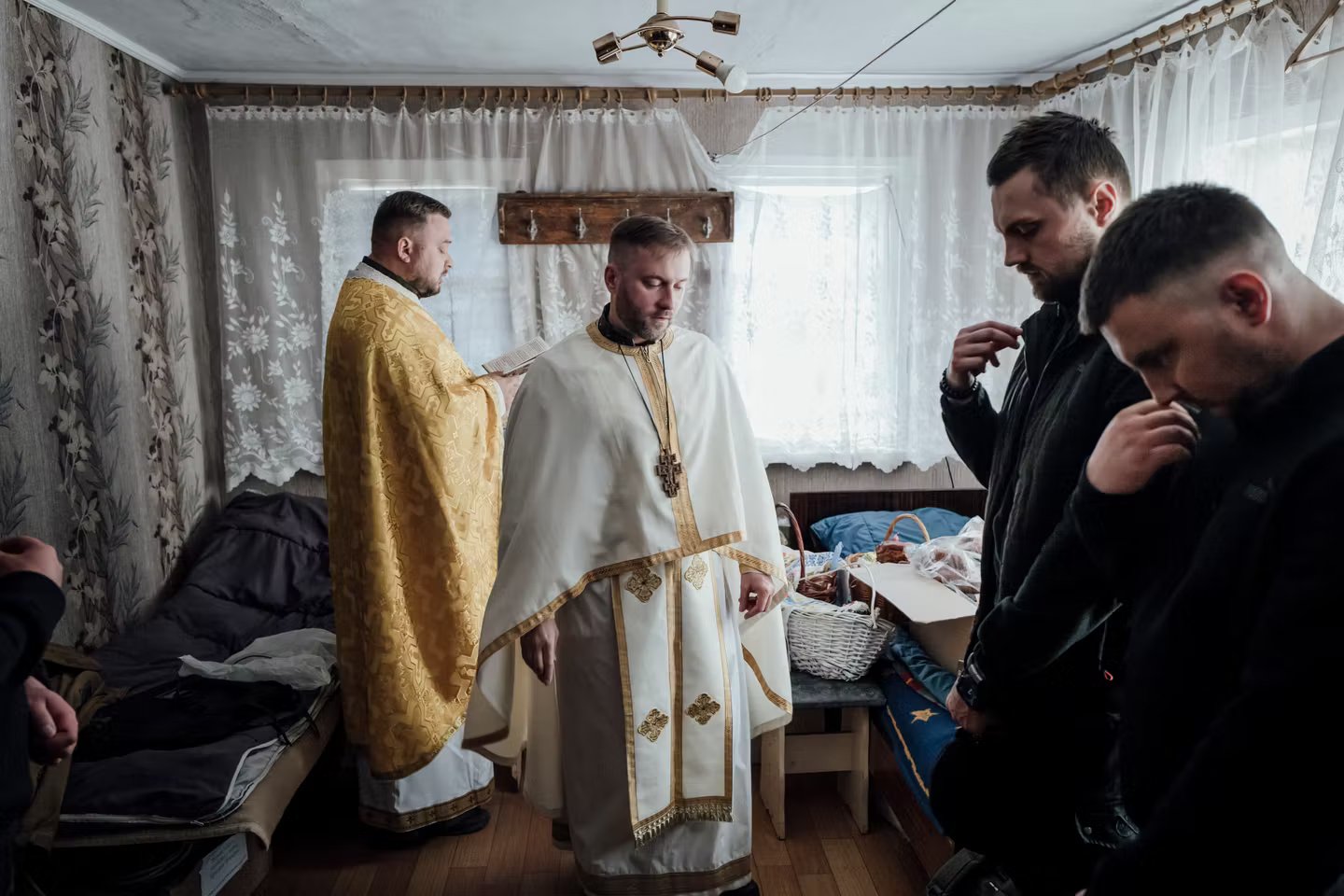
On the morning of April 12, Orthodox Easter, the soldier attended mass with around 20 fellow servicemembers. Two military chaplains held the service in a house in a village located several dozen kilometers from Kramatorsk, in the Donetsk region. The name of the village was not disclosed for security reasons. Between missions, the soldiers from this unit stayed there, 35 kilometers from the front line, in homes largely abandoned by civilians.
You have 83.8% of this article left to read. The rest is for subscribers only.