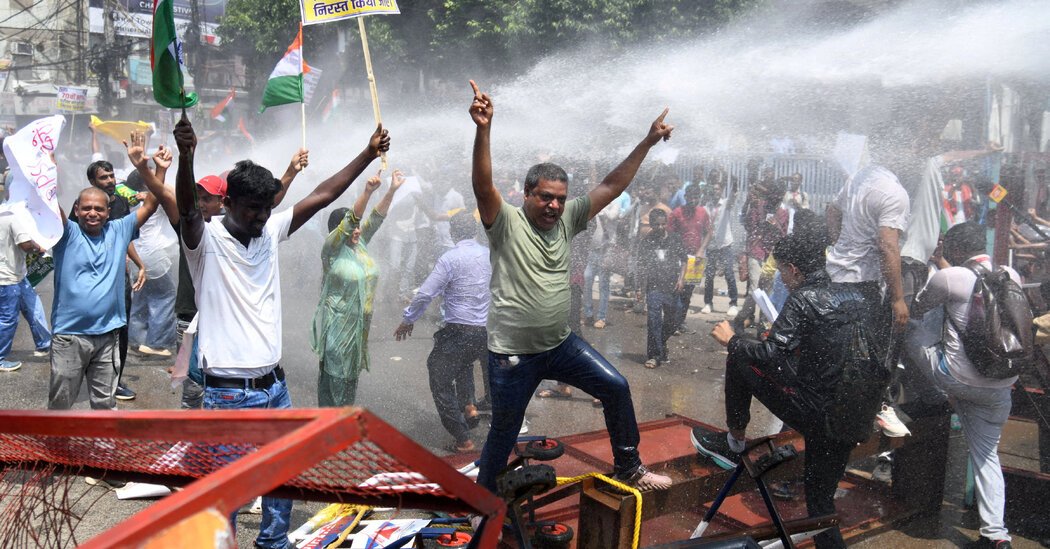
India’s long, hot summer of youth unrest shows no sign of cooling off, with protesters undeterred by monsoon rains or police crackdowns.
The police trained water cannons on crowds in the city of Patna on Tuesday, 600 miles east of New Delhi, the capital, as protesters tried to storm the office of the chief minister, the top elected official in the state. The protesters were condemning irregularities in a civil service-entrance exam and demanding reforms of the testing system. Similar protests and clashes have gripped the nearby state of Jharkhand in recent weeks.
At the same time, the organizers of this summer’s high-profile protests over education in India’s capital have vowed to return to the streets. They had declared victory after the resignation of India’s education minister, but are now accusing the government of failing to deliver on promises made to protesters to end the nationwide uprising.
Across the country, India’s youth are expressing intense disillusionment with their education and the bleak opportunities ahead. A government report released this week showed that only about 8 percent of college graduates find jobs that make use of their degrees.
State and national authorities are simultaneously promising concessions and cracking down. Protests that peaked in New Delhi last month taking aim at Prime Minister Narendra Modi have spread to other states, including some governed by India’s other parties.
The protesters in Patna, the capital of the state of Bihar, have spent weeks raising slogans against a complicated local array of government exams and recruitment programs.
The thrust of their demands match the frustrations over education and jobs that have been spreading since the start of this summer.
Abhijeet Dipke, the graduate student who started the Cockroach Janta Party, the group that led the earlier protests, has taken to the road with a “Fix Schools” campaign to assess and improve the physical condition of India’s elementary classrooms.
His remarkable, grass-roots protest movement, started as satire, reached its high point last month when it forced the resignation of India’s education minister, whom it blamed for botched standardized testing. Hours later, after securing several related commitments from Mr. Modi’s government, the group called off its protests.
On Monday, it threatened to restart them.
“On July 25, solemn promises were made,” the C.J.P. told its 26 million followers on Instagram. But those promises have not been kept, it said, and so “we have been forced to return to the streets.”
The education minister’s ouster was an astonishing victory for the C.J.P. No one else during Mr. Modi’s 12 years in power had succeeded in pressuring him to ditch a member of his cabinet.
The government made other concessions. It agreed to pay compensation to the families of students who died by suicide after the leak of a medical college-entrance exam; to withdraw police cases against protesters; and to discuss a five-point charter on broader exam and education overhauls.
In the weeks since, the movement leaders’ doubts have grown over the government’s sincerity. Protesters said the criminal cases that were supposed to be dismissed have lingered, and there has been little movement on reforming the education system.
The group has cried foul, and on Sept. 5, India’s Teacher’s Day, they plan to lead a peaceful march from the India Gate monument, near the center of New Delhi, to the city’s police headquarters. That risks another confrontation with security forces, who fired pellets and used batons and tear gas to disperse a similar march in July.
Putting a date on it sets high stakes. If protesters can be reassembled in large numbers, that will pile more pressure on Mr. Modi’s government. Failing to do so would suggest the C.J.P. has lost momentum.
“I would like to see the specific demands they have from the government,” before deciding whether to participate, said Akash Saxena, who works in education and mental health in Delhi and marched with the students in July.
The police are at the heart of the movement’s revived complaints. Of the agreements the Cockroach Party’s leadership struck with the government, preventing the prosecution of protesters who marched in July was foremost. The police told the Supreme Court last week in an affidavit that the protests were “hijacked by antisocial elements.”
It has proved difficult to keep track of the criminal indictments that police have filed against the protesters in the capital and in states governed by allies of Mr. Modi. The C.J.P. has asked the Supreme Court to consolidate a list. The government has refused to provide any written guarantee, arguing that it cannot interfere with charges already being considered by the courts.
The demand for compensation for the families of 21 students they say committed suicide after their exam results were canceled was also a key win for the Cockroach Party’s leaders.
But Mr. Dipke has said that none of the bereaved families in his home state of Maharashtra had received the $104,000 he said each was promised. Instead, he said, officials told him they needed to “look into the rules and norms.”
The march from India Gate is intended to show their determination.
Showkat Nanda contributed reporting.