Prime Minister Mia Mottley has urged Caribbean people to guard against the “enslavement of human minds” and embrace self-love, knowledge of their history and stronger communities.
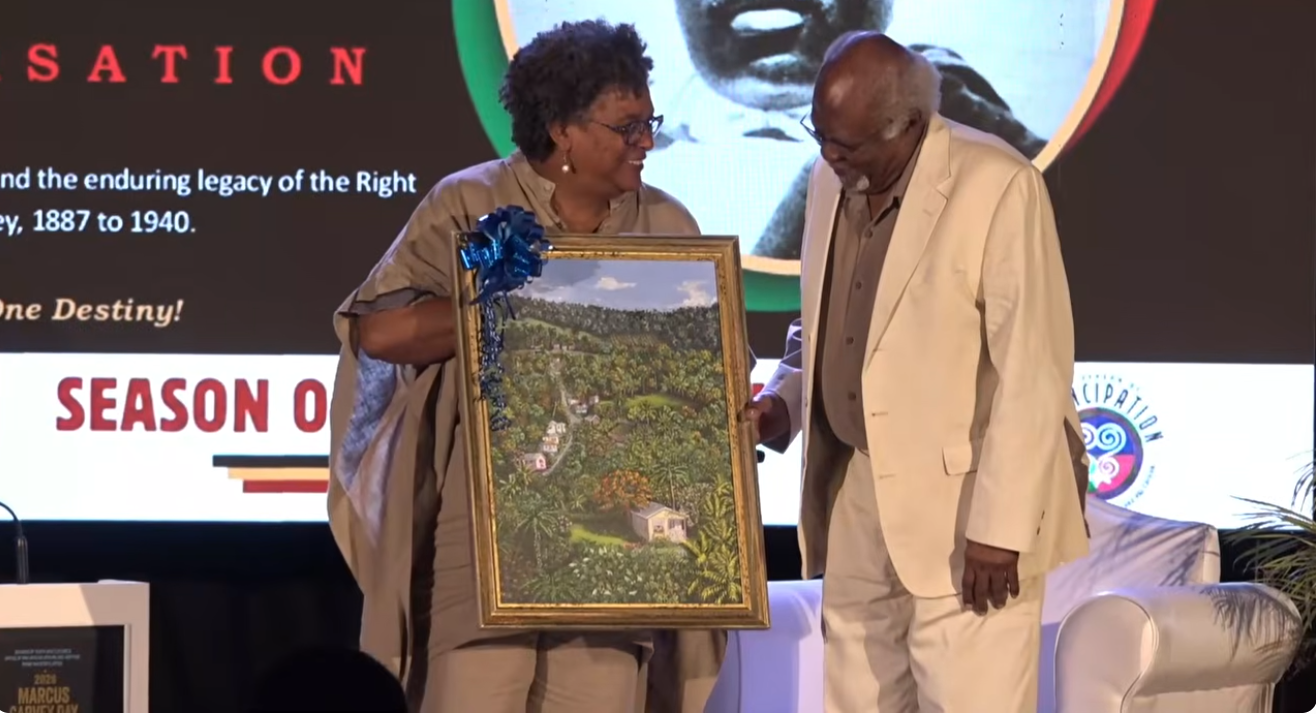
Speaking at the Queen’s Park Steel Shed during the Marcus Garvey Legacy Conversation with Dr Julius Garvey, son of Jamaican National Hero Marcus Garvey, Mottley reflected on the venue’s history while calling for greater mental strength, self-repair and stronger ties with Africa.
The Prime Minister recalled that colonial authorities had once sought to prevent Garvey from entering Barbados, fearing the impact of his message.
“The colonial authorities refused your father the right to travel to Barbados,” Mottley told Dr Garvey. “Mercifully, the uprising of 1937 clearly made them understand that something had to give.”
She said Garvey’s eventual address at the Queen’s Park Steel Shed, which focused on intelligence versus ignorance, influenced the thinking of subsequent generations of Barbadian leaders.
Mottley expressed concern about the challenges confronting the region’s young people, warning that contemporary threats were less about physical chains and increasingly about influences on how people think.
“I fear that our young people are in danger of walking open-eyed to captivity yet again,” she said. “And this time, the captivity is not the enslavement of human bodies, but it is truly the enslavement of human minds.”
She argued that modern technology and media were making it increasingly difficult to distinguish truth from misinformation and stressed the importance of grounding young people in self-respect, community and the African philosophy of Ubuntu: “I am because we are.”
“The most popular Caribbean artists never sang about pulling a gun globally,” Mottley said. “The most popular Caribbean artists told us about emancipating ourselves from mental slavery. The most popular Caribbean artists never denigrated women as sexual objects.”
The Prime Minister also reaffirmed her government’s commitment to what she described as self-repair, pointing to universal adult suffrage, free public education and land redistribution under the Tenantries Freehold Purchase Act as steps in Barbados’ journey of empowerment.
She said curriculum reform would also focus on responsibility to self, family, community and country.
Mottley praised the Rastafarian movement for preserving Pan-African ideals and promoting self-reliance despite historically being marginalised.
“Your persistence ensured that you were able to deal with other generations of Caribbean people who have come to see the light,” she said, adding that the country needed to address the historical treatment of Rastafarians as outcasts.
Looking towards upcoming national milestones, including the commemoration of 400 years of settlement in Bridgetown and Speightstown, Mottley argued that promoting Pan-African identity and self-love should not be viewed as divisive.
“To assert self-love is not to advocate hate,” she said. “I can only look in the mirror and love the rest of the world if when I look in the mirror, I love myself and I’m prepared to repair myself.
“Difficult conversations must come and will come, but they will not and must never be rooted in hate, but in self-love and self-repair.”
Mottley urged Barbadians to see themselves as participants in an ongoing struggle for freedom, with a responsibility to pass its gains to future generations.
(RR)