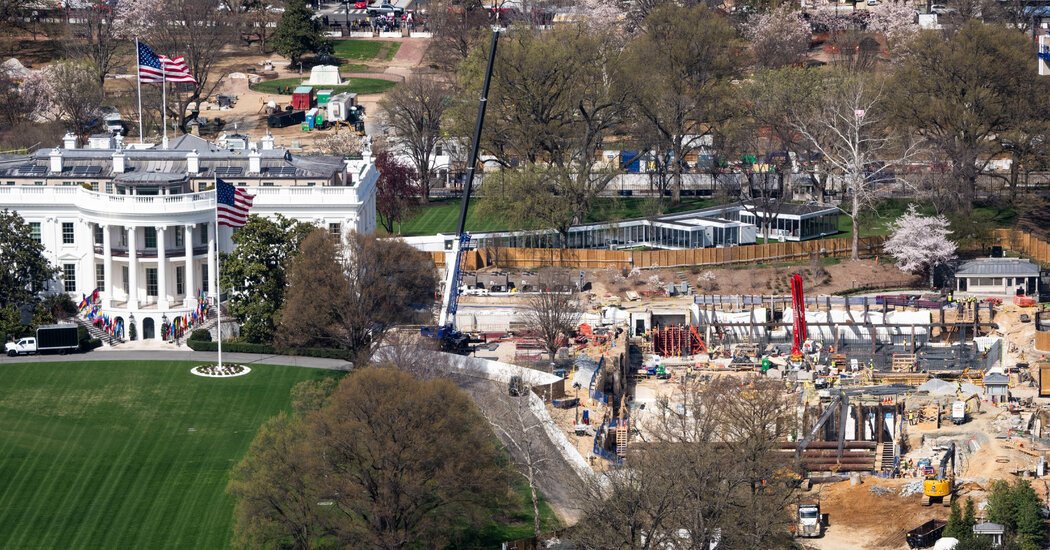
The Supreme Court on Friday temporarily allowed President Trump to continue construction of a luxury White House ballroom to replace the East Wing he demolished last fall.
In a one-sentence order, Chief Justice John G. Roberts Jr., acting on his own, issued a placeholder that gives all nine justices additional time to more fully consider whether construction of the planned 90,000-square-foot ballroom can proceed.
The chief justice’s order did not provide a timeline for when the court would act next, stating only that a lower-court ruling against the Trump administration was paused “pending further order of the undersigned or of the court.”
Lower court judges had ruled that Mr. Trump exceeded his authority by moving ahead with the construction without approval from Congress. Even so, they had allowed the project to continue in recent months while litigation was underway.
Mr. Trump first promoted the ballroom, estimated to cost $400 million, as a much-needed expansion to properly host visiting dignitaries who have been relegated to tents outdoors because of the lack of such space — a version of the ballroom he built at his Mar-a-Lago estate in Florida but more than four times larger.
But the project has grown in size and scale. In recent months, the president and his legal team have pivoted to emphasize what they say is the national security imperative. They now say upgrading a secure military bunker beneath, built during World War II, is integral to the ballroom project.
When the administration asked the justices to intervene last week, the president referred to the project on social media as the “Military Complex.” Mr. Trump had posted about the ballroom several times on social media on Friday before the order was issued. He celebrated the outcome and praised the court.
“The Military/Ballroom Complex being built on the hallowed grounds of the White House, which is so vital for National Security, will be THE GREATEST OF ITS KIND!” the president posted on Truth Social. “It is something that Presidents have wanted for 150 years, and that the Military has been seeking for the last 100 years. Their wish will soon be fulfilled!”
The president’s lawyers have submitted sworn statements to the Supreme Court from top national security officials, including Dan Caine, chairman of the Joint Chiefs of Staff, and Jay Clayton, director of national intelligence. They warned that halting the construction would put the president and his family at risk and said the renovations were urgently needed to protect against possible attacks.
As of Aug. 14, D. John Sauer, the solicitor general, said the project was 65 percent complete and that it was essentially too late to turn back.
The temporary order from Chief Justice Roberts came two weeks after a three-judge appeals court panel in Washington issued a lengthy 2-to-1 ruling that said Congress had not “ceded unfettered authority to the executive branch to dramatically redesign, reshape and reconstruct the White House — the People’s House — to fit a particular president’s desires.”
But the U.S. Court of Appeals for the District of Columbia Circuit had agreed to pause its order until Friday, and construction has continued in the interim.
The challenge to the project was brought by the National Trust for Historic Preservation in the United States, a nonprofit chartered by Congress to guard public buildings. The group said the president had resisted oversight in violation of the Constitution and federal law, which gave Congress the power to decide which structures can be built on federal property in Washington.
In a statement on Friday, the organization said of the Supreme Court’s order: “To be clear, this is not a final decision on the merits of the government’s stay application, and we await further action.”