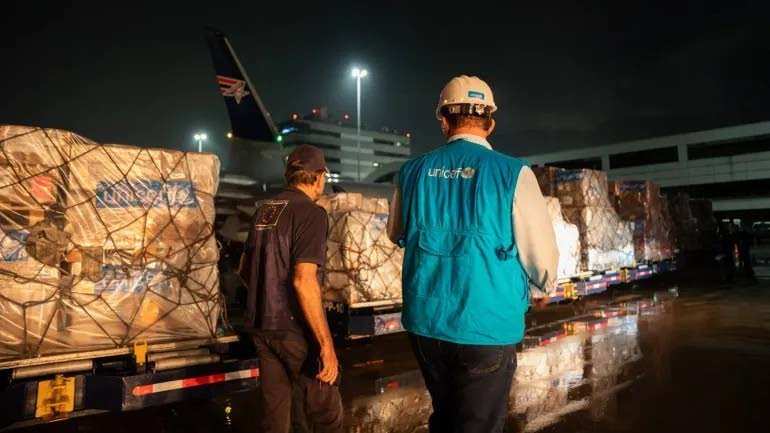
The United Nations Children’s Fund (UNICEF) says the European Union (EU) in 2026 has allocated US$19.9 million to support vulnerable children and families across Latin America and the Caribbean (LAC) through programmes focused on disaster preparedness, education, child protection and assistance for the most vulnerable children, including refugee and migrant populations.
UNICEF said on Tuesday that the EU funding includes funds dedicated to strengthening preparedness and resilience in Indigenous communities across the Amazon basin, as well as support for refugee and migrant children and families in transit in Bolivia, Brazil, Chile, the Dominican Republic, Peru and Trinidad and Tobago.
UNICEF said the funding will also help expand education and child protection services for vulnerable children and adolescents in Costa Rica, Guatemala and Honduras.
Additionally, UNICEF said EU funding supported national projects across the region, including efforts to strengthen child protection and education continuity for children affected by, or at risk from, conflict, armed violence, and other emergencies in Ecuador and Colombia; and deliver integrated child protection and education in emergencies services to the most vulnerable in Haiti.
In Venezuela, UNICEF said EU humanitarian funding has supported, and will continue to support, UNICEF’s earthquake response, providing life-saving assistance to affected children and families while helping to strengthen community resilience and recovery.
“At a time when climate-related hazards, displacement and humanitarian needs continue across the region, this contribution will help ensure that vulnerable children are better protected, prepared and able to access essential services when they need them most,” UNICEF said.
Roberto Benes, UNICEF Regional Director for Latin America and the Caribbean, said, “preparedness and timely action are essential to protecting children in a region increasingly affected by climate-related emergencies, displacement and other complex crises.
“Thanks to the European Union’s continued support, UNICEF and its partners will be better equipped to help vulnerable children and families anticipate risks, strengthen resilience and access life-saving services when emergencies strike,” he added.
Luigi Pandolfi, Head of EU Humanitarian Aid in Latin America and the Caribbean, said that “the EU continues its commitment to support effective and efficient humanitarian actions in Latin America, anticipating the impact of shocks and building resilience for vulnerable children via our long term and solid partnership with UNICEF.”
As countries observed World Humanitarian Day on Wednesday, UNICEF said it and the EU “continue to work together to protect children’s rights and provide life-saving assistance to the most vulnerable children and families across Latin America and the Caribbean, while strengthening communities’ preparedness capacity.”
UNICEF said many children and families remain exposed to significant protection risks, including exploitation, trafficking and violence along migration routes.
Through US$3.2 million, UNICEF said it will support vulnerable children and families on the move through integrated child protection, education and essential services, while strengthening national systems, coordination mechanisms and cross-border responses in Bolivia, Brazil, Chile, the Dominican Republic, Peru, and Trinidad and Tobago.
Since 2024, UNICEF said EU funding has enabled UNICEF to strengthen humanitarian responses in child protection, education and essential services, reaching more than 132,000 refugees, migrants and stateless people across the region. —PANAMA CITY, Panama (CMC)