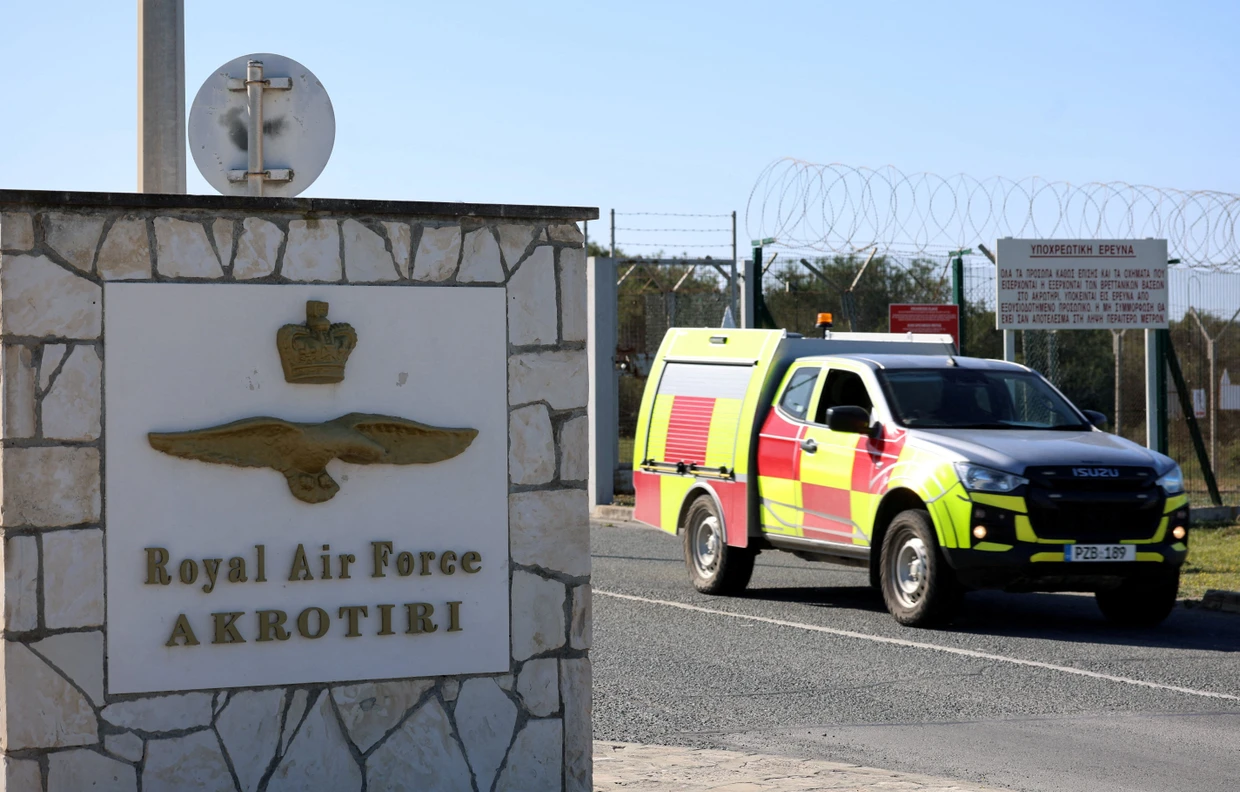
At the beginning of March there was excitement in Cyprus. In the middle of the night, an Iranian-made kamikaze drone hit the island. It was launched from Lebanon. The Tehran-allied terrorist organization Hezbollah probably wanted to retaliate for the American-Israeli attack on Iran that had begun two days earlier. Their destination: the British air force base Akrotiri, only around 400 kilometers away.
Three days later, Greek warplanes intercepted two more drones traveling from Lebanon toward Cyprus. The international airport in Larnaca was closed. On March 24, a ballistic missile was launched over Lebanon, again targeting Cyprus. The US used Akrotiri to attack Iran, the Revolutionary Guard said, making the air base a legitimate target.
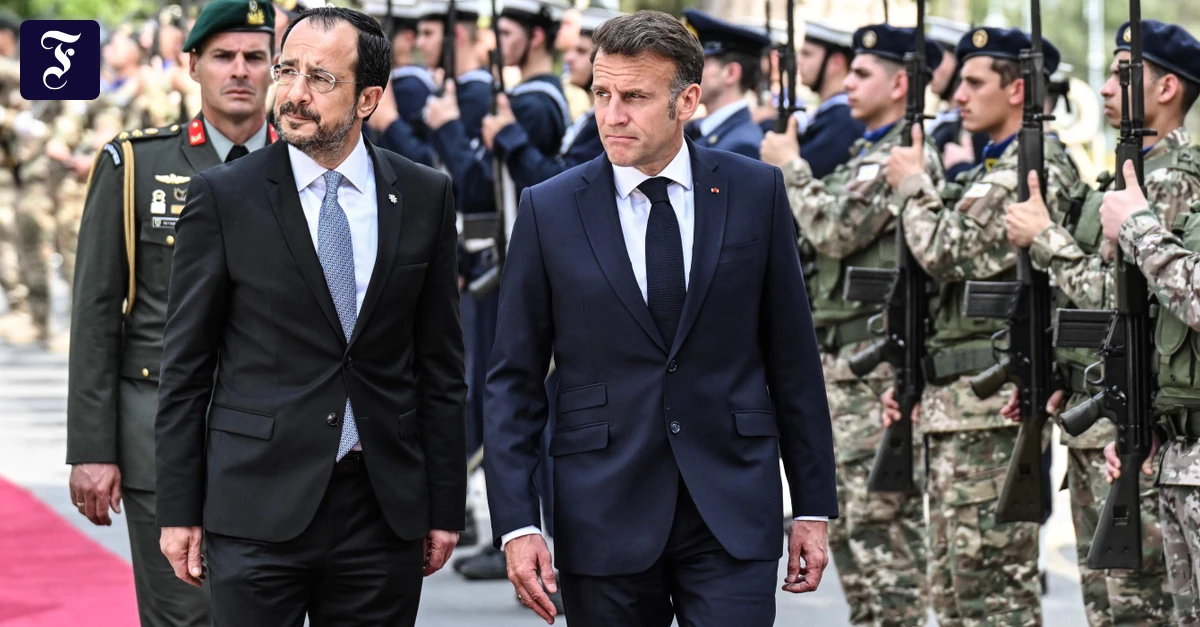
That wasn’t true. Nicosia and London immediately made it clear that there was no such permission for Washington. Cypriot President Nikos Christodoulides did not want to be drawn into the war. At the same time he had to realize how defenseless his country was. It was never able to join NATO because of the territorial conflict with Turkey. The conservative politician considered asking the EU for help. As Article 42.7 of the Lisbon Treaty provides: “In the event of an armed attack on the territory of a Member State, the other Member States owe it all the assistance and assistance in their power.”
“We don’t know what will happen if a Member State triggers Article 42.7”
Christodoulides began consultations after the first attack and spoke with Council President António Costa and Commission President Ursula von der Leyen. His country had tested the article, he reported in Brussels in mid-March. But the result was unsatisfactory: no one could tell him exactly how the promised support would be organized. Finally, the article does not provide for a procedure or a role for the EU institutions.
Cyprus then received bilateral aid, primarily from France and Greece. Christodoulides summed up the dilemma in these words to the AP news agency on Wednesday: “We have Article 42.7 and we don’t know what will happen if a Member State triggers this article.”
That is why the heads of state and government of the European Union should deal with it for the first time on Thursday evening. Christodoulides wanted to raise the issue at the informal European Council dinner at the Ayia Napa marina in southeastern Cyprus. “So we will have a discussion and develop an operational plan on what should happen in the event of a Member State triggering this article,” the host said.
The fact that the topic is currently generating great interest is not just due to small Cyprus. The island is a special case – of the other 26 member states, 23 are in NATO. However, they can no longer be sure whether the alliance will still provide them with protection after US President Donald Trump threatened to withdraw his country.
EU foreign policy chief Kallas should work out three scenarios
When Trump claimed Greenland in January and did not rule out military force, the question even arose as to how the Europeans would react if one of their countries were attacked by the United States. Denmark raised the question of whether an attack on its autonomous territory in the Arctic was covered by Article 42.7. After some back and forth, the EU Commission confirmed this. So could the article be a kind of Plan B if NATO and its promise of assistance in Article 5 of the North Atlantic Treaty can no longer be relied on?
This question was also discussed by the heads of state and government on Thursday. EU foreign policy chief Kaja Kallas should make suggestions on how Article 42.7 could be implemented in practice. According to FAZ information, the Estonian wanted to focus on three possible scenarios. First, a hybrid attack that falls below the threshold of “armed aggression” that is the standard for triggering Article 5. Secondly, if the mutual assistance clauses in the NATO and EU treaties are activated in parallel. And thirdly, when a country like Cyprus, which is not part of the alliance, is attacked.
In each of these scenarios, it is necessary to clarify how Article 42.7 will be invoked and implemented. In NATO, in the case of Article 5, this is the task of the North Atlantic Council. Only they can determine – by consensus – that an attack on one or more states is seen as an attack on the entire alliance. Then each country decides for itself what measures it deems necessary, including the use of armed force. Of course, if the worst comes to the worst, the alliance has troops on high alert, sophisticated defense plans and joint command staff to carry them out. There is nothing like this in the EU.
So far, the European assistance clause has only been activated once – after the terrorist attacks in Paris in November 2015. At the time, the French government turned to the Council of Foreign Ministers, which promised full support. However, the respective contributions were coordinated bilaterally with Paris: some states supported the air strikes on the “Islamic State” in Syria, others relieved France by becoming more involved in Mali.
The EU military staff has only 120 employees
The foreign affairs representative would also like to have the other two scenarios played out in the PSK. Your goal would be a kind of manual for emergencies. The implementation of Article 42.7 could be anchored in the European Security Strategy that Kallas and von der Leyen are working on. However, there is also a lot of skepticism among government leaders. The larger states have efficient leadership structures, while the EU’s military planning and execution staff has just 120 employees. When it came to Ukraine and the Strait of Hormuz, coalitions of willing people formed who could rely on national headquarters. The Eastern Europeans in particular do not want to send the signal that they are weakening NATO on their own.
The debate is also being pushed forward in the European People’s Party (EPP), to which most heads of government belong. The Prime Ministers of Greece and Finland, Kyriakos Mitsotakis and Petteri Orpo, are expected to present a position paper on the EU mutual assistance clause by the next regular European Council in June. “For me it is about the efficient coordination of aid for an attacked member state, not about the bureaucratization of the structures,” says EPP party leader Manfred Weber to the FAZ. The CSU politician can imagine “that a European Security Council, which not only includes EU states, but also the United Kingdom and Norway, will be set up and play a role in this.” The signal should be: “We stand together in Europe.”