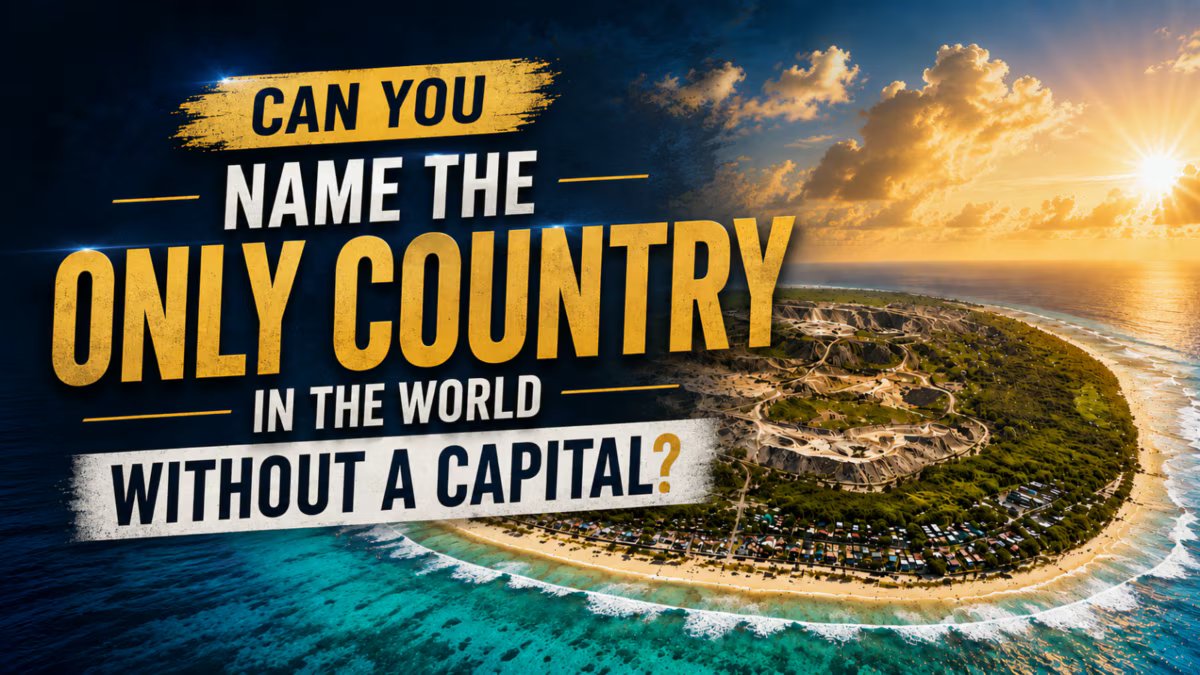
Located in the Pacific Ocean, northeast of Australia, Nauru is a tiny island nation and is widely described as the world’s only sovereign state without an official capital. Government offices and the country’s parliament are located in the Yaren District, but Yaren has never been formally declared Nauru’s capital. (Image-AI)
According to reports, Nauru covers just around 21 square kilometres, making it the world’s third-smallest country by area after Vatican City and Monaco. Its population is also relatively small, with roughly 10,000 people living on the island. Because of its limited land area, most settlements are concentrated around the coastal region.
Nauru was once among the world’s wealthiest nations. The island had vast deposits of phosphate, formed over thousands of years from accumulated bird droppings. Phosphate became a highly valuable export because it is used in the production of fertilisers and other industrial products. For decades, Nauru made enormous amounts of money by mining and exporting phosphate. At one point in the 1960s, its per-capita income was among the highest in the world.
Add News18 as
Preferred Source on Google
However, extensive mining came at a high environmental cost. A large portion of Nauru’s land was severely degraded, leaving much of the interior rocky and unsuitable for farming or habitation. As phosphate reserves declined, the country’s economy also suffered a major setback.
With limited land suitable for agriculture, Nauru became heavily dependent on imported food. The traditional diet, which included locally available fish and fresh produce, was increasingly replaced by imported, processed and packaged foods. This shift has also been linked to serious health concerns. Nauru has one of the world’s highest rates of obesity and diabetes, with a large majority of its adult population affected by overweight or obesity.
The tiny island nation also relies on external support and income sources, including arrangements with Australia related to its offshore refugee processing system.
Despite its small size, Nauru’s unusual history makes it one of the most fascinating countries in the world, from having no official capital to becoming wealthy through phosphate mining and later facing the environmental and economic consequences of its dependence on the resource.