
Listen to this article
Estimated 5 minutes
The audio version of this article is generated by AI-based technology. Mispronunciations can occur. We are working with our partners to continually review and improve the results.
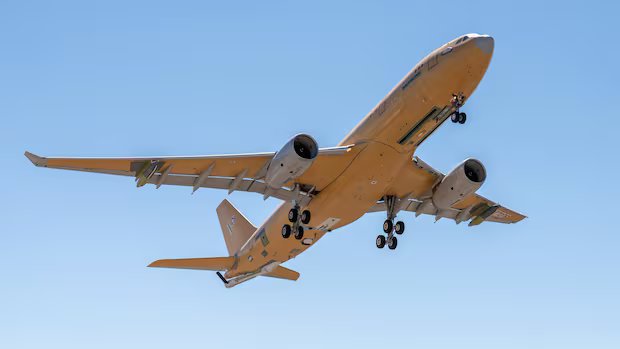
Canada’s air force will have to wait until the end of next year before it receives the first of four new air tankers critical to refuelling fighter jets in the Arctic.
The Royal Canadian Air Force (RCAF) has for the first time outlined the state of the CC-330 Husky fleet purchased to replace its aging Airbus 310s.
The wide-body jets are the backbone of the air force’s intercontinental fleet, flying troops and the prime minister around the globe.
But it’s their role as flying gas stations that matters so much as Canada looks to boost continental defence.
A spokesperson for the Department of National Defence said in a statement to CBC News that the first new aircraft will be “delivered to the RCAF in late 2027.”
In July 2023, Canada purchased nine Airbus A330s for approximately $3.6 billion — five used jets, which saw less than 10 years’ service with Kuwait Airways, and four brand new planes.
Until now, the department had not disclosed how many of the new aircraft would be delivered by next year.
3 used jets delivered
So far, three of the used Airbus planes have arrived, in their original airline configuration.
They are being used to transport passengers, including the prime minister, around the world. However, one has already gone into a scheduled heavy maintenance at Mirabel Airport.
The fourth is in Switzerland getting a new interior and defence components, and the fifth is in Spain to be refitted as an air tanker.
The first new-build tanker is in testing in Spain, while the other three new builds are in production in Toulouse, France.

The RCAF’s fleet of CF-18s and soon its new F-35s need air tankers to stay on patrol over the Arctic. Fighter jets quickly burn through fuel, and frequently work with air tankers to extend the time and distance they can stay aloft.
This role was highlighted during the FIFA World Cup games in Toronto this summer.
One of the air force’s aging air tankers was able to help CF-18s stay aloft over the stadium for hours at a time.
Canada’s new tankers will have the boom and hoses necessary to refuel all NATO equipped aircraft.
The aircraft they are replacing lacked the large boom, essentially a long metal pipe, used primarily for aircraft designed for the U.S. Air Force including the C-17 cargo plane and the F-35.
Defences for PM’s new plane
There has been recent talk about threats to the aircraft of world leaders.
The air force confirms the new V-VIP Airbus, the used jet currently being refitted in Switzerland for use by the prime minister, will have a “self-protection suite” to help protect the aircraft from missile attack.
This system could include a system of lasers, flares and aluminum foil meant to confuse or defeat an incoming missile.
Much of the components from this system won’t be visible to the naked eye but there will be a few telltale bulges around the skin of the aircraft.
The air force expects plane spotters and foreign governments to take note of them, and what their capabilities may be.
In a statement to CBC News, the air force says initial operational capability for the CC-330 Husky fleet is planned for 2028-29, and full operational capability of all nine jets will follow by 2032-33.
Right now the jets are based in Ottawa, but new facilities are being built in Trenton, Ont., and Edmonton.
Old fleet in service until 2030
The RCAF’s fleet of five smaller Airbus A310s, also known as the CC-150 Polaris, started as Wardair passenger jets in the late 1980s.
The former Airbus 01, which served the last three prime ministers, is now a museum piece in Trenton.

Prime Minister Mark Carney announced Canada has entered negotiations to purchase the Saab GlobalEye early warning aircraft from Sweden rather than a competing Boeing model, as his government tries to reduce a reliance on U.S. military technology.
Another A310 was written off after a parking lot incident in 2023 in Guam.
The Canadian jet rolled back and collided with a nearby parked French cargo plane, seriously damaging both aircraft. A flight safety investigation found the parking brakes on the Airbus were only designed to hold for 12 hours, and after that period would give way.
The investigation board cited the lack of chocks being installed around the aircraft’s wheels, crew fatigue and checklist design as the factors that led to the incident. The report said no one was injured in the incident.
The remaining three aircraft will stay in service until 2030.