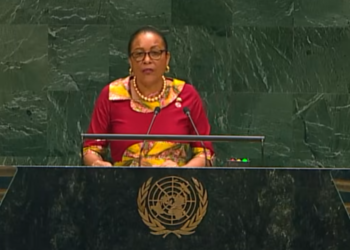

Opposition Leader Jesma Paul-Victor credited the government with achieving an overall Public Sector Investment Programme implementation rate of approximately 98 per cent, while highlighting significant disparities among individual ministries.
During her response to the national budget this week, Paul said the approved Public Sector Investment Programme (PSIP) allocation for 2025-2026 stood at approximately EC$661.66 million, while revised actual expenditure amounted to about EC$650.24 million.
She said this represented an implementation rate of approximately 98.3 per cent, allowing the Cabinet to claim it had substantially delivered on its overall capital investment programme.
However, Paul-Victor said the aggregate figure concealed significant differences between ministries.
She argued that while some portfolios demonstrated strong implementation, “others spent considerably less than their approved allocations, while two ministries exceeded their budgets.”
Furthermore, Paul-Victor said the variations raised concerns about “planning, project scheduling, procurement, expenditure forecasting and budget discipline.”
The Opposition Leader maintained that strong government performance should not simply mean high overall spending, but consistent execution across individual ministries.
Moreover, she singled out several government ministries for weak implementation of their capital budgets during the 2025-2026 fiscal year.
Presenting her own assessment during the parliamentary budget debate, Paul-Victor said the Ministry of Tourism recorded an execution rate of approximately 35.3 per cent.
She described this performance as particularly concerning given tourism’s importance to Dominica’s economy.
Paul-Victor placed the Ministry of Finance at approximately 26.2 per cent execution and said roughly EC$10.5 million in planned capital spending remained unspent.
Education was placed at approximately 21.7 per cent, with Paul-Victor saying, “less than one-quarter of approved capital investment had been delivered.”
National Security recorded the lowest figure cited by the Opposition Leader at approximately 17.3 per cent.
Paul-Victor said more than 82 per cent of the approved investment under that portfolio had not been implemented.
She argued that the disparities point to the need for improvements in project planning, procurement, forecasting and coordination across government.
Meanwhile, she credited the Office of the Prime Minister and the Ministry of Agriculture for strong implementation of their capital programmes during the last fiscal year.
According to the figures cited by the Opposition Leader, the Prime Minister’s portfolio recorded an execution rate of approximately 104.3 per cent.
She described this as a very strong implementation record, noting that “expenditure exceeded the approved allocation by approximately EC$15.3 million as major flagship projects progressed.”
The Ministry of Agriculture was also praised, recording approximately 95.1 per cent execution.
Paul-Victor said the relatively small variance between its allocation and expenditure suggested realistic planning and effective project management.
The Labour and Public Service Reform portfolio was placed at approximately 84.2 per cent.
Paul-Victor said while Cabinet achieved strong overall implementation of the Public Sector Investment Programme, individual ministry performance varied significantly.