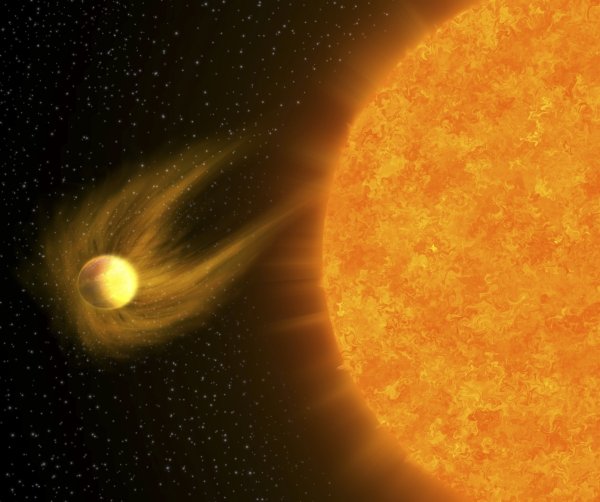
A star about 1,300 light-years from Earth shows signs of having devoured one of its planets — and is now gearing up for a second helping, according to a pair of new studies.
For many planets, it is their cosmic fate to one day become engulfed by their own stars, then slowly melted down into their constituent elements. This process, known as planetary engulfment, is destined to occur in our own solar system. When the sun balloons into its red giant phase in several billion years, it will envelop Mercury, Venus and perhaps even Earth.
For now, astronomers can see examples of planetary engulfment elsewhere because it leaves behind elemental hints that become imprinted in the star’s light, like cosmic cookie crumbs.
That’s what they saw for the hungry star named TOI-5882: It is glowing with the half-digested remains of what was likely once a planet. And that planet may have been flung to its fate by its neighbor, a celestial object called a brown dwarf that is orbiting the same star, according to a study in The Astrophysical Journal.
At 22 times the mass of Jupiter, the brown dwarf could easily disrupt the orbits of neighboring planets. But it will get its own comeuppance when it, too, is inevitably served up to its star, perhaps sooner than once expected.
TOI-5882, about 30% more massive than the Sun, attracted astronomers’ attention last year partly because of its orbiting brown dwarf. That huge object, known as TOI-5882-b, is very close to the star, orbiting it once every week, at a proximity that guarantees it will be engulfed in the future. But when astronomers took a closer look, they found that TOI-5882’s starlight revealed high amounts of lithium, an element far more abundant in planets than in stars. Had a planet already succumbed?
Scientists have spotted signs of lithium and other planetary ingredients in many stars, hinting that they may have eaten planets in the past. And TOI-5882 is at a “sweet spot” in its evolution that makes other explanations unlikely, according to Melinda Soares-Furtado, an assistant professor of astronomy and physics at the University of Wisconsin-Madison and an author on both studies. — BECKY FERREIRA
This article originally appeared in The New York Times.