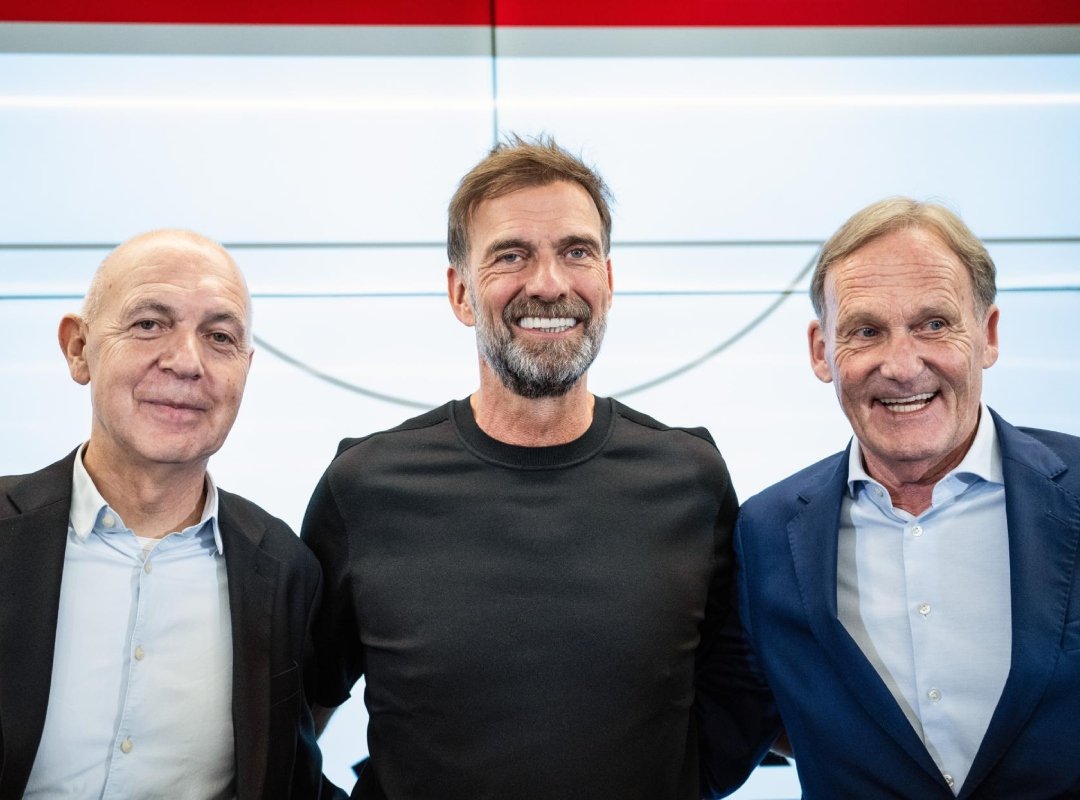
After a long and successful career at club level, Jurgen Klopp takes on a new challenge by becoming Germany coachfour-time world champion, something very different from those she had at Mainz, Borussia Dortmund and Liverpool, clubs where she built her prestige.
The task of a coach has notable differences from that of a club coach – although there have been those who perform remarkably in both subjects – something of which there has traditionally been awareness in Germany.
If you review the list of German coaches you find that Many of them had little experience before coming to office. or even none in clubs, according to EFE.
Of the four German world champion coaches, only one, Joachim Löw (2014), had previously had a career worthy of mention, although not excessively outstanding, as a club coach and had won the German Cup with Stuttgart in 1997, and had been Austrian champion with FC Tirol in 2002.
However, his arrival to the position of coach was not due to his career as a club coach, but to the fact that in 2006 he had been Jürgen Klinsmann’s second in the national team and was considered the right person to continue the project.
Of the other world champion coaches, Franz Beckenbauer (1990) did not even have a coaching title, Helmut Schön (1974) had been promoted after being second to Sepp Herberger (1954), who came from a time when there were no professional clubs in Germany.
Jurgen Klopp’s stamp
Unlike a club coach, a coach does not have his team together throughout the entire season. You cannot ‘sign’ either, but has to make do with what they give of themselves the players of the country they represent.
Klopp’s teams have largely been what can be called ‘signature teams’in which the coach’s seal was evident and that began with the creation of the squad, with players who were suitable to develop a specific script. In the case of Klopp’s teams, that had to do above all with high pressing and direct, fast football.
A coach, on the other hand, often has to adapt his script to the players he has at his disposal, which implies a certain degree of flexibility.
In favor of Klopp it must be said that in His teams have managed to produce the best version on many occasions. of some players from whom not much was expected and who only managed to show a high level under him. A much-mentioned case is that of the years of Marcel Schmelzer and Kevin Grosskreuz at Dortmund, where they went from the mediocre level they had had in their previous teams to being close to excellence.
Another case was that of Mats Hummels, whom Klopp brought to Dortmund to turn him into one of the best center backs in Germany after he had practically no prospects at Bayern, his original team.
The untapped potential
In that sense, it is possible that, as a coach, Klopp will try to discover players in whom he sees as yet untapped potential. We will have to wait for his first call to see if there are any surprises – which would be a risk – or if he prefers to get healthy and make a list within what is expected.
Another element in his favor is that there are many players who, under him, have had a performance that they had never had before and never had again. The list would be long, but we would have to start with Nuri Sahin and Mario Götze.
The first match, in the Nations League, will be against the Netherlands, on September 24. A match that in Germany is normally assumed to be a classic. There you can see the first touches of what could perhaps become a ‘Klopp era’ after his predecessors – Julian Nagelsmann and Hansi Flick – were no more than episodes, despite the successes they had previously had with their clubs.