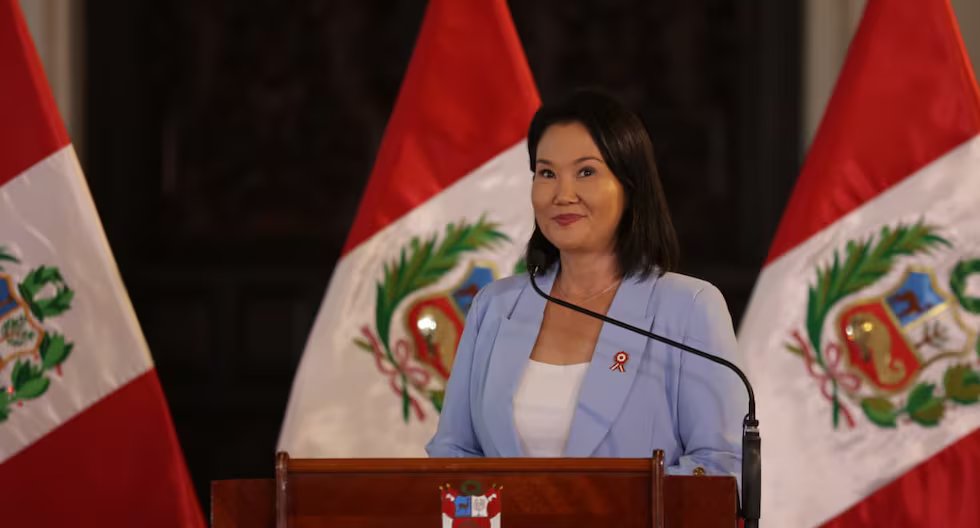

President Keiko Fujimori has launched the boldest challenge that an incoming president has posed in the last 25 years, based on her government’s fierce commitment to an ambitious demand for results and accountability.
He has done so in a forceful manner from the podium where he received his electoral credentials, almost completely saving us the suspense regarding what he will have to say upon his assumption of power, next Tuesday the 28th.
It is about imprinting a 180 degree turn on the presidency itself, on its Council of Ministers and on those who, without being from Fuerza Popular, want to be part of the government or want to remain as a vigilant opposition or as recalcitrant adversaries.
The challenge is threefold: to his own government and State leadership, which will immediately be measured in the leadership and performance of his ministerial cabinet; to the will to make the State not only function, but also to be strong in generating trust and authority; and to the construction of common political spaces, where disagreements can be aired, conflicts managed and reconciliations and consensuses can be achieved, without these being mere salutes to the flag.
Her first challenge will lead Fujimori to have to define, at every step, the democratic character of her leadership, as she herself wants and as circumstances demand: a strong democratic leadership, strictly subject to the law and the Constitution. The overused stereotype that there would be an authoritarian genetic incarnation in her does not withstand the slightest analysis. The truth is that a government can perfectly combine the principle of authority and the rule of law. The absence of this combination encourages the demand for dictatorships and authoritarianism when chaos devours us. The current Constitution is in itself a principle of authority and a guarantee of human rights. There is no way for someone who truly believes in it to become an autocrat.
Part of that first challenge, regarding her leadership, is her status as head of Government and head of State. It will be required, especially in the recovery of the lost institutions, a palpable demonstration that it is above the political organization of the country. In their sphere of influence, and not direct command, they are, with respect for the corresponding autonomies and jurisdictions, from Congress to the Comptroller’s Office, passing through the Judiciary, the Public Ministry and the Constitutional Court. She is not only the president and commander in chief of the Armed and Police Forces; She is also the leader and incarnation of the country.
The second challenge, that of making the State function and be as strong as it can, fundamentally compromises the Council of Ministers and the person who leads it: the Chief of Staff, also called “prime minister.”
While the question arises as to what will come in a short time in this executive body, there is one more question to know: what will be the response of Congress and the opposition to the olive branch firmly extended by the president-elect.
*El Comercio opens its pages to the exchange of ideas and reflections. In this plural framework, the Diario does not necessarily agree with the opinions of the columnists who sign them, although it always respects them.