
The Asia-Pacific Economic Cooperation Climate Center is expanding its role as an international cooperation hub for responding to the climate crisis.
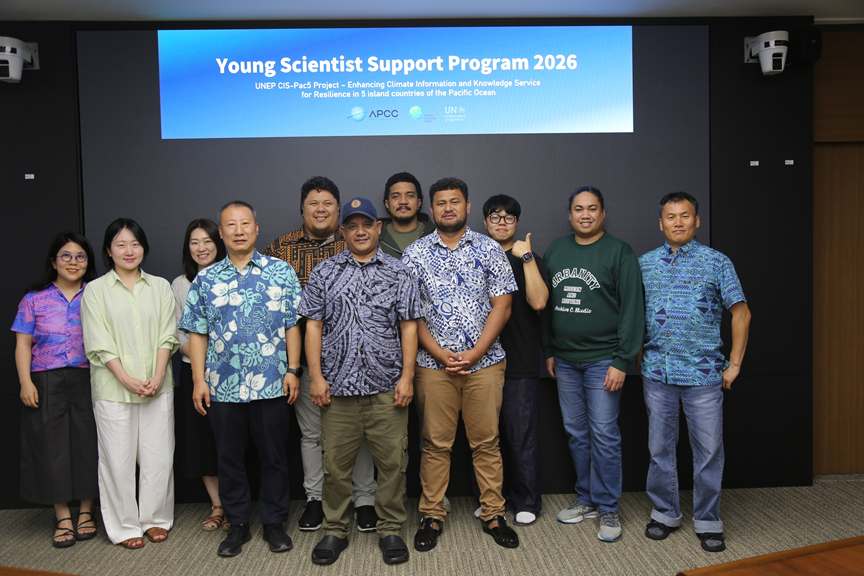
According to the Asia-Pacific Economic Cooperation Climate Center (APCC) on the 21st, the center invited five junior climate prediction officials from the meteorological agencies of five Pacific island nations — the Marshall Islands, Palau, the Cook Islands, Niue and Tuvalu — to the APCC in Haeundae, Busan, for the “2026 Pacific Island Nations Young Scientists Support Program,” held over 27 days from the 17th of last month to the 13th of this month.
The program is a core project of the “Enhancing Climate Information and Knowledge Services in Five Pacific Island Nations (UNEP CIS-Pac5),” promoted by the United Nations Environment Programme (UNEP) and supported by the Green Climate Fund (GCF). Going beyond the level of short-term training, it focuses on cultivating practical experts so that Pacific island nations, which lack their own climate prediction capabilities, can continuously produce and utilize climate information.
In particular, this year’s training was systematically structured from basic to advanced courses, targeting new personnel newly recommended by each country’s meteorological agency based on the results of operations from 2023 to 2025. Rather than simple theoretical education, emphasis was placed on securing data analysis skills and prediction techniques that can be immediately applied to actual work.
Participants intensively practiced collecting and processing global climate data, programming and visualization techniques. They also directly analyzed how large-scale climate variations such as El Niño affect abnormal weather in their own countries, and learned how to apply this to national climate prediction work. Special lectures by outside experts in tropical meteorology and climate change were also held to deepen scientific understanding.
Pacific island nations are considered among the most vulnerable regions to climate change, including sea-level rise, typhoons and drought, but their own climate prediction personnel and research base are relatively lacking. The center plans to continue expanding international cooperation projects that help these countries produce and utilize climate information independently, without relying on external information.
“The goal of this project is to support the newly selected junior climate personnel of Pacific island nations so they can directly produce and utilize climate information suited to their own circumstances and respond to abnormal weather,” said Kim Hyung-jin, acting director of the center. “We will continue to expand international cooperation projects to further strengthen our standing as an international climate cooperation hub leading the response to the climate crisis.”