
The Organisation of Eastern Caribbean States (OECS) is stepping up efforts to tackle the growing sargassum seaweed problem by drawing on successful strategies used in Martinique and Guadeloupe, according to an OECS press release.
The regional body said knowledge gained during a five-day study tour is helping shape a more practical and coordinated approach to managing the recurring influx of sargassum, while also exploring opportunities to turn the seaweed into an economic resource.
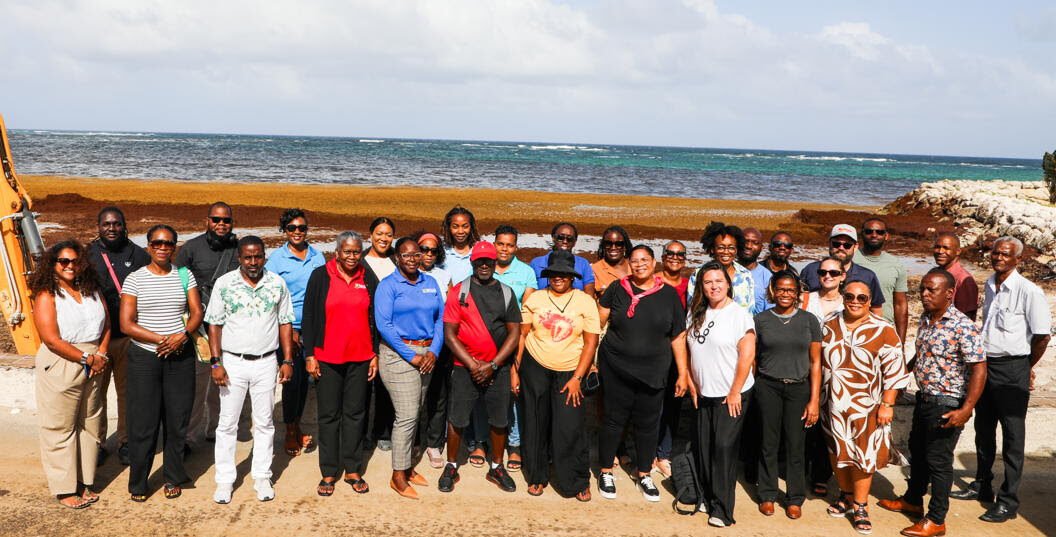
The June 1-5 mission, supported by the European Union’s 11th European Development Fund (EDF) RIGHT Programme and the SARSEA project, brought together technical specialists and policymakers from nine OECS member states. The delegation visited the French Caribbean Outermost Regions to study advanced methods for collecting, managing and transforming sargassum, with the goal of adapting proven solutions for use across the Eastern Caribbean.
The initiative focused not only on reducing the environmental impacts of sargassum but also on identifying ways to convert the seaweed into commercially valuable products, creating new opportunities within the region’s blue economy.
Susana Agüero, Programme Manager at the Delegation of the European Union to Barbados, the Eastern Caribbean States, the OECS, and CARICOM/CARIFORUM, said the French territories have valuable experience that can benefit the wider Caribbean.
“Martinique is one of the French regions tackling the very same issues affecting economies, public health, and tourism across the wider Caribbean and OECS Member States. We are learning directly from their experience. They have built an integrated network using multiple approaches — from manual collection to specialized sea barriers and offshore harvesting. Furthermore, ongoing developments in storage and processing will soon convert sargassum into valuable commercial products, simultaneously protecting vulnerable sectors and community health.”

According to the OECS, the need for effective management has become increasingly urgent as large volumes of decomposing sargassum continue to affect coastal communities throughout the region. In places such as the fishing village of Soubise in Grenada, rotting seaweed releases harmful gases that impact residents and disrupt daily activities.
The environmental effects are equally significant. The OECS noted that decaying sargassum damages mangrove ecosystems and coral reefs, contributes to coastal erosion, and creates major challenges for small-scale fishers by restricting access to fishing grounds and damaging fishing equipment.
One of the key areas explored during the study tour was the concept of sargassum valorisation—transforming collected seaweed into useful commercial products rather than treating it as waste.
At the Holdex facility in Le François, Martinique, delegates observed operational systems that convert sargassum into compost and bioenergy. According to the OECS, processed seaweed has the potential to increase agricultural yields by as much as 14 percent while also serving as an affordable source of biogas for energy production.

During a roundtable discussion with local officials in Marie-Galante, Natasha Deterville-Moise, Officer-in-Charge of the OECS Economic Development Unit, said the lessons learned would directly influence future regional planning.
“These operational insights will directly inform the development of robust regional mitigation and adaptation plans. By fostering active collaboration between public and private stakeholders, the OECS Commission is positioning the proven solutions in the French Territories as a practical framework for building a more resilient and sustainable Eastern Caribbean.”
Throughout the mission, delegates examined each stage of the sargassum management process.
The group observed offshore barriers and specialised barges in Martinique designed to intercept floating seaweed before it reaches beaches and other sensitive coastal areas.
Site visits to Macabou and Pointe Faula highlighted environmentally responsible collection techniques. Saint Lucia’s Ministry of Agriculture representative, Dr. Hardin Jn. Pierre, said the use of manual collection methods was particularly valuable because it reduces the need for heavy machinery that can compact beach sand and disturb sea turtle nesting sites.
Participants also visited the air quality monitoring agencies Madininair in Martinique and Gwad’air in Guadeloupe, where they learned about early-warning systems that monitor gases released by decomposing sargassum and provide health alerts to coastal communities.
Field safety was another important component of the tour. Miklembly Bridgeman of Grenada’s Ministry of Tourism pointed to the use of personal gas monitors during field operations, noting that adopting similar safety measures throughout the OECS would be critical to protecting personnel involved in sargassum response efforts.
The OECS said the knowledge gained during the mission will help shape regional policies by adapting proven operational practices, institutional frameworks and public-private partnerships to the Eastern Caribbean. The Commission said these efforts are intended to strengthen climate resilience while providing coastal communities with more sustainable ways to manage one of the region’s most persistent environmental challenges.