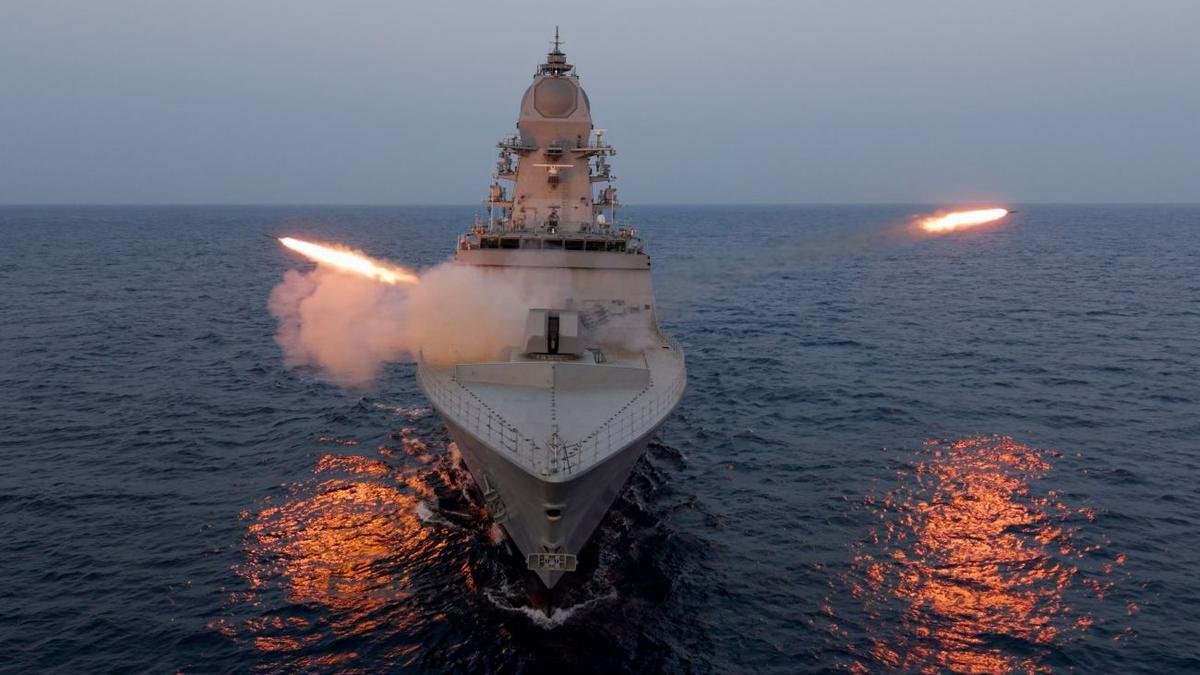
The Indian Navy officially commissioned the sixth of the advanced P17A class of stealth frigate ‘INS Mahendragiri’ in Visakhapatnam on Saturday (July 11, 2026).
The commissioning ceremony, held at the Eastern Naval Command headquarters, in the presence of Union Defence Minister Rajnath Singh, marked a significant leap in India’s capacity to design, construct, and deploy state-of-the-art naval platforms independently.

Named after the majestic mountain range in the Eastern Ghats, the vessel symbolises the resilience and indomitable resolve of the Indian armed forces, a press release from the Ministry of Defence read. Its induction into the Navy is viewed as a cornerstone of the broader “Atmanirbhar Bharat” (Self-Reliant India) initiative, reflecting the country’s shift from an importer of military hardware to a global hub for sophisticated warship manufacturing.
INS Mahendragiri, an advanced stealth frigate, is equipped with cutting-edge technology that places it among the most formidable assets in the Indian Navy’s fleet. The vessel features a sophisticated Combined Diesel or Gas (CODOG) propulsion system, an Integrated Platform Management System (IPMS), and an array of indigenous combat systems designed for high-intensity naval warfare.
‘Bridging conventional and modern warfare’
Addressing the gathering, Union Defence Minister Rajnath Singh underscored the critical balance between embracing next-generation technology and maintaining robust conventional military power. While acknowledging the transformative impact of drones, artificial intelligence, cyber warfare, and hypersonic weapons, he emphasised that the bedrock of national security remains the resolve and expertise of trained soldiers.
“Future wars may be fought with Artificial Intelligence, but they will still be won by national resolve, trained soldiers, and credible military power,” Mr. Singh remarked.
He described the integration of conventional and modern capabilities as a necessity, citing recent naval operations as proof of the Navy’s ability to evolve while staying grounded in core defensive strengths.

‘Advanced in World’
Equipped with the lethal BrahMos surface-to-surface missile, advanced multifunction radar, and a formidable suite of indigenous anti-submarine and electronic warfare systems, INS Mahendragiri significantly bolsters the Indian Navy’s combat readiness, he lauded.
While addressing the fleet’s strategic importance, the Union Minister highlighted the success of Operation Urja Suraksha, which saw the Navy safely escort 18 merchant vessels carrying cargo valued over ₹9,000 crore during the West Asia conflict, underscoring its dual role as a combat force and economic guardian. The commissioning of this stealth frigate further consolidates India’s blue-water reach and maritime security across the Indian Ocean Region. This advancement aligns with the broader Maritime India Vision 2030, supported by robust policy frameworks like the Maritime Development Fund and Shipbuilding Financial Assistance Scheme, which collectively aim to modernise port infrastructure, enhance domestic shipbuilding capacity, and secure India’s position as a self-reliant global maritime power.

Economic and industrial multiplier
Beyond its role as a combat platform, the induction of INS Mahendragiri underscores the deep impact of warship construction on India’s industrial landscape. The Defence Minister pointed out that the 75% indigenous content of the frigate is not merely a statistical achievement but an economic engine.
Mr. Singh noted that the project has stimulated growth across critical sectors, including steel, electronics, sensors, propulsion systems, and precision engineering. By fostering a high-tech maritime ecosystem, the government aims to generate high-skilled employment and nurture innovation among young engineers, entrepreneurs, and researchers, the Minister said. Mr. Singh issued a call to action for the nation’s youth to develop technologies that will define the trajectory of future warfare, thereby reinforcing India’s status as a “net security provider” in the Indo-Pacific region.
Timeframe
The Chief of the Naval Staff Admiral Krishna Swaminathan highlighted the project’s efficiency, noting that Mazagon Dock Shipbuilders Limited (MDL) and the Navy achieved a remarkable reduction in construction timelines.
The commissioning ceremony was attended by senior naval officers, including the Flag Officer Commanding-in-Chief of the Eastern Naval Command, Vice Admiral Sanjay Bhalla, and representatives from the shipbuilding industry.
Published – July 11, 2026 10:11 am IST