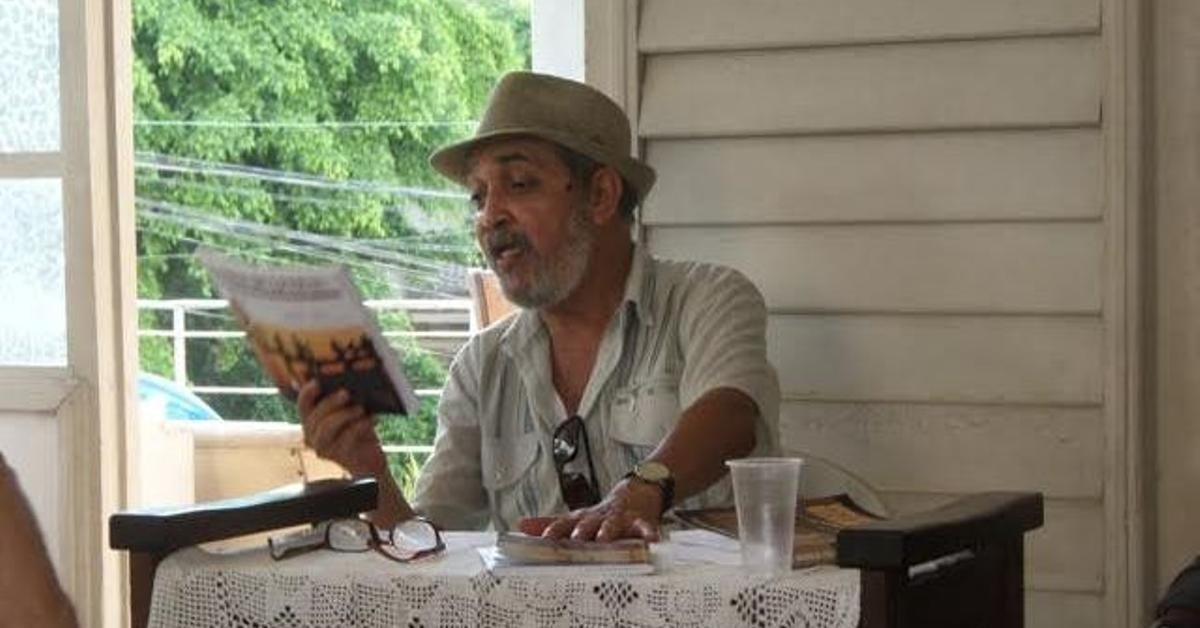
Havana/The journalist and writer Víctor Manuel Domínguez, one of the most veteran voices of the Cuban independent press, died this Friday in Havana after years of a progressive deterioration in health caused by diabetes and other associated complications. He was 68 years old.
The news was announced by journalist Julio Aleaga Pesant and confirmed by writer Boris González Arenas, who reported that Domínguez died around eight at night. Shortly after, CubaNet, a medium with which he collaborated for three decades, published an obituary in which he defined him as a “reference of independent journalism in Cuba.”
Born in Bayamo in 1957, Domínguez belonged to the generation that began to build an alternative press outside the State in the nineties, in a country where practicing independent journalism means exposing yourself to arrests, interrogations, permanent surveillance and smear campaigns. Since 1996 he published in CubaNet opinion articles, chronicles and analysis on Cuban reality, in addition to cultivating poetry, short stories and literary criticism.
His commitment to freedom of expression was not limited to journalism. In 2007 he founded the Cuban Independent Writers Club, a project designed to give visibility to authors excluded from official cultural institutions. Under that seal, around twenty books were published that would hardly have found space within the state publishing system.
Among his books is the collection of poems ‘Café sin Heydi Frente al Mar’, presented in Miami by the poet and journalist Luis Felipe Rojas, as well as various stories and texts that circulated outside official channels.
He also participated in independent union initiatives and training programs for workers, activities that earned him years of harassment by State Security. On several occasions he was temporarily detained, subjected to interrogations and declared “regulated”, an administrative measure used by the regime to prevent journalists, activists and opponents from leaving the country.
In addition to his journalistic work, he left a literary work marked by introspection and marginality. Among his books is the collection of poems Cafe without Heydi facing the seapresented in Miami by the poet and journalist Luis Felipe Rojas, as well as various stories and texts that circulated outside official channels due to censorship.
Rojas also remembered it with a loaded text of personal anecdotes and admiration for his character. He recalled that he met Domínguez “at a great moment of journalism and very free literature in Cuba in the early 2000s” and described him as a man “without mincing words and without an iota of diplomacy to say what he thought.” Rojas also highlighted his dedication to the Cuban Independent Writers Club, to which, he wrote, “he dedicated his soul,” and he said goodbye to his friend imagining him reunited with other deceased Cuban free press leaders: “There goes Vittorio“Guys, prepare a party.”
The last years of his life were marked by a particularly difficult situation. Diabetes caused serious circulatory problems that led to the amputation of a leg. His health continued to deteriorate to the point of losing much of his vision and preparing for a second amputation. Even so, he continued writing whenever his strength allowed him.
Domínguez’s death has provoked numerous expressions of sorrow among journalists, writers and activists
His case also highlighted the precarious conditions in which many dissidents and independent intellectuals age in Cuba. He lived in a modest room in Central Havana and frequently depended on the help of friends to meet medical expenses and basic needs. During some hospital admissions, relatives reported that he remained under surveillance by State Security agents even while receiving treatment.
Domínguez’s death has provoked numerous expressions of sorrow among journalists, writers and activists. Boris González Arenas he remembered it as “writer, trade unionist and journalist”, while CubaNet highlighted his status as one of the oldest collaborators in the medium and an essential figure in the history of Cuban independent journalism.
His death also coincides with a particularly difficult time for the free press on the Island. In the midst of increased repression, the exile of dozens of reporters and the closure of civic spaces, one of the men who helped demonstrate that it was possible to practice journalism outside the control of the Communist Party disappears, even when doing so meant paying a high personal price.
With Víctor Manuel Domínguez leaves one of the voices that documented for decades the Cuba that the official discourse tried to silence. His journalistic and literary work remains a testimony of a generation that decided to write even knowing that, in their country, independence had a cost.