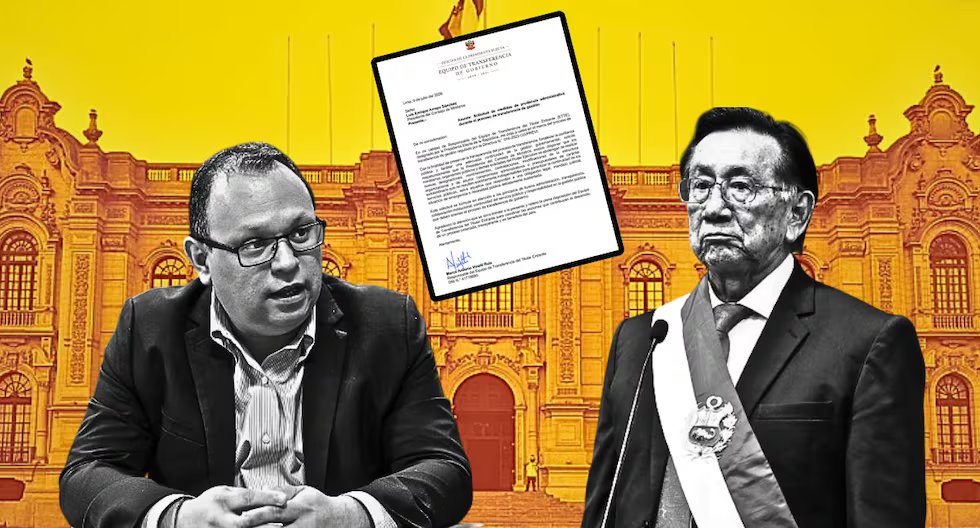
In the midst of the transfer of management and administrative changes in the Government, Marco Vinelli, head of the transfer team Popular Forceasked the head of the PCM, Luis Arroyowhich provides for the suspension of new appointments and appointments in State entities. The request was presented as a measure of “administrative prudence.”
“I respectfully request that the Presidency of the Council of Ministers evaluates ordering that the ministries, public organizations and other entities of the Executive Branch refrain from making new appointments, (…) or from assuming administrative or budgetary commitments of an extraordinary nature,” the document states.
Vinelli maintained that these measures will preserve the transparency of the transfer process between the government of José Balcázar and the incoming government of Keiko Fujimori, will strengthen public trust and facilitate the continuity of government management.

The request was presented after the recent appointments of congressmen Jorge Marticorena as Minister of Education and Flavio Cruz as head of the Ministry of Labor. In addition, it was sent two days after El Comercio revealed that in just one month more than 50 changes of officials in key positions were made.
According to a Fuerza Popular source consulted by this newspaper, these appointments and the recent changes in officials motivated the sending of Vinelli’s document to the Government of José Balcázar.
“Such sudden changes for 15 more days of government are more than unnecessary. In addition to that, we could have officials in senior management who are going to hinder or make mistakes before Balcázar leaves office,” he said.
—More appointments?—
In this regard, El Comercio contacted Balcázar Zelada. The head of state maintained that, as long as he continues in office and the circumstances warrant it, he cannot stop making appointments or appointments.
“In reality, for example, if a minister resigns, I cannot stop appointing him. In other words, there are exceptional cases. (…) I cannot stop appointing, of course. It would never be possible. (If I stopped doing so) it means that my government is already over,” he added.
Asked about the recent appointments, he stated that there are officials who must guarantee continuity during the management transfer process.
“We are not going to abuse appointments either. For what? We are on our way out. I have not seen that any case could harm the new administration,” he added.
Balcázar highlighted that Keiko Fujimori will only receive the title of top State official on July 15 from the National Elections Jury (JNE) and that, until then, she will continue to exercise the Presidency.
“The law is clear, the constitution is clear. Imagine, the president will only be given the title on the 15th by the JNE. She is not yet president. And when she is sworn in, I will only leave office as the Constitution mandates,” he said.
At the time of the call he said that he was in Cajamarca and that upon his return to Lima he was going to evaluate the Fuerza Popular document. Before concluding the conversation, he said: “The issue is, I don’t think they will impose on me to close the Executive.”
—What are the risks?—
In this regard, public management expert Karla Gaviño questioned the recent appointments and appointments made by the Government.
“This constant rotation of senior officials of the Executive Branch is quite alarming, it is unusual because of the frequency and the date on which it is occurring, a few weeks before the end of the presidential term and the change of government,” he said.
Gaviño maintained that, by not appointing the most suitable people for these positions, there is a risk that areas such as education, health and work, among others, will be neglected.
“There is a concern from the point of view of public management. All this reveals to us that we do not have the type of leadership that Peru needs for the most basic needs of citizens,” he added.
The specialist pointed out that citizens need an explanation about what is happening in the Executive Branch for changes in ministers to occur so frequently.
“The Executive in general seems to be in a blind spot in which citizens do not have greater knowledge of how it is being managed and what types of decisions are being made and what causes this constant rotation of ministers,” he said.
Furthermore, he opined that the incoming management should cautiously receive the information that will be transferred to it and evaluate the status of the portfolios whose owners have been replaced a few weeks after the change of government.