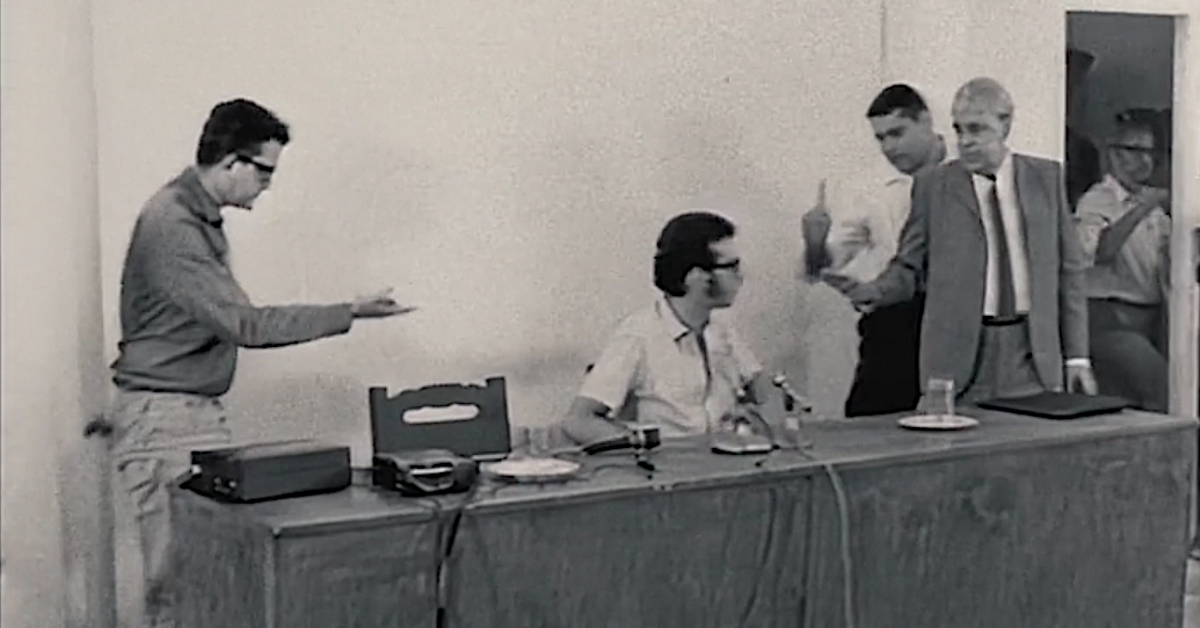
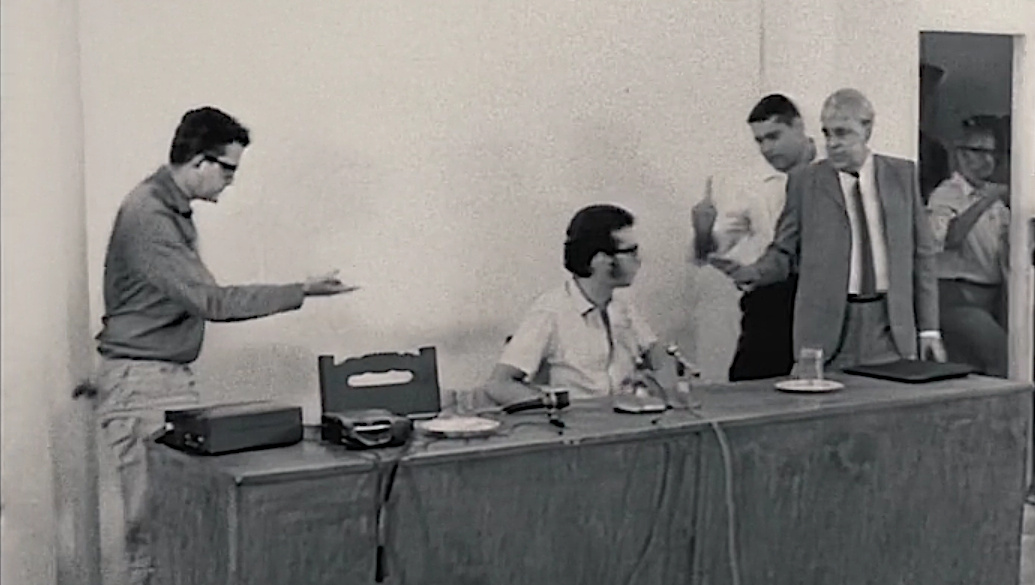
San Salvador/When night falls on April 27, 55 years will have passed since the most despicable event that Castro’s totalitarianism carried out on Cuban art and culture: the poet’s sadly famous “self-criticism.” Heberto Padilla (1932-2000) before a group of prominent members of the Union of Writers and Artists of Cuba (Uneac), after spending 37 days in prison accused of maintaining critical attitudes against the Revolution.
The Padilla Case (as it has been known since then) constituted a true watershed, a breaking of spears, both inside and outside the Island. Authors who until that moment had been unwavering in their support for the revolutionary process, painfully understood—suddenly—that Castroism was no better than Stalinism in its tolerance of intelligent dissidence and creative disapproval. Even those who remained faithful to Caribbean socialism, out of emotion or pragmatism, came to wonder how far Cuba had gone in imposing limits on art and culture within its so-called democratic system.
And it’s not that the warnings had been lacking, by the way. In addition to the infamous speech of June 1961 in which Fidel Castro made clear how he conceived the “responsibility” of artists and intellectuals within the framework of the historical project he led – “…Within the Revolution, everything; against the Revolution, nothing” -, it is sometimes forgotten that long before, in October 1959, the Film Study and Classification Commission had been formed, attached to the Cuban Institute of Cinematographic Art and Industry. (Icaic), an entity that began to censor films considered “problematic” due to their content.
In October 1959, the Film Study and Classification Commission had been formed, attached to the Cuban Institute of Cinematographic Art and Industry (ICAIC), an entity that began to censor films considered “problematic” due to their content.
Works like Once in portby Alberto Roldán, or a little more blueby Fausto Canel, were banned from being broadcast on the island in 1964, the first because it realistically documented the life of the Havana neighborhoods that overlooked the sea and the second because it addressed the always thorny issue of exile. Both filmmakers suffered, of course, the consequences of their “reactionary” acts: they were excluded from Icaic (of which they had been founders), their freedom of expression was restricted, and they ended up leaving Cuba. (Roldán died in Miami, at age 81, in 2014, and Canel lived in France and Spain before also settling in the United States, where he resides).
The hardest blow to creative freedom had been, however, the one suffered in 1961 by the documentary P.M by Orlando Jiménez Leal and Sabá Cabrera Infante, banned and confiscated by the authorities, pointing out that it offered “a partial painting of the nightlife” of Havana because, “far from giving the viewer a correct vision of the existence of the Cuban people in this revolutionary stage, it impoverished, disfigured and distorted it…”. It was precisely as a result of the scandal caused by the condemnation of this short film, barely 14 minutes long, that Fidel Castro in person brandished his fearsome Words to intellectuals.
The regime’s terrifying “all or nothing” found its next victim in Heberto Padilla, whose excellent collection of poems Out of the game had been recognized by Uneac (somewhat reluctantly) with the 1968 National Prize. Despite having obtained the award by the unanimous decision of the jury, the entity made a strange “declaration” in which it stated that the book would be published – along with that of Antón Arrufat in the theater branch – with a note “expressing its disagreement” because it considered them “to be ideologically contrary to our revolution (sic).”
Three years later, in January 1971, Padilla dared to star in a recital at Uneac with his new book, Provocations. And that is, in fact, considered his attitude: provocative. A few weeks later, on March 20, Heberto and his wife, the writer Belkis Cuza Malé, were arrested by State Security agents and taken to the Villa Marista bars. The charge against them was “subversive activities against the government.”
“Did you think you were untouchable, the rebellious artist…?” Padilla recalled what the henchmen told him in prison. “(Did you think) we were going to forgive you for all your counterrevolutionary antics?”
“Did you think you were untouchable, the rebellious artist…?” Padilla recalled what the henchmen told him in prison. “(Did you think) we were going to forgive you for all your counterrevolutionary antics?” After the brutal interrogation, in which the poet was beaten, he woke up in a military hospital where he received an unexpected visit from Fidel in person. “Yes,” says Heberto in bad memory (1989), “we had time to talk, or for him to talk and expand as he pleased, and shit on all the literature in the world.”
Then it was “suggested” to the writer that he write a long text listing his “errors,” a document that 55 years ago he recited from memory at that private meeting at Uneac. The recorded material of the “self-criticism” was finally known, in 2022, when the Cuban filmmaker Pavel Giroud rescued it and used it to put together an extraordinary documentary titled The Padilla casenominated for several prestigious film awards.
At this moment, the three and a half hours of the writer’s confession can be seen on YouTube, something that I would like to recommend to anyone who wants to delve into the censorship processes that Castroism instituted to turn art into propaganda and writers into obligatory spokespersons for a revolution that ended up devouring their illusions.