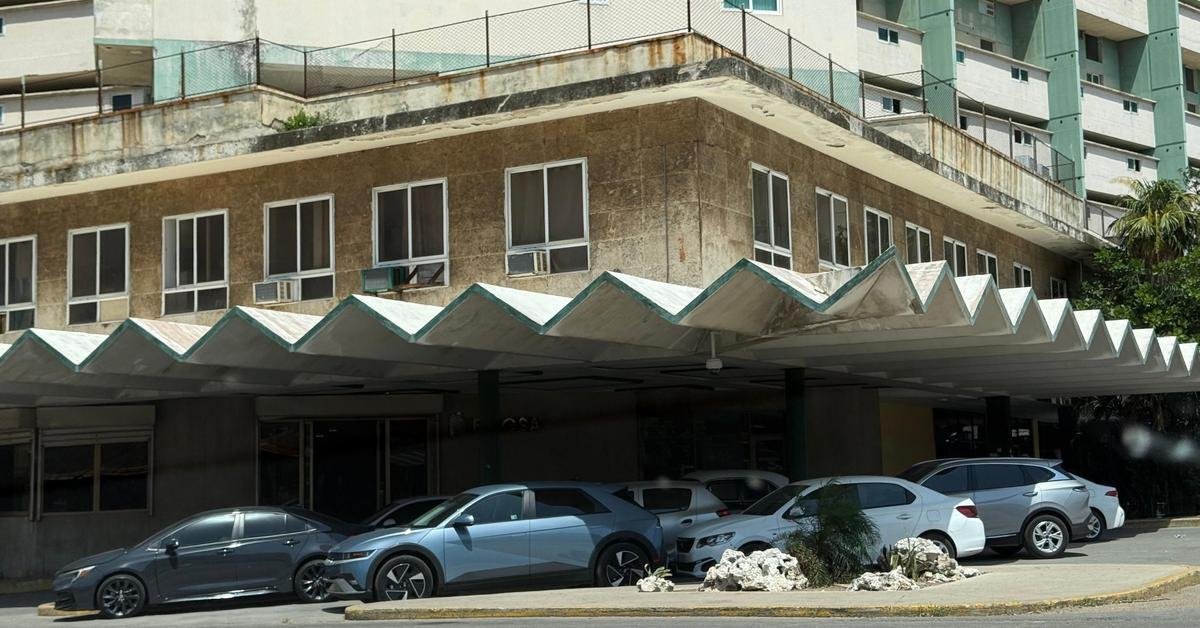
Havana/In Focsa, one of the jewels of Cuban engineering, deterioration is no longer hidden behind the monumentality of its silhouette. It is enough to cross the almost empty lobby, go down to the garage or look into the utility rooms to find falls in the ceilings, exposed rods, accumulated garbage, walls stained by humidity and common areas converted into a waste deposit. The neighbors, tired of complaining without receiving a response, have decided to make public a complaint that points directly to the administration of the property, in the hands of the Real Estate Company Cimex SA.
The document, sent anonymously by residents of the building out of a “caution,” describes a panorama of sustained abandonment, mismanagement and lack of transparency in investments. The question that runs through the entire complaint is simple: how is it possible that a property that, according to neighbors, collects more than a million dollars annually in rent for spaces and apartments, claims not to have funds for basic repairs?

/ Courtesy
The contrast between the history of Focsa and its current state is difficult to ignore. Located on 17th Street, between M and N, in Vedado, the building was for decades a symbol of modernity and architectural ambition. At 121 meters high and 36 floors, it is one of the tallest buildings in Havana. Today, according to the complainants, that image barely survives on the façade. “Lack of care and abandonment abound in the building,” they say, before pointing out that “high signs of corruption” have been perceived for some time among those who manage the property.
The photographs sent by neighbors reinforce the most visible part of the complaint. In the garage, large areas of the roof are observed with the coating detached, pieces of concrete on the floor and visible metal reinforcements, even over spaces where vehicles are parked. In an interior staircase, cracks, open areas and exposed rods are observed in circulation areas. Other images show internal rooms full of black bags, cardboard, packaging remains and garbage accumulated without order or cleanliness.
In their complaint, the residents claim that “it is common to find roof detachments on the floor,” a sign of deterioration caused by the prolonged lack of maintenance. They add that there are only three workers to attend to the entire Focsa, a large building, with dozens of floors, commercial areas, garages and internal services.
/ Courtesy
One of the most serious problems is that of elevators. According to the document, of the building’s seven elevators, only two operate regularly: one in the lobby and another for service. Neighbors report that they have to wait in endless lines to get to their apartments and that the situation worsens with blackouts. In these outages, they say, several people have been trapped in the elevators due to lack of fuel for the building’s generator set.
The situation especially affects older adults, children and families who live on upper floors. Neighbors point out that, when the elevator stops between floors, those affected must be extracted by security and protection personnel, an operation that, according to them, puts at risk both those who are trapped and those who try to help them. The complaint even proposes coupling the elevators to the property’s underground electrical system to prevent them from stopping during power outages.
Garbage is another source of alarm. The document states that there are hardly any waste containers and that the stench occupies several levels of the building. According to neighbors, in recent days containers and piles of garbage that had been accumulated in the garden for months caught fire, and only the intervention of firefighters made it possible to extinguish the fire. The images received by this newspaper show accumulations of waste in closed spaces, near internal facilities, which increases concern about possible health and fire risks.
/ Courtesy
Adding to this concern is another safety complaint: a good part of the fire extinguishers, according to residents, do not work, and the old fire fighting system using water pumps would be useless. They also mention a lack of signage, poor lighting in hallways, common areas and stairs, as well as leaks in the garages.
Neighbors not only talk about abandonment, but also about poorly executed investments. One of the examples they cite is the remodeling of the lobby, carried out more than five years ago. According to the complaint, two air conditioners were installed that were never used, an air curtain that never worked, and a television that broke without having been used. PVC sheets were also placed over the building’s original mirrors, while the furniture that needed to be replaced never arrived. The result, they say, was “an immense empty room” without aesthetics or functionality.
Another questioned intervention was that of the garages. At the end of last year, they say, the real estate company contracted work to paint the entrance, place signage and install automatic barriers. But, according to residents, the paper signs came off “after two days,” the paint was of poor quality, and the electric barriers were poorly installed, affected by the wind, and rendered useless during the blackouts.
/ Courtesy
The third case is that of the supposed capital repair of the elevators. The neighbors claim that there was talk of a million-dollar investment to change cabins, cables, motors, buttons, rails, doors and other components, but that in the end only the cables and some minor parts were replaced. The breaks, they say, continue. “Where did the money invested go?” they ask.
The management of the garages also appears at the center of the complaints. According to the neighbors, although Focsa has sufficient capacity for its residents’ cars, a considerable part of the area was converted into a warehouse by decision of the real estate management. The complainants affirm that this measure has expelled vehicles towards the outside of the building and towards the marquee, with the consequent blocking of passage areas, momentary stops and accesses that could be necessary in an emergency. Added to this, they say, is the separate charging for parking spaces to those who need them, a practice that they consider imposed by the administration.
/ Courtesy
The neighbors ask that the investments in the real estate accounting be reviewed and compared with the works actually carried out in the building. They also insist that everything reported can be verified with a visit to the property and interviews with its residents.
Beyond the specific responsibility of each manager, Focsa once again offers a precise image of today’s Cuba: abandoned emblematic buildings, opaque state administrations, repairs that do not solve essential problems and residents forced to live among blackouts, garbage, landslides and elevators that fail. The jewel of Cuban engineering, its neighbors warn, is deteriorating for all to see.