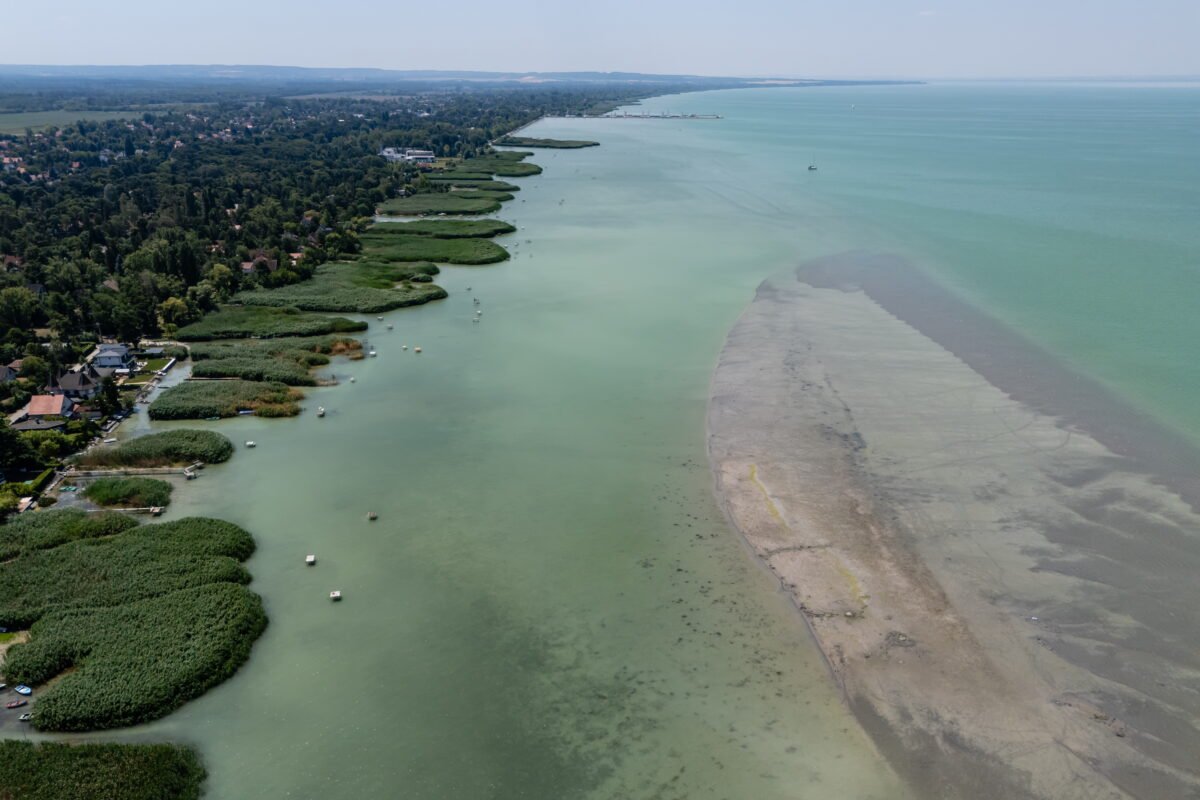

Low water levels near Balatonfenyves
Hungary is experiencing an unprecedented heatwave, with yesterday marking its most intense day as air temperatures climbed to a record 42°C – the highest ever recorded in the country. In response to the prolonged extreme heat, surface temperatures in Lake Balaton exceeded 32°C in places and developed unusual thermal stratification. Simultaneously, persistent drought and severe water shortages across eastern Hungary have driven the Tisza River to historically low water levels.
Lake Balaton, Central Europe’s largest lake, is heating up rapidly. As the HUN-REN Balaton Limnological Research Institute (BLKI) reported on its social media page, the heat is penetrating noticeably deeper into the water than it did just a week ago.
On Monday afternoon, extreme surface temperatures were recorded at the official measuring stations. Keszthely, at the western end of the lake, led the way with 32.3 °C, followed by Szigliget with 32.1 °C.
In the top five centimeters of the water column, temperatures in Keszthely even peaked at 32.9 °C.
Even at a depth of one meter, the thermometer in Siófok read 29.5 °C.
The physical stratification of the water is particularly pronounced at present, as researchers observed near Szigliget. A layer of warm water has formed down to a depth of one meter, lying like a bell over the “cooler” water starting at a depth of one and a half meters.
Official data are measured in open water.
In the shallow areas immediately adjacent to the shore and at beach access points—on both the north and south shores—temperatures are often significantly higher locally.

Lake Balaton near Balatonfenyves on June 29, 2026. Photo: MTI/Vasvári Tamás
Despite the extreme conditions, the institute has given the all-clear regarding algal blooms for the time being. There is currently no evidence of increased algal growth. However, scientists emphasize that the unusually high temperatures—which are now also affecting the bottom sediment—will noticeably strain and shape the ecosystem and water quality for the remainder of the summer.
The same heatwave that has warmed Lake Balaton to unusually high temperatures is also exacerbating the hydrological crisis along the Tisza River in eastern Hungary, where water levels continue to decline.

The Tisza River at Kisköre on June 29, 2026. Photo: MTI/Czeglédi Zsolt
At the lower gauge in Kisköre, the water level dropped to a historic low of –342 centimeters on Monday morning, idokep.hu reported. This tied the previous record low, which was first recorded on August 10, 2025. The main cause of the low water levels is a prolonged drought and the lack of precipitation throughout the river’s entire watershed. The current heat wave is acting as a catalyst here, causing water levels to drop further due to significant evaporation.
Based on current forecasts by the National Water Management Directorate (OVF), the water level could even drop to –343 centimeters in the first days of July. This would mean the Tisza would fall another centimeter below its own historic low.

Via MTI, idokep.hu; Featured image: MTI/Vasvári Tamás