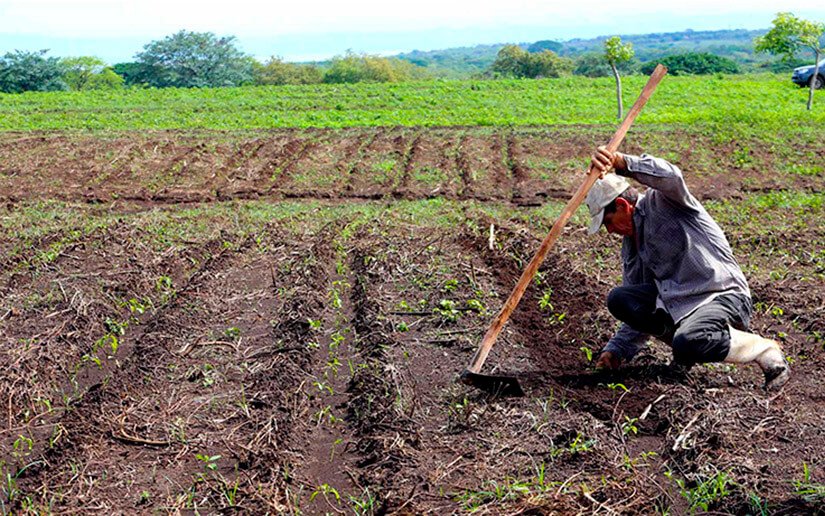
Agricultural activity in Nicaragua has had three “bad” years, between 2023 and 2025, as a result of a combination of three factors: the “El Niño” climate phenomenon, lower productive dynamism and a progressive deterioration in access to credit, according to official data analyzed by CONFIDENTIAL.
Since 2023, when the Central Bank of Nicaragua (BCN) reported a 6.1% contraction in the sector’s added value, mainly due to the impact of the El Niño meteorological phenomenon, activity performance reflects a sequence of sustained falls.
Although in 2023 the BCN initially estimated the fall at 3.8%, the final data revised in the national accounts confirmed that agriculture fell 6.1% that year, due to the drought that “reduced agricultural yields.”
He climate effect directly impacted the main crops. Coffee fell 4.5% due to the “delay in rains” and lower external demand, while sugar cane had a contraction equivalent to 6.1%, due to climatic variations.
Basic grains, in 2023, registered a drop of 8.9%, with lower harvests of beans, rice paddies and sorghum, which was “partially offset by the growth reflected in corn production” in that period.
In 2024, although the contraction was minor, the sector failed to recover. The conditions generated instability in the planting cycles and loss of cultivated areas. The sector closed that year with a drop of 0.8%, according to BCN data.
The greatest impact in 2024 was concentrated in basic grains, whose added value fell by 13.2%, due to lower production of beans, corn and rice. That same year, some items such as coffee, which grew 1.6%, and sugar cane (13.9%), showed positive behavior.
Why was 2025 worse than 2024?
In 2025, agricultural activity fell again 2.9%, due to the collapse in basic grains. This contraction was associated with a reduction in “cultural work”, that is, less maintenance and care of crops, which directly affected the productivity of corn, beans, sorghum and rainfed rice.
The BCN, however, reported that “production volumes were maintained that made it possible to guarantee primary supply in national markets and export flows.”
The National Plan for Production, Consumption and Commerce for the 2025-2026 cycle contemplated a growth of 8.9% in agriculture, but the reality of the sector was different.
According to the Plan, in the previous production cycle a growth of 7.7% was expected, but the year closed with a contraction of 13.6%.
Added to this were falls in sugar cane, despite the fact that there was an expansion of the plantation area of the sugar mills. The Plan projected a growth of 1.4%, but in practice it decreased by -1.6%.
The BCN shows that there were lower production levels in other items such as soybeans, peanuts and tobacco.
The country’s Gross Domestic Product (GDP) at constant prices in 2025 – without the effect of inflation – stood at 221,656.0 million córdobas. The real value of agriculture was 14,028.6 million that year, but in terms of growth it subtracted 0.2 percentage points.
In previous years, the results were also not encouraging. Agriculture represented 7.1% of GDP in 2023 (14,569.4 million córdobas) and 6.8% in 2024 (14,447.5 million). In terms of growth, the sector subtracted 0.3 percentage points in 2023, while in 2024 it had practically zero contribution.
Coffee farmers still resent it
Arnold He is a small producer who has a farm in Matagalpa where he has predominantly planted coffee for many years and has been able to overcome the situation.
Although 2025 was a year in which coffee farming saw its income improve, that bonanza did not benefit everyone equally. In general terms, the winners were the large producers who have access to resources to take care of their plantations, and knowledge to look for the best windows of opportunity to negotiate their coffee.
At the other end of the scale, small producers saw how the climate, and the lack of financing, denied them the possibility of improving their income.
He earthquake that the union suffered with the closure of CISA Exportadora unbalanced their production scheme, by denying access to the largest player in the sector, and leaving them in the hands of competitors who took advantage of the dominant position they acquired when the sector leader disappeared.
“Now it is more difficult to obtain financing, or to have hope of obtaining a good price for our harvest,” explained the farmer. Additionally, climate variability introduces an additional element of uncertainty, which forces decisions to be made on the fly. Like when it rains early (or late), or it’s hotter than the plants can handle without consequences.
Another dramatic moment is when plants flower out of time, because it disrupts the search for labor, which affects producers who must pay more to obtain cutters, or see part of the harvest lost.
This same phenomenon also affects families that move with the crops because they can no longer go to cut a farm after having completed work on the previous one. Instead, they must take a job while missing out on earning the income they would have had if they had been able to move from farm to farm.
Credit shakes the sector
Agricultural credit has also had ups and downs in the last three years.
The gross loan portfolio of the Banking and Financial System (SBF) totaled 238,105.3 million córdobas. The sector concentrated 7.3%, equivalent to 17,282.9 million, showing a reduction of 4.7% compared to 2024 when the credit portfolio was 18,142.3 million.
In 2023, agricultural credit stood at 16,963.3 million, which shows that, despite the rebound in 2024, financing contracted again in 2025.
The data confirm that the Nicaraguan countryside suffered a net withdrawal of bank liquidity of almost 860 million córdobas in the last year, which coincides with the deepening of the fall in agricultural production observed in the same period.
The primary sector – which includes agricultural activities, hunting, forestry and fishing – remained the fifth employer in the country in the period analyzed, despite the drop in production. In 2025 it registered 62,493 members of the Nicaraguan Social Security Institute (INSS), while in 2024 it counted 62,621 members.
Agricultural performance in 2026
According to the Monthly Economic Activity Index for January 2026, farmers are carrying out greater cultural work and there is progress in production output in crops such as coffee, sugar cane, irrigated rice and corn.
The average annual variation remained with a contraction of 2.5%, which indicates that the sector continues a prolonged phase of weakness, which continues to be influenced by climatic, productive and financial factors.
In contrast, between 2023 and 2025, the livestock sector showed an evolution with variations in its growth rate. An increase of 1.4% was recorded in 2023, followed by a slight slowdown in 2024, when growth was 1.3%. However, in 2025 a significant recovery was observed, with an increase of 6.3%, according to official data.