It was the fault of Underground (1995) that I The last islanders by Stefan Popa read as pure fiction for far too long. In the final scene of that film by the Serbian Emir Kusturica, you see a number of Yugoslav revelers standing on a piece of land that breaks away from the mainland, after which it slowly but surely floats further out onto the water. Kusturica wanted to say something about the disintegration of Yugoslavia, where a civil war was raging at the time. For example, the island in Popa’s novel must also be a metaphor, you think for a long time, that was invented to symbolize something.
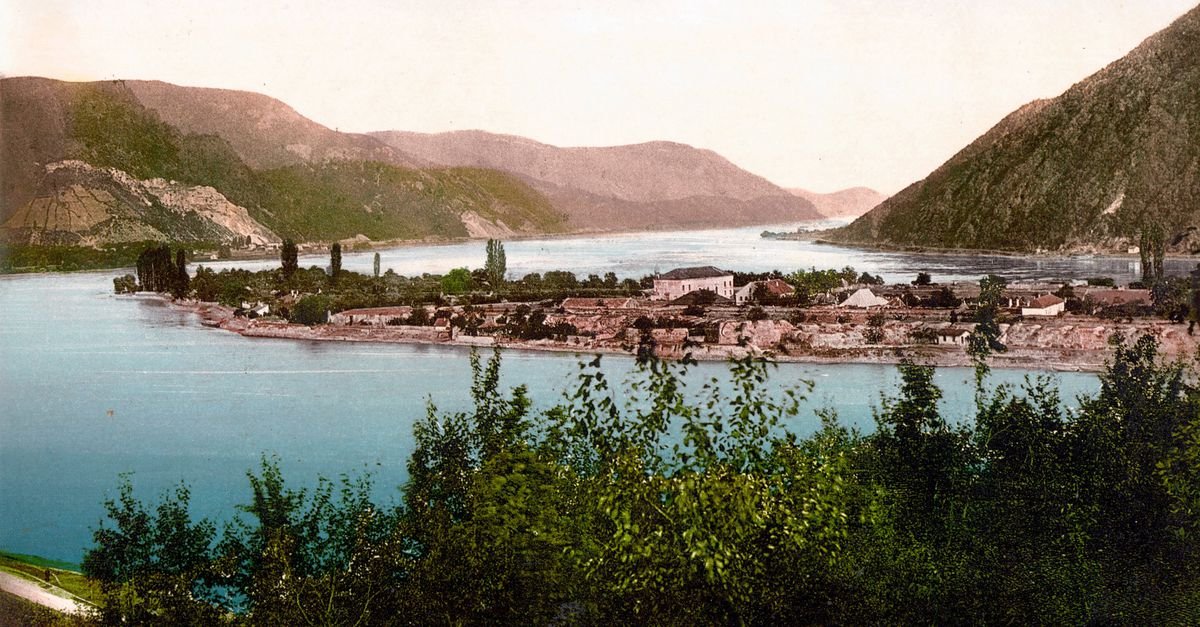
Until you Google it and find that Ada Kaleh, the island in question, really existed. And that it ended exactly as tragically as in the book: the piece of land located in the Danube, about two kilometers long and about half a kilometer wide, disappeared under water in 1970 because a hydroelectric power station was opened nearby. The few hundred people who lived there had to seek refuge elsewhere. Apparently, although that may also be a smart move by marketing agency Vakantieland Romania, you can sometimes still see the island when the water is clear.
Stefan Popa (1989) is of Dutch-Romanian descent and has already written several novels about half his motherland. For example, it was published three years ago the tragicomic tone In the shade of the oakin which he wrote, among other things, about a Romanian mother with a questionable history and the overly enthusiastic felling of forests in Romania. That may all sound a bit heavy-handed, but Popa described it wittily and lively and he introduced all kinds of colorful characters that you would not easily encounter with a Dutch colleague. For example, there was a man who tried to drink himself to death with 150 cups of coffee.
Melting pot
It is also similarly fresh and cheerful The last islandersin which Popa stars a trio of teenagers who grow up on Ada Kaleh just before the unwanted immersion. Two boys (Ibrahim and Deniz) and one girl (Azra): it will come as no surprise that, in addition to the arrival of the hydroelectric power station, the novel also contains a story about love, jealousy and revenge. Once upon a time, Ada Kaleh was an ethnic melting pot: mainly (Muslim) Turks lived there, but there was, also in the novel, a coming and going of all kinds of different ethnicities. The arrival of communism put an end to that diverse unity and demanded that everyone be the same, after which people suddenly started treating each other with envy.
Like a slow waltz (the machine, not the dance) the moment approaches when the hydroelectric power plant will be opened. The residents of Ada Kaleh don’t seem to believe it at all, they deal with it so resignedly. What should happen to the mosque? Or with all those people buried on the island?
Lies
Popa delivers beautiful, committed passages about the suffering that happened to the islanders. “There are hundreds of ways to make a people disappear. The most elegant is to make them believe that they belong somewhere else. They tried that with us. But we became others among the others. On land we were no longer islanders, we became hunted partridges. They divided us over the land (…). The communists gave us nothing, nothing at all, except their verbose, empty lies. They said we would never have to pay rent or utility bills again, because the electricity would henceforth be raised at the expense of our homes, as if we had won a lottery.”
These are words that capture the great history of Ada Kaleh (they could also have appeared in Geert Mak’s non-fiction, so to speak), but Popa is at least as adept at portraying the intimate, small events that give a novel so much color. He is sharp, that’s the right word, he rarely writes out scenes in a routine manner, there is almost always a surprising discovery, from a girl who is suddenly happy during sex that Stalin is dead, to the arrival of a mooring boat with Christmas trees, to subtly make it clear to the Muslims on Ada Kaleh that a different time has arrived. Yes, Popa is a very fine writer and it’s about time more people saw that.