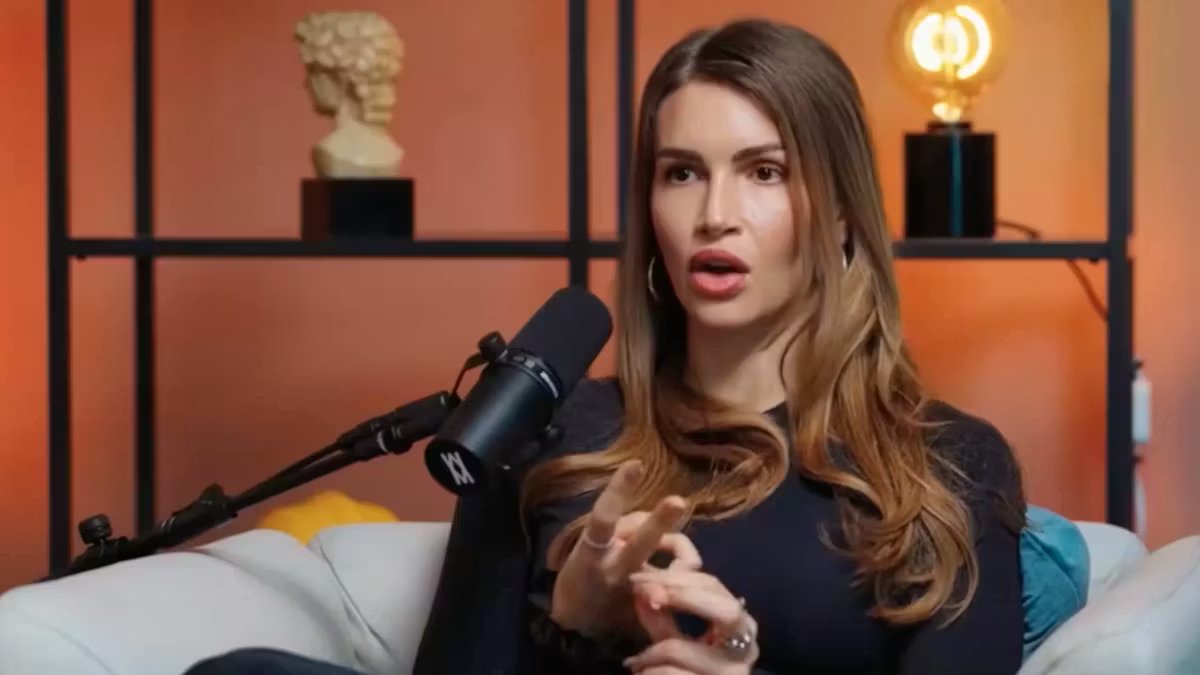
- Influencer Sylwina Spiess caused criticism with statements about McDonald’s employees when choosing a partner.
- But in doing so she has drawn attention to the topic of “career data”.
- Studies show that career is important for many people when choosing a partner.
- Couples with similar educational and social status are often more stable and have fewer conflicts.
- Relationships with big differences can work, but they are more likely to have tensions.
The influencer Sylwina Spiess was a guest on the podcast “Bireweich Talk”. Her statement caused a stirthat a relationship with a McDonald’s employee would be out of the question for her. Sylwina has since apologized for this and pointed out that the statement was taken out of context. A look at the transcript (see box) confirms this.
Spiess’ statements verbatim
But the uproar shows that the importance of one’s job when choosing a partner is an issue. And that not just on social media.
One thing in advance: “Profession” stands for many things
In connection with the statements made by Spiess, the term “profession” or “job” does not only mean an activity, but also a multitude of factors that are closely related to it. For example, education, social and economic status, interests and experiences. Short for similar living environments and with that for encounters with as much eye level as possible. Spiess made this clear to 20 Minutes: She wants a similar value system, a similar environment and similar interests in a relationship. She had already spoken in the podcast that she would prefer to have someone “who might also be in the creative or advertising industry.”
Graduate psychologist Lisa Fischbach, who also works for Elite Partner, explained why the profession is very closely linked to a person’s value system: The profession makes up a large part of one’s personal identity. “For those who have developed a strong relationship with their job, the job is often much more relevant when choosing a partner,” she is quoted by Welt.de. A high level of identification with the job can lead to the expectation that “your partner will have similar attitudes.” An Elite Partner study showed last year that for many of the Career is important or even very important when choosing a partner.
“If you have developed a strong relationship with your job, your job is often much more relevant when choosing a partner.”
However, couples often come together where both partners have similar jobs does not necessarily mean that they actively strive for this. Rather, it often has to do with where you actually have the opportunity to get to know someone, as a Dutch study shows (PDF). Such places include school, university or workplace. The researchers see this fact as an important reason why people usually enter into relationships with people who are socially or culturally similar to them. Or as Martin Fieder, Professor of Anthropology at the University of Vienna, put it on Standard.at: “Education also separates spatially.”
What are the advantages of relationships in which both partners have similar jobs?
Similar interests and characteristics can make life easier for those involved. “That’s why many people consciously or unconsciously look for someone who is similarly well educated,” explains clinical and health psychologist Caroline Erb at Standard.at. The reason: “Interests and life experiences trigger a feeling of familiarity.” But that is not the only aspect that plays a role in falling in love or entering into a relationship. “Whether Cupid’s arrow hits depends on personality traits, values and good communication. The chemistry has to be right and you should be able to laugh together,” says the psychologist, who also works for Parship.
Do relationships between partners of different socioeconomic status generally work worse?
Researchers say a cautious yes here. Relationships with unequal socioeconomic status (education, income, social background) can work, but they often show points of friction. This is what a study from 2020 showed (PDF), that in couples with high socioeconomic inequality, the perceived relationship quality decreases over time for both partners, regardless of who is more senior.
If we only look at educational differences, the picture is less clear. A Finnish one study with 20,452 unmarried couples showed that extreme educational differences increase the risk of separation, while equality in education – especially among the highly educated – can have a stabilizing effect. On the other hand, a Belgian study According to 458,499 marriages, relationships in which the woman was more highly educated than the man were not generally more prone to divorce – especially where such partnerships occur frequently.
Do you and your partner work in the same job?
Research does not produce a consistent picture when it comes to income differences either. Differences in income are particularly stressful for a relationship when they do not correspond to the prevailing local norm. For example, if the woman earns more than the man in an area where the man is traditionally viewed as the breadwinner of the family, this has a negative impact on the relationship. One study Using data from Germany, 2024 showed that in this constellation both men and women report lower life satisfaction. One US study from 2016, on the other hand, showed that the previously frequently observed connection between “woman earns more” and divorce no longer exists in this pronounced form today.
Conclusion
In summary, couples with significantly different socioeconomic statuses are often more unstable. However, since there are also different study results, it cannot generally be said that inequality is necessarily stressful for relationships.
That’s why the comment field was deactivated
Subscribe to Knowledge Channel notifications in the 20-minute app. You’ll be informed about groundbreaking research findings and discoveries, explanations of current events and curious news from the wide world of science. You will also receive answers to everyday questions and tips for a better life.
This is how it works: Install the latest version of the 20 Minutes app. Tap on “Profile” at the bottom, then on the “Settings” gear and finally on “Push notifications”. Select the topics you want here.

Fee Anabelle Riebeling (fee) has been working for 20 minutes since 2014. She is deputy. Head of Knowledge, History & Digital and Head of the Fact Check & Verification expert committee.

Jean-Claude Gerber (jcg) has been working for 20 minutes since 2005. He has been head of the Knowledge, History and Digital department since 2013 and a Blattmacher since 2020.