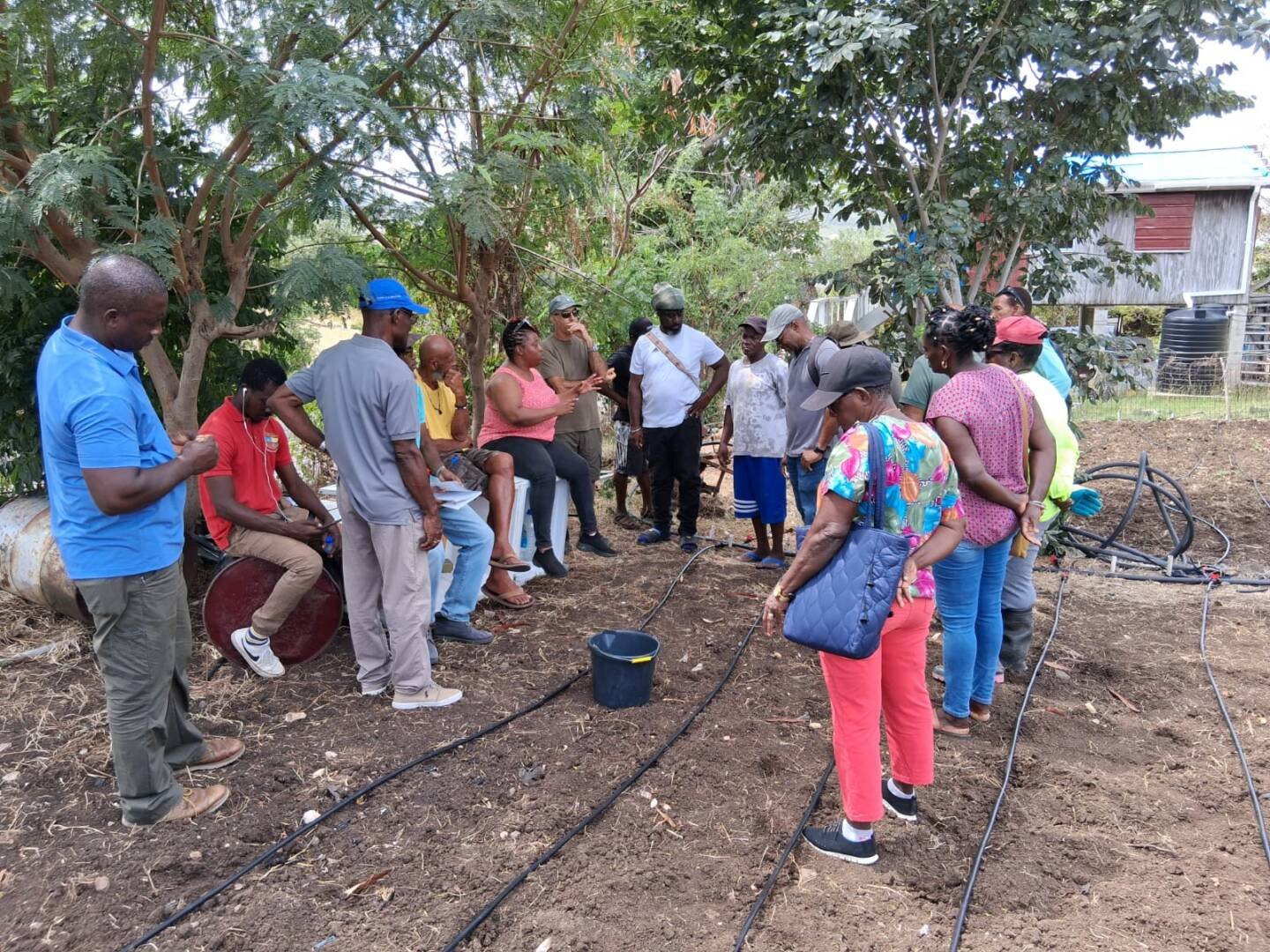
Farmers across Carriacou and Petite Martinique are now better equipped to improve their productivity and climate resilience following specialised training in the installation of micro-sprinkler and drip irrigation systems.
The training was conducted after 12 farmers, 7 from Carriacou and 5 from Petite Martinique, received irrigation equipment designed to enhance water efficiency on their farms.
Both the provision of irrigation systems and the hands-on training were made possible through the Climate-Resilient Water Sector in Grenada (G-CREWS) Challenge Fund for Agriculture (CFA).
The programme continues to support farmers with water-efficient technologies, including micro-sprinklers, drip irrigation, and rainwater harvesting systems, aimed at strengthening resilience within the agriculture sector.
Through this intervention, farmers are now able to deliver water directly to crops with greater precision, reducing water loss and improving overall operational efficiency. This is particularly critical for Carriacou and Petite Martinique, where water scarcity and prolonged dry periods can significantly impact agricultural output. In addition to boosting production, the training has enhanced farmers’ technical capacity, enabling them to independently install, manage, and maintain irrigation systems.
For farmer Rohan Thomas, the training has provided him with practical knowledge that will directly improve his farming operations. He said, “Thanks to the G-CREWS project. The training was very informative. I learnt a lot. It should help us, as farmers, in a great way. First, in conserving water and farming year-round.”
Another beneficiary, Kurt Quashie was appreciative of the training, noting that it will greatly assist them in the dry season, especially. He said, “The equipment comes at a good time, now that it is the dry season. It will help towards improving food security in the near future.”
Supporting the installation of the irrigation systems was Kaitlyn Weekes, who highlighted the impact it will have on the agriculture sector in Carriacou and Petit Martinique. She said, “It is very important that we have this system in which we can water our plants and get them growing at a faster rate. This system drops the water directly into the roots of the plants, resulting in increased production over time.”
Facilitator of training, Elhaddaji Lahcen from the company Agile Water Solutions, said the farmers were taken through the different parts of the system. He said, “The only system that can save water right now on irrigation is drip irrigation and micro-sprinklers, but more drip irrigation. We did a small demonstration on the installation of the drip irrigation system, while reminding farmers of the importance of securing spare parts for repair needs.”
CFA Consultant from the Grenada Development Bank Derek Charles said the farmers were very intrigued with the training. He noted that through the programme, some farmers received water tanks for rainwater harvesting in addition to the irrigation systems. “They had hands-on experience with the layout of the lines and checking the pressure within the lines. From this training we are sure, they would be able to install their own lines.”
The G-CREWS project is jointly financed by the Green Climate Fund (GCF) and the German Federal Ministry for the Environment, Climate Action, Nature Conservation and Nuclear Safety (BMUKN) under its International Climate Initiative (IKI), and the Government of Grenada (GoG).
The project aims to enhance climate resilience in Grenada’s water sector through a comprehensive transformation at various levels, fostering a paradigm shift for overall national resilience.
G-CREWS