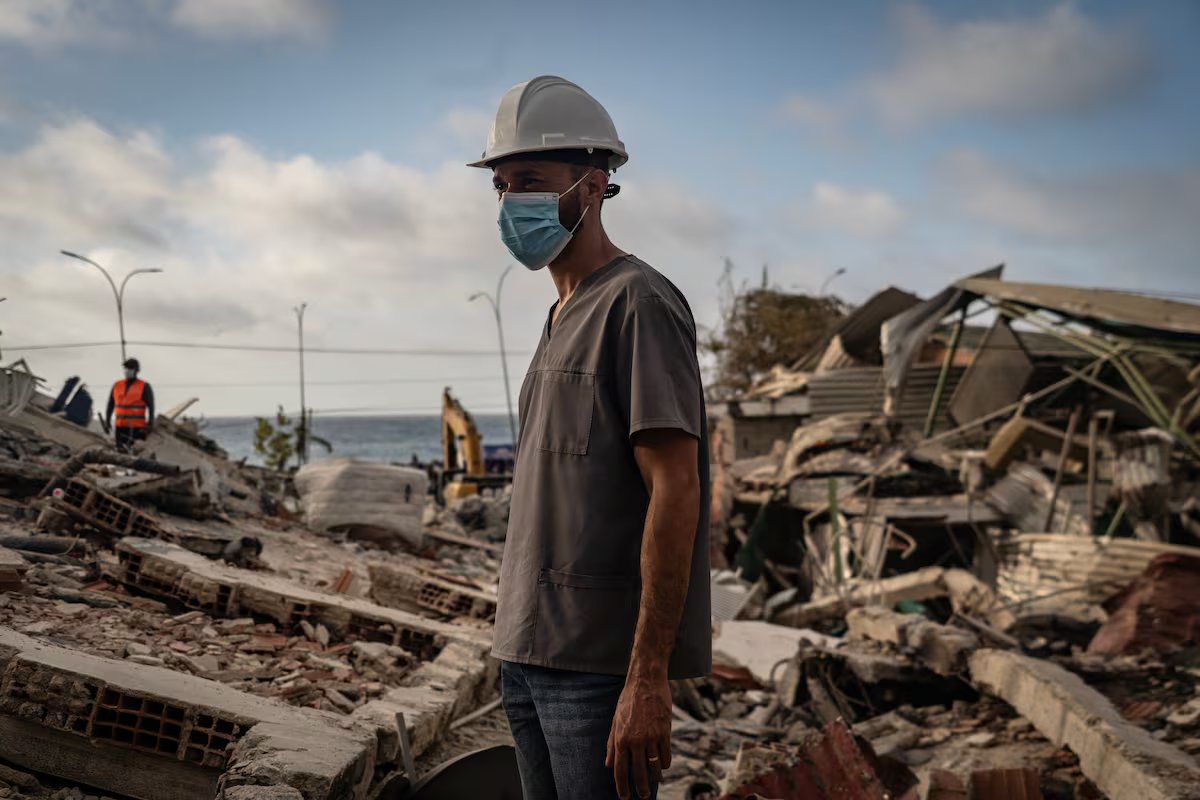
The only way to escape the smell is to get as close to the sea as possible. The coastal road is a physical and olfactory frontier. On one side, the serene and Caribbean water of an almost desert beach. On the other, one building after another, all collapsed in a mass of iron and cement. Mountains of rubble, excavators, ambulances, military, police. All searching for hundreds of bodies buried after the earthquake at ground zero in La Guaira. A world in ruins under the sun that reaches 40 degrees in mid-afternoon. The Government of Venezuela has distributed masks due to the risk of infections due to the decomposition of corpses. Four days after the earthquakes that shook the country, The smell of death is so present that it only disappears with the salty sea breeze.
Ángel arrived at dawn with another dozen colleagues from a motorcycle club. He has come to help from the State of Sucre, almost 10 hours away by car, and they began searching through the rubble with the first rays of the sun. The roof of one of the buildings next to the beach road is now a vertical wall with the satellite dishes lying on the sidewalk. Ángel and his companions slipped through one of the gaps. As they made their way, the first thing they found was an arm sticking out of the rubble. Then, one leg dangling. Ángel felt a chill and turned away from the scene. He is 23 years old and his grandmother recently died. “I saw his body at the wake, but this is something else. It’s something strange. Especially the smell,” he says, sitting in a plastic chair under an umbrella looking at the sea.
The rows of umbrellas still stand, as if the sand on the beach had miraculously protected them from the tremor. It is the only remnant of daily order, a memory of the placid life before the tragedy. Alejandro, another volunteer who has traveled almost an entire day from Barinitas, in the Venezuelan Andean mountain range, has also come here. “I needed to relax my mind. There are many things that one sees and they are difficult to overcome, then.” Alejandro, 29, works as a driver for tourists in his town, and this morning he found a body lying on a bed among the rubble. Unlike Ángel, it was not the first time he had faced raw death. “I’ve seen shootings, but this is different. People here have lost their lives all at once, without expecting it,” he says behind giant glasses and a sweatshirt with the word “faith” written on the chest in the shape of a crucifix.
A military helicopter flies over the beach towards the devastated city and the noise of the propellers interrupts the conversation. Alejandro looks up at the sky with his mask hanging from his neck. He doesn’t know how to explain how that smell fills everything. “It’s not like rotten fish, it’s stronger and you don’t take it off unless you come here, near salt water.” Gentle waves wet the shore and repeat the same cadence in a loop, oblivious to the unpredictable chaos on the other side of the road. In another corner of the beach, two rescuers have taken off their overalls, boots and helmet. They sleep, or at least rest with their eyes closed, on plastic chairs facing the sea.
Hope and frustration
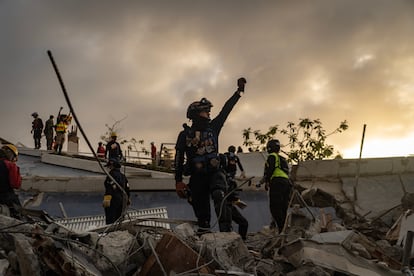
The search for the buried bodies is an explosive mixture of hope and frustration. Climbing to the top of a mountain of rubble, what remains of an eight-story building, Rubén asks for silence with the code of raising his right arm in the air with a closed fist. When the swarm of people obey from the sidewalk, he says from above in a hoarse voice: “Two professional rescuers have confirmed that there is a survivor.”
The door of hope had opened in the morning, when a voice was heard from the depths of the rubble. Firefighters arrived, as well as police and military. But the leader of the improvised rescue plan is still Rubén. “That guy is tough, he’s very hot,” says one of the neighbors from the street.
Everyone thinks the same about Rubén, who lives, or rather lived, two blocks from here. They say that it arrived on Wednesday, the day of the earthquake, and that with their help, five people have already been recovered alive from this building on the side of the beach. “Today he was here at eight in the morning, he came from helping at another house next door. He worked until noon. He stopped to sleep on the floor for about an hour and continued again. He is like the protagonist of a novel.” It is told by Flavio, himself, another character in an epic story. His wife has been trapped in the rubble and is participating in the rescue efforts. His entire body is tanned from the long hours in the sun and he has an enviable mood: “I eat an arepita with cheese and continue forward. “You try to survive no matter what.”
Adrenaline is a powerful fuel, perhaps the only possible fuel in the face of desolation. But the spiral of faith also hides traps. More professional rescue teams have already arrived to try to remove the voice that was heard in the morning. The last signal was a light sound of two stones colliding, the protocol requested by the rescuers assuming that the survivor, after four days buried, no longer has a voice left to ask for help.
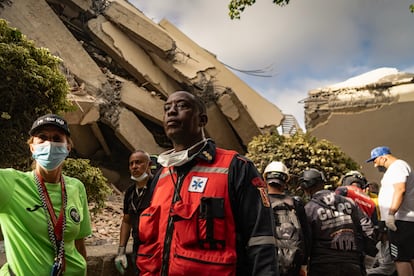
From the top of the mountain, Rubén reports: “Rescue cancelled. The professional rescuers have not been able to confirm the signal and the place is too dangerous. Everything can collapse and they have decided not to risk five lives for a person who there is no certainty is still alive.” The electric atmosphere of excitement turns into a void of silence. Volunteers and rescuers are climbing down from the mass of rubble. One of them is a Mexican soldier. He carries a portable orange stretcher under his arm. When he manages to get down, he asks where the rest of his team is. No one has seen more Mexicans in the olive green uniform. He has lost them and decides to walk back along the beach road with the stretcher under his arm, like the surfboard that a drowned person clings to.