Madrid/More than three months ago, Francisco Pichón, resident coordinator of the United Nations in Cuba, told the press international organization that was negotiating with the United States to bring fuel for humanitarian purposes to the Island and thus be able to mobilize the agency’s aid. The situation is stagnant at that level – “Until this moment, there has been no solution” – although the official said this Monday in an interview with elDiario.es What has been achieved is obtaining some amounts through the Cuban private sector.
“It is not enough to implement our action plan, but it has allowed us to move many containers that were already in the port or in warehouses in the country and that had arrived as part of the response to Hurricane Melissa,” he explains in the conversation. The World Food Program (WFP) first obtained 15,000 liters of fuel through alliances with private parties, thanks to the authorization of the regime for them to buy and from Washington for companies in their country to sell only to individuals on the Island.
Now, adds Pichón, a second, much larger shipment has been achieved, “of 120,000 liters that are already in the country.” The official adds that this allows them to continue working, but a “broader” solution is needed, with access to minimum and predictable fuel, for which they continue to advocate and negotiate from their headquarters in New York and Geneva.
The official adds that this allows us to continue working, but a “broader” solution is needed, with access to minimum and predictable fuel, for which he continues to advocate and negotiate from his headquarters in New York and Geneva.
Pichón says that the UN plan for Cuba has a goal of 94.1 million dollars, a third of which is insured, although there are better established parts. Furthermore, he specifies that without that fuel what is achieved is of little use, which is why he insists on reaching agreements. He says that Mexico was one of the main interested parties in contributing, as well as Brazil, but these and other States are waiting for the result of the conversations with the United States, in which – he affirms – he is not personally involved.
“The implementation of the action plan depends on access to fuel, and the plan is essential to identify the fuel needs that are required in the humanitarian field, not to stabilize the country’s economy, but only for humanitarian purposes,” he adds. The priority is in the health, food security, water and sanitation, education, habitability and protection of the vulnerable sectors.
In addition, he adds that the WFP has an estimate of the fuel required to maintain these services and the needs of other international NGOs with a presence on the Island. It all depends on the solutions that can be reached.
“We know that there are political differences between Member States and it is governments that have to work to resolve those differences. But we, as the United Nations system, are people-centred, and our humanitarian action is about people’s rights to life and dignity,” he argues.
In the interview, the official provides some indicators of the humanitarian crisis that the Island is suffering and how living conditions are deteriorating and although, when asked if it would technically help if Cuba declared the emergency, he avoids going into depth. “We see that there is a recognition of the severity of the situation, and there has also been talk of the resilience of the Cuban population, but due to the accumulated impacts of previous disasters and the contraction of the economy by 15% in recent years, that resilience also has a limit, especially without a fuel solution in sight,” he laments.
In fact, the official regrets that practically all countries and companies are “over-compliant” in the face of the threat of being penalized.
Pichón believes that if the United States provided this humanitarian fuel, other countries would have less fear of sanctions. In fact, the official regrets that practically all countries and companies are “over-compliant” in the face of the threat of being penalized. “Faced with the threat of sanctions from executive orders, especially that of May 1, these companies avoid exposing themselves to the risk of being sanctioned. And this is manifested in contracts and deliveries that are already underway, but that suffer delays or uncertainty,” he details.
According to Pichón, there are 2,900 tons of food purchased and acquired by the WFP, but now they have to renegotiate how to bring them to the country. “It is one thing for suppliers or shipping companies to have restrictions due to the executive order, but another is for them to apply measures that are not in the restrictions for fear of being sanctioned, because it narrows the space for humanitarian action,” he rejects, while remembering that international law protects humanitarian actions, which cannot suffer punishment.
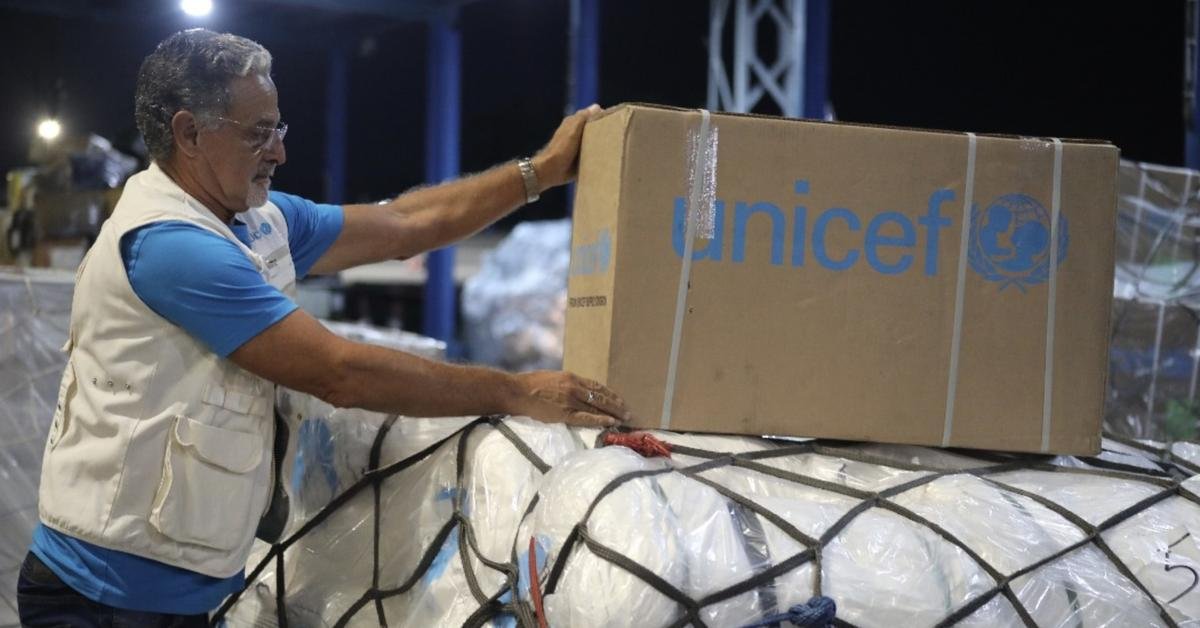
Unicef has seven shipments affected, adds Pichón, valued at $630,000, mostly emergency medical kits, supplies for newborns, nutritional supplies for pregnant and lactating women. “Some of these supplies have had to be redirected on alternative routes, which are always longer and more expensive. In the health field it is especially delicate, because there are medicines that need refrigeration conditions,” he laments.
Regarding the mental repercussions caused by the situation, the official also expresses concern. The lack of electricity, water and other vital services, together with speculation on social networks, he says, are generating a feeling of psychological distress and exhaustion in the population, especially in groups such as children, adolescents, the elderly and their caregivers. “People are more focused on their day-to-day survival.”