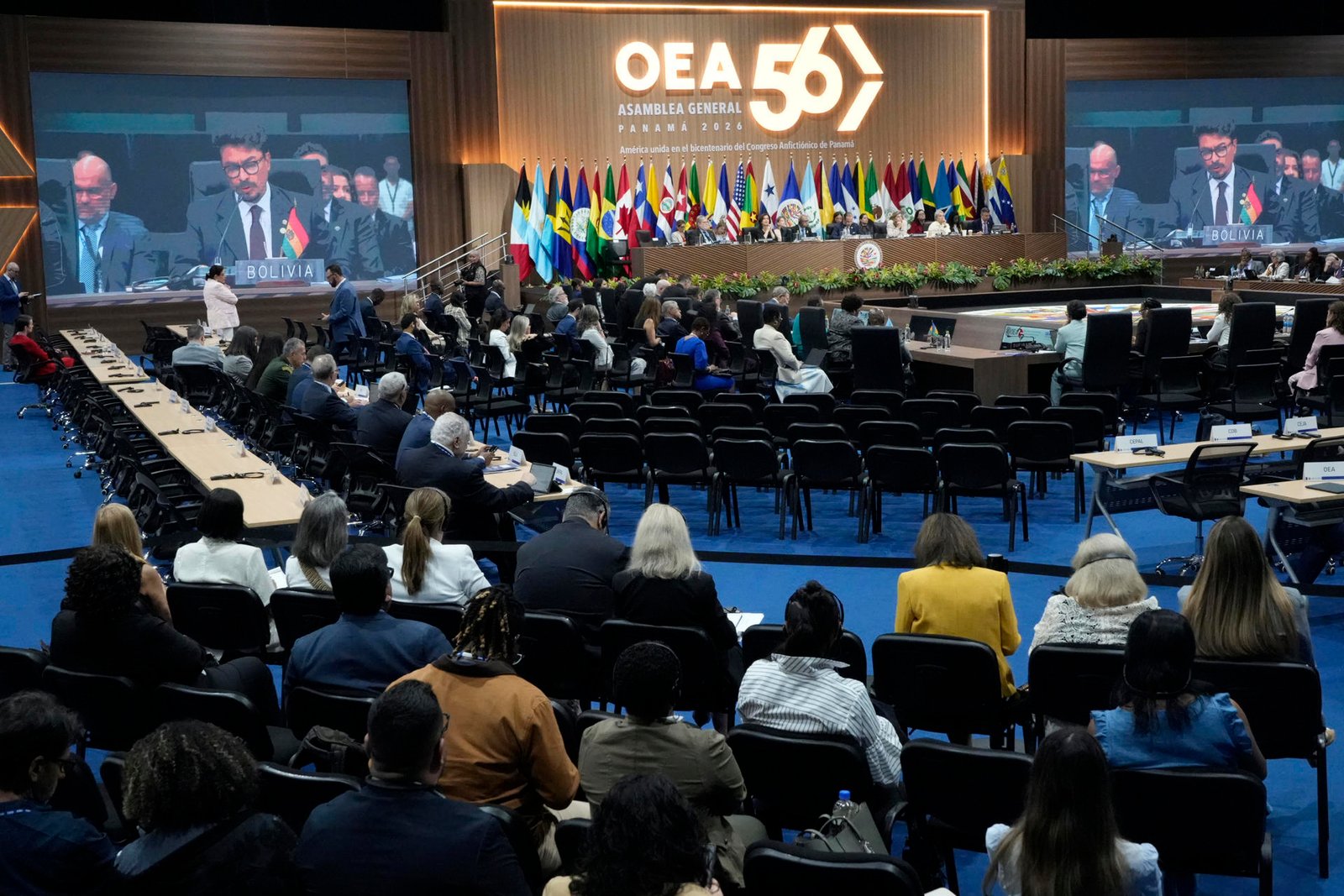
In the Organization of American States (OAS) there is a “consensus” that Daniel Ortega “is a dictator” and that his “regime is brutal,” said members of the Nicaraguan opposition participating in the 56th General Assembly being held in Panama.
“No one is defending Ortega and (Rosario) Murillo in this space,” they emphasized.
Delegations from countries such as Chile or Argentina, which are part of the Shield of the Americas promoted by Donald Trump, maintain “a tougher position” against the Nicaraguan dictatorship, warned the representative of the Nicaraguan University Alliance (AUN), Douglas Castro. Even, he continued, countries like Mexico, Brazil or Colombia “are critical” of the Nicaraguan regime, but with “nuances.”
In an interview on the program The TertuliaCastro highlighted that “the consensus” obtained to approve the statement on Nicaraguawhich condemns the repeated violations of human rights in the country, is something “quite positive.” This fact reflects that “there is a consensus in Latin America that Ortega is a dictator and that the regime is brutal.” Unlike other authoritarian regimes, when talking about Nicaragua “there is unanimity,” he noted.
Lesther Alemán, also a representative of AUN, explained that—prior to the opening of the General Assembly—countries such as Brazil, Mexico and Colombia were expected to present some footer. To the surprise of the Nicaraguan delegations “they did not do it” and, furthermore, “they joined the consensus.”
Alemán highlighted the interventions of the Foreign Minister of Costa Rica, Manuel Tovar, of the President of Panama, José Raúl Mulino; and the statement by the Secretary General of the OAS, Albert Ramdin; who in his opinion “presented the demands of the Nicaraguans.”
Costa Rica’s firm intervention stands out
The political movement in exile “Ruta del Cambio” highlighted the firm intervention of Costa Rica during the General Assembly, in which it expressed its country’s concern about the Russian military presence in Nicaragua, as well as “terrorist organizations” such as Hamas and Hezbollah.
“Costa Rica reiterates its deep concern about the situation in Nicaragua, the restrictions on fundamental freedoms, the closure of civic spaces, the complaints of arbitrary detentions, the persecution against dissident voices, human rights defenders and members of religious communities, including the Catholic Church,” said the Costa Rican Foreign Minister for the second consecutive day in the Assembly of the hemispheric organization.
Ruta del Cambio expressed its “recognition and gratitude to the Government of Costa Rica and Foreign Minister Manuel Tovar Rivera for their firm intervention during the OAS General Assembly,” in a statement by the political movement, led by the denationalized opposition leader Félix Maradiaga.
The opposition group valued positively that Costa Rica “continues to raise its voice against the threats that the Ortega-Murillo dictatorship represents for democracy, human rights and regional security, as well as its support for the initiatives that keep Nicaragua on the hemispheric agenda.”
“The solidarity and democratic commitment of countries like Costa Rica are fundamental to accompany the struggle of the Nicaraguan people for freedom, justice and democracy,” he added.
They celebrate “strong words” from President Mulino
On the other hand, several Nicaraguan opposition movements and organizations celebrated the inclusion of Nicaragua on the agenda of the regional organization, despite the fact that ceased to be a member in 2023; as well as “the strong words” from President José Raúl Mulino on the Nicaraguan crisis, those of Foreign Minister de Tovar, and of the United States Undersecretary of State Christopher Landau.
Amaru Ruiz, president of the canceled Fundación del Río and coordinator of Red Local, stated that the joint work between civil society organizations and opposition actors contributed to the situation in Nicaragua being incorporated into the agenda and that there was “a firm statement” regarding the
deterioration of human rights and fundamental freedoms.
President Mulino recalled the political and human rights situation that exists in Nicaragua, Cuba, Venezuela and Bolivia.
Mulino stated that, in its capacity as host State, Panama considers its “obligation” to point out what the organization “cannot ignore,” in reference to the situation in Nicaragua, where he denounced a “serious deterioration in respect for human rights.”
“The persecution of opponents, the systematic closure of civic space, the expulsion of humanitarian organizations, the imprisonment of religious leaders and the forced exile of thousands of citizens are facts incompatible with the principles that this organization defends,” said the Panamanian president.
Asks the OAS to declare the regime illegitimate
The opposition platforms also asked the OAS to declare the Ortega and Murillo regime “illegitimate,” because the positions they hold were obtained through electoral fraud documented by the same regional organization.
“The member states (of the OAS) are being asked that the treatment granted to the regime headed by Daniel Ortega and Rosario Murillo corresponds to that of an illegitimate regime, both in its origin and in the exercise of power,” they indicated in a joint statement.
The group recalled that in the resolution The situation in Nicaraguaapproved by the OAS General Assembly on November 12, 2021, it was declared that the elections held on November 7, 2021 were not free, fair or transparent and lacked democratic legitimacy.
“The organizations consider that this declaration must be translated into concrete political and institutional consequences,” they argued.
Therefore, in addition to declaring the illegitimacy of Ortega and Murillo, the opponents ask the OAS “to reaffirm the sovereign right of the Nicaraguan people to freely elect their authorities through truly democratic elections.”
With information from EFE.