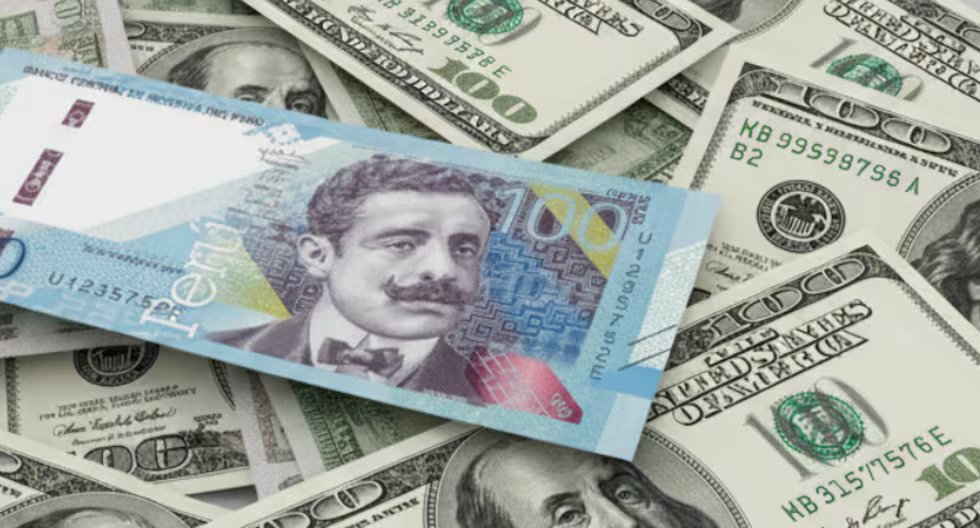

The exchange rate begins the election week with a price of S/3.42, which represents a decline of 0.73% compared to the last Wednesday before Easter.
During the first quarter of the year, the North American currency recorded episodes of volatility, especially in March, although in relative terms it was a period of limited fluctuations. According to specialists consulted for this report, the range at the beginning of 2026 ranged between S/3.31 and S/3.49; However, towards the end of the third month of the year, the pressures took it to averages between S/3.44 and S/3.47.
According to Bloomberg Línea, the first relevant jump was observed on March 2, when it went from S/3.36 to S/3.41. From that moment on, the greenback did not return to the levels it showed at the beginning of the year. It even reached a peak of S/3.50 on March 29, a record not seen since the last week of September last year.
“It was a quarter of low relative volatility, although with episodes of tension in March,” commented Gustavo Ayala, Maura Lead Fx Peru at Rextie.
The conflict in the Middle East became the main trigger for the rise during the third month of the year, raising doubts about its duration, says Juan Acosta, professor of International Business at UPC.
“Investors anticipate different scenarios to guide their decisions; however, the most feared scenario is, without a doubt, the one marked by uncertainty, like the one we are currently experiencing,” he highlights.
In parallel, adds Rextie, at a global level the weakness of the dollar also influenced, associated with expectations of rate cuts by the Fed and the decline of the DXY Index (US dollar index), which favored emerging currencies such as the sun. However, episodes of risk aversion partially offset this effect.
Domestically, the impact was more limited. In fact, “not even the unexpected change in the country’s presidency in mid-February had an impact on the evolution of the sun,” highlights Pablo Nano, deputy manager of Economic Studies at Scotiabank.
Peru begins the week before the presidential elections on April 12. The expectation surrounding the candidates who would go to the second round could generate movements in the price at the local level.
“The market will analyze the scenarios that could arise as a result of the political and economic approaches proposed by both candidates,” highlights Acosta.
For now, Hugo Perea, chief economist at BBVA Research, rules out that the electoral effect is already being reflected in the price. Proof of this is the decline recorded at today’s close; however, changes could be seen in the coming days as the weekend approaches.
“(The electoral issue) is always important. Issues linked to elements that can generate uncertainty and reduce visibility about what is coming forward can affect exchange rate movements, but so far there is no electoral risk premium that is being quoted in the currency,” he highlighted.
From Rextie they anticipate an increase in volatility during these days. “Although the market still perceives a spectrum of moderate candidates, the uncertainty inherent to the electoral process could lead the dollar to remain in the upper part of the recent range (around S/3.45), with movements sensitive to surveys and governance expectations. This effect could be transitory if the results are perceived as pro-stability,” Ayala mentions.
During this week the dissemination of surveys is prohibited; However, previous processes have shown that some circulate through social networks, and the trends they reflect could influence the exchange market.
“Towards the end of the week we will see how the dollar will mark a clearer trend and reflect investors’ expectations about the two candidates who lead the vote preference, as well as the economic and political ideas they propose,” says Acosta.
For now, adjustments to estimates for the end of 2026 remain on hold. In the case of BBVA Research, they are waiting for the results of the first round to review their forecasts for December.
Meanwhile, Rextie projects a year-end between S/3.40 and S/3.45, incorporating volatility scenarios in the first half due to the electoral process and a normalization in the second half.
For its part, Scotiabank maintains its initial projection of S/3.35 per dollar for the end of this year. “This projection is based on the new government maintaining the current economic model and the conflict in the Middle East beginning to de-escalate, reducing its impact on the price of oil and on inflation expectations during the second half of the year,” Nano mentions.
In the short term, the exchange rate will be highly sensitive to the evolution of the conflict in the Middle East, which could increase global risk aversion and strengthen the dollar; the Federal Reserve’s monetary policy decisions, especially around rate cuts that could put downward pressure; and to the development of the Peruvian electoral process.
Added to these elements are other external risks that could intensify volatility. Among them, an eventual correction in international financial markets, after having reached maximums driven by expectations about artificial intelligence; China’s structural vulnerabilities, especially in its real estate sector and in a context of oversupply and deflationary pressures; and the possible consequences of the conflict in the Middle East on global oil production, considering the damage to energy infrastructure in Gulf countries and the uncertainty about the ability to compensate for lower supply.