About 6 000 fisherfolk are set to benefit from a pioneering insurance mechanism that will release funds before hurricanes strike, giving them critical time to secure vessels and livelihoods, Barbados TODAY can reveal.
The ground-breaking programme, initiated by the government, was developed jointly by the United Nations Office for Disaster Risk Reduction (UNDRR) and CCRIF SPC (formerly the Caribbean Catastrophe Risk Insurance Facility), the regional insurance facility that provides quick payouts after catastrophic events.
This first-of-its-kind initiative — known as an anticipatory action (AA) mechanism — is designed to release funds to vulnerable fishing communities up to three days before a hurricane makes landfall – well before losses and damages materialise – giving fishers the time and means to secure their boats, remove their engines, protect their equipment and seek shelter, ultimately reducing the risk of lost lives and livelihoods.
AA mechanisms are forecast-based financing tools designed to release funding before a disaster strikes, rather than after damage has occurred. Using advanced weather modelling and risk thresholds, these systems trigger early payouts when a credible threat — such as a hurricane — is detected, enabling vulnerable communities to take preventive measures such as securing assets, evacuating safely and protecting livelihoods.
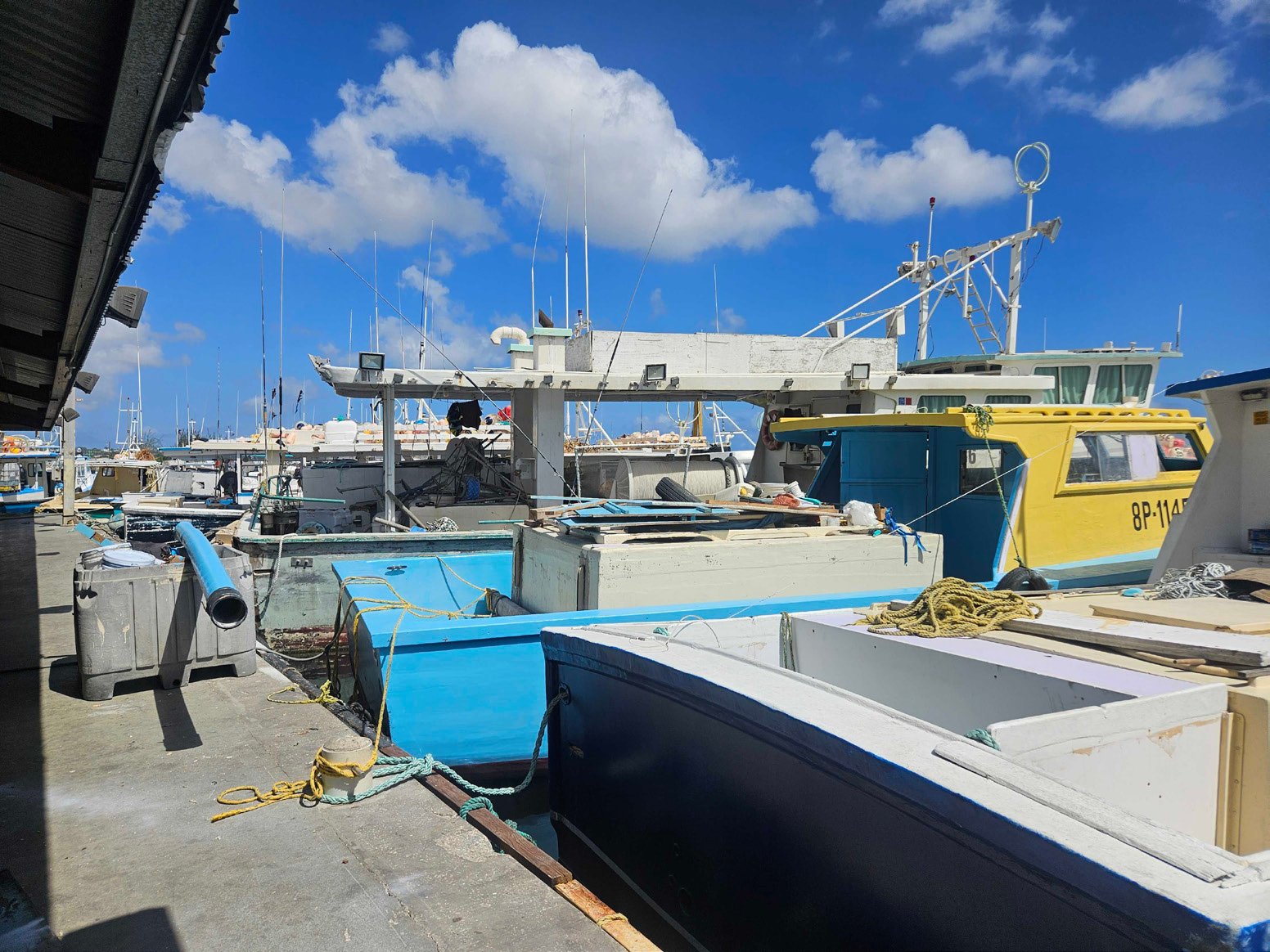
By shifting the focus from response to preparedness, AA mechanisms aim to reduce human and economic losses, improve recovery times and make disaster risk management more proactive and cost-effective. It comes in the wake of Hurricane Beryl’s near-wipeout of the fishing fleet as it swept by Barbados in 2024, from which many fishers are still recovering.
President of the Blackfin Fleet Cooperative Society (BFCS), Moonesh Dharampaul, said: “I think everyone in the fishing sector should benefit from this, and the fishing sector is roughly 6 000 persons; and that would be all vendors, fishermen, processors, people who mend nets; anybody who is involved in the fishing industry. We have fellows who do pot fishing, you have fellows who do spear-fishing and so on.”
Dharampaul’s cooperative was involved in discussions with the developers of the programme before its rollout on Thursday.
He said: “I had a meeting about this three to four weeks ago. This mechanism represents the first parametric insurance product, which is designed specifically for the fishing sector. This mechanism is a rapid financial protection for the fishing industry, in the light of adverse weather conditions and climate change. It is a welcome addition to the fishing sector.
“When it comes to payouts and so on, it goes to the Government of Barbados through the Ministry of Finance and Division of Fisheries, so that they would be able to get to the vulnerable persons, especially the fisherfolk who live along the coastal areas and so on.”
Dharampaul continued: “We see it as an addition to the other things the government is to put in place. This also addresses heavy rainfall and coastal erosion at the end of the day. So, it is something that we are looking forward to working with the government on, and the insurance model known as COAST (The Caribbean Oceans and Aquaculture Sustainability Facility).”
The developers also said the insurance instrument builds directly on the operational model of COAST, the world’s first parametric insurance product designed specifically for the fisheries industry, launched in 2019 and currently held by seven Caribbean countries.
But while giving the new social and economic safety net and its potential benefits the thumbs up, the fishing industry spokesman expressed concerns about boat owners’ ability to be fully prepared to protect their assets during an approaching storm.
“We still have concerns going into the hurricane season, which would be the ability to have different haul facilities and slipways. We don’t have enough slipways as yet, and we don’t have enough haul-out facilities as well.
“We are looking to work with the ministry to ensure that those programmes that they have in place, would be able to come to fruition so that we can get the boats out of the water as fast as possible.”
There are presently 280 active boats on the water, and it takes a minimum of 72 hours to effectively get those vessels out of the sea and find a place to put them, he disclosed.
Dharampaul added: “You are taking these boats out of the water, they need to go on trailers, they need to go on props, where we are going to put them; and when we put them, we still have to put them in a safe area too. A hurricane can be so strong, it could blow those boats down. So, that is something we are looking at as well.”
The AA mechanism draws on the same fully probabilistic hurricane risk models that already underpin CCRIF’s parametric insurance policies, but introduces a decisive innovation: rather than paying after an event, it pays ahead of one, with anticipatory payouts driven by transparent, verifiable trigger conditions linked to reliable hurricane forecasts.
Anchoring the triggers in probabilistic risk models allows for a rigorous definition of how frequently the instrument will be activated, which in turn determines its operating cost and underpins its long-term financial sustainability.
Because forecast-based triggers tend to activate more often than past observed events alone would suggest, the pricing is carefully calibrated through adjusted thresholds, geographic refinements and premium loadings, so the product remains both operationally useful and financially sound.
Dharampaul also added his understanding as to how the payouts will work.
“I believe that most of them are done on the number of persons in the fishing sector, based on the value of boats, and the effects, not only for the fisherman, but fish vendors and processors along the way. So, that is how they will calculate the metrics.”
The instrument addresses a long-standing dilemma. Every time a hurricane forms in the Atlantic, fisherfolk face a difficult choice: stay ashore and lose the income that sustains their families, or head out to sea under deteriorating conditions, hoping to make use of the last hours before the storm.
By design, the mechanism carries strong potential for scale-up across the Caribbean and allows for replication in other regions where hurricanes occur, as well as expansion to other forecastable hazards such as droughts, lightning and heavy rainfall, which also disrupt the lives and livelihoods of the most vulnerable communities.
But Dharampaul said he is so far uncertain whether it covers the impact of the Sargassum seaweed.
The developers said the product is structured as a macro- or meso-scale insurance solution: rather than paying individual fishers, it pays an intermediary institution that channels funds to affected communities.
The World Food Programme (WFP) has expressed strong interest in serving as policyholder and has confirmed its capacity to disburse funds to fisherfolk rapidly and at scale, with organisations such as OCHA (the United Nations Office for the Coordination of Humanitarian Affairs) or national governments able to play the same role.
The technical foundations for the instrument were established through a UNDRR-commissioned study under the Early Warnings for All initiative, focused on three pilot countries – Barbados, Jamaica and Dominica. The study confirmed that an anticipatory action instrument for hurricane wind impacts is technically feasible and well aligned with the region’s existing forecasting and risk-transfer systems.
(EJ)