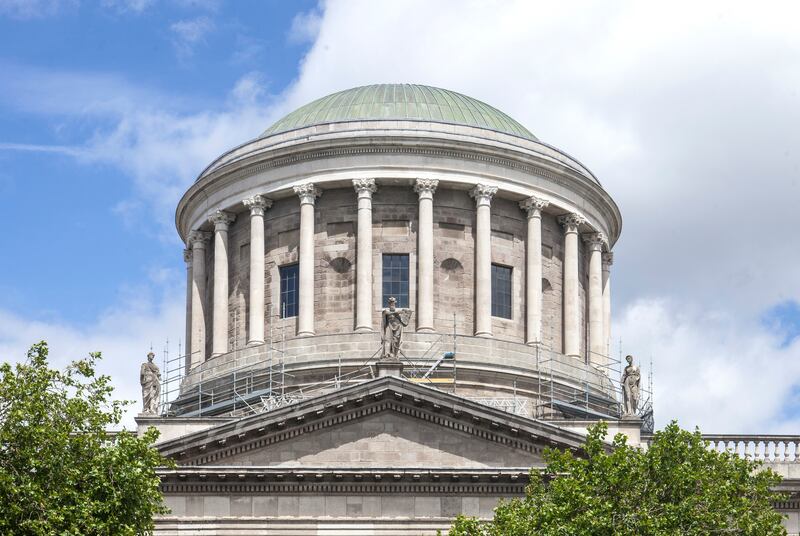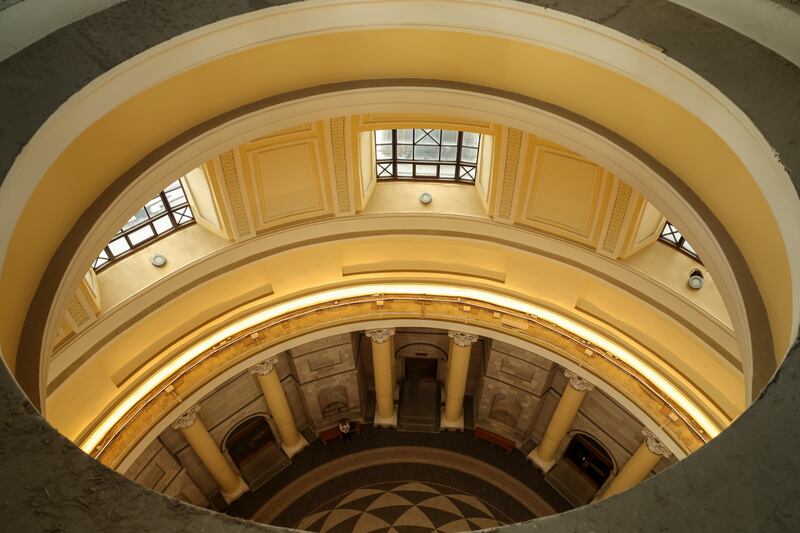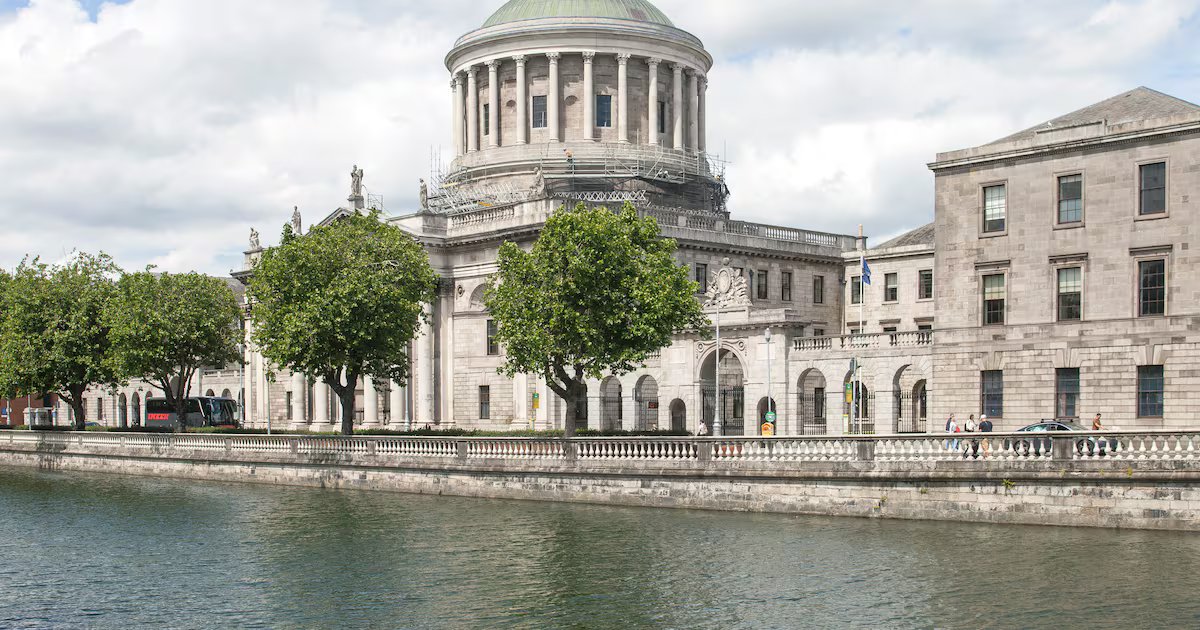
There’s a sense of history repeating itself in the view of Dublin from Grattan Bridge west along the Liffey towards the Four Courts. Over recent months the dense scaffolding that has shrouded the landmark 18th-century building for the best part of a decade has finally been dismantled, slowly revealing, like a classical striptease only the Romans could concoct, the landmark drum and dome.
The seductive view of this neoclassical colossus, looming over the chimney tops of Ormond Quay, revives the sensation that stirred its London-born architect, James Gandon, to record in his diary in January 1794 that four of the columns, complete “with their entablature, were raised, and set around the drum of the dome, so that some idea could be formed of what was intended”.
He also wrote that “the dome, from its eminence, was now become the most conspicuous feature of the public buildings of Dublin, and from many adjacent parts of the country was seen to imposing effect”.
Gandon’s pride was also tinged with relief after years of political and financial wrangling that bedevilled the early years of the Four Courts project. It’s a mood that would not be unfamiliar to the design team overseeing its €11 million conservation, which has taken almost as long as building the entire complex did in the late 18th century.
“That’s the boyo that started it all,” Audrey Farrell, senior architect at the Office of Public Works, says, pointing to a photograph of a richly carved capital adorning one of the dome’s 24 columns, which are designed in the Corinthian order. “It was a fall of masonry from this capital in 2011 that started our investigations into the drum and dome. They were last assessed when we were up there in the 1990s.”
We’re standing in the OPW’s offices on George’s Quay, downstream from the Four Courts, which coincidentally have sensational views of Gandon’s Custom House masterpiece, on the other side of the Liffey. Covering the boardroom table is a mosaic of photographs documenting the Four Courts project, from investigations into stonework defects in 2015, when the first major scaffolding was erected, to subsequent repairs.
“By 2021 we had a very clear picture of what was required,” Farrell says. “Many of the capitals were in distress, and extensive stone and roof works were required in parallel to their repair.”
That masonry decay was a direct result of the turbulent history of this magnificent building. Constructed between 1786 and 1802 on a scenic bend of the river – absorbing an earlier public-record office, designed by the architect Thomas Cooley, on the western side – the Four Courts replaced Dublin’s earlier law courts and offices that had been nestled against Christ Church since the 1600s.
The new commission was a coup for Gandon, whose concurrent accomplishments at the Custom House – a project begun in 1781 – benefited from the deep pockets and architectural ambitions of his influential judicial client.
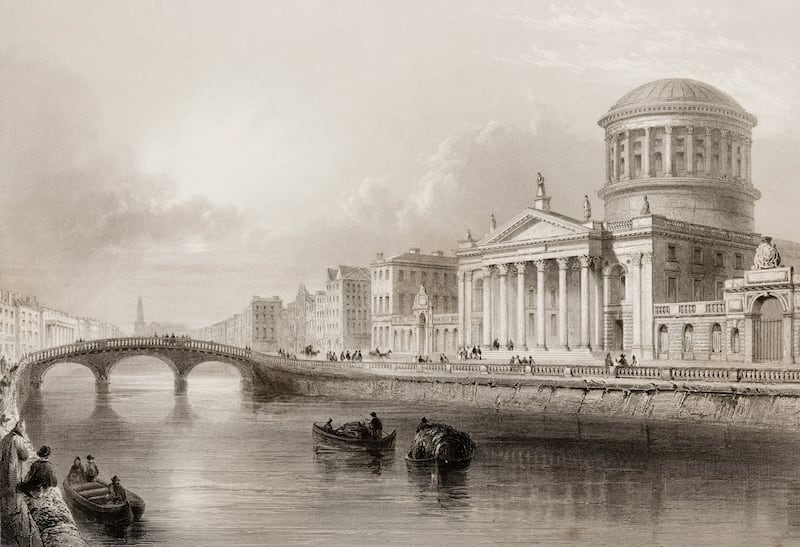

Gandon grabbed the opportunity, parachuting from antiquity on to the Liffey quays a monumental Roman silhouette of a scale and bombast never seen in Ireland before or since. The colossal neoclassical drum, 22 metres in diameter, cleverly compensates for the shortcomings of the site, which was constricted in depth and positioned just out of view of the commercial core of the city, to the east.
By raising the building like a lantern floating above the city, Gandon delivered usable floor area above its four courtrooms while ornamenting the capital city with a stupendous new landmark.
“It’s more monumental than just embodying justice,” says Tomás O’Connor, the OPW’s architectural head of conservation in Dublin. “Everyone knows it as part of our collective memory.”
That recognition is probably best known from the devastating Four Courts bombardment in June 1922, when occupying anti-Treaty parties were attacked by the Free State army.
The loss of centuries of Ireland’s social and cultural annals in the adjacent public-record office is well known, less so the near-destruction of the Four Courts itself, or just how perilously close the building came to being demolished in the aftermath.
It was the determination of the principal architect to the board of public works, TJ Byrne, that persuaded WT Cosgrave, the president of the executive council – taoiseach, essentially – that the building could even be saved, harnessing every pragmatic tool, from reinforced concrete to judicious stone recycling to stabilise and rebuild its shattered form.
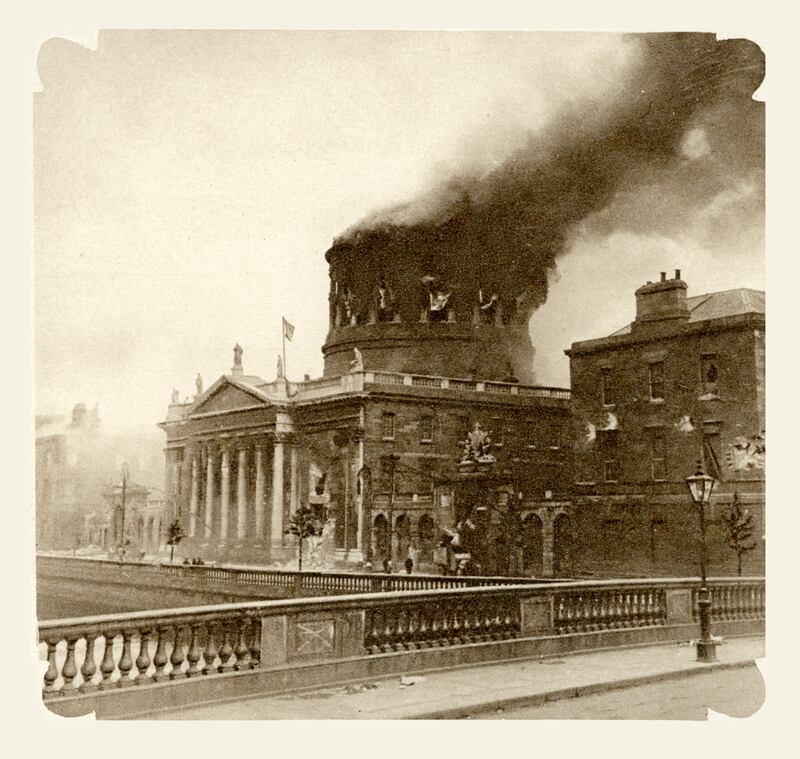

“This is a seriously shell-shocked structure,” Farrell says. “Just think what Byrne had to contend with in the 1920s, with the Custom House, GPO and O’Connell Street all being rebuilt and a shortage of skilled labour.
“He had to act fast on saving or letting go [of] the Four Courts. Saving it called for innovative techniques to stabilise the structure and cap the dome as quickly as possible.”
That solution came in the form of a new reinforced-concrete dome poured in a near-continuous 36-hour operation, replacing Gandon’s original timber roof. This had the benefit of quickly and economically capping the exposed masonry drum, which was literally belted and braced outside, with a giant steel band, to prevent the walls spreading horizontally under the enormous weight.
This had the unintended effect of turning the 24 column capitals into load-bearing elements, placing pressure on their delicate carvings. Falling masonry called for repairs as early as the 1940s, and again in the 1960s.
“Even the position of rotated capitals” – their damaged faces were turned inward – “tells us about the thinking in the 1920s,” Alan Keenan, the project architect, says. “The concentration of rotated capitals on the northeastern elevation of the drum suggests the most damaged elements were moved out of the prevailing wind and rain because of their vulnerability.”
Farrell agrees. “Europe is far more familiar with this type of trauma to their historic buildings,” she says, referring to damage inflicted during the second World War. “Conservation involves interdependent issues, and we couldn’t have anticipated the scale of [column] capital repair that was required until we physically removed each of the units for inspection.”
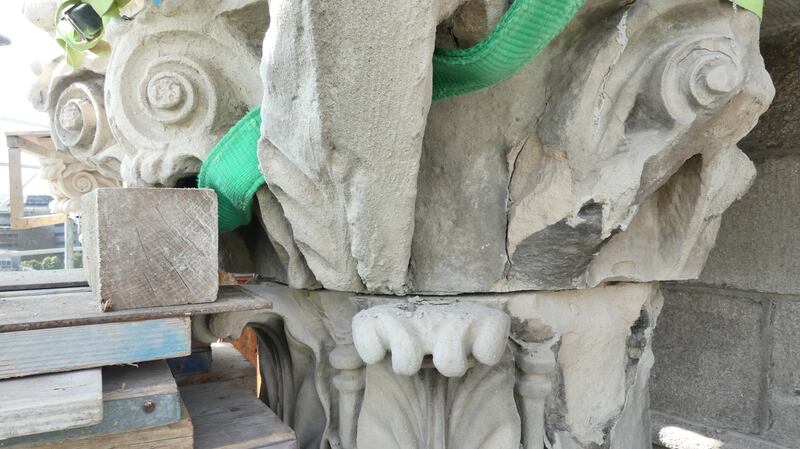
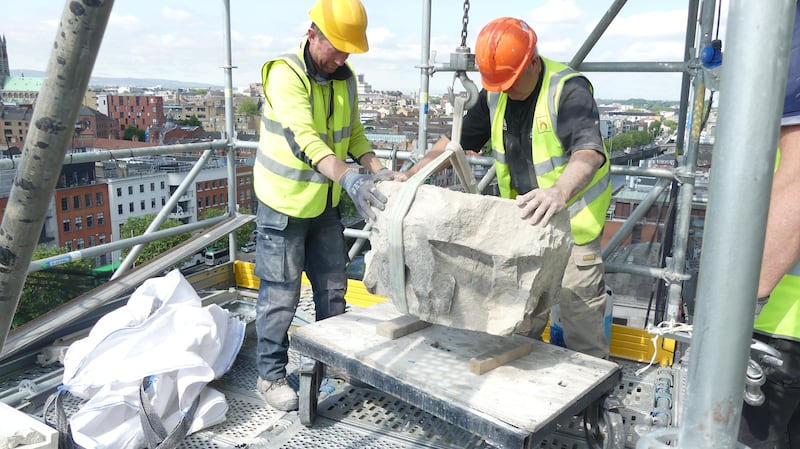

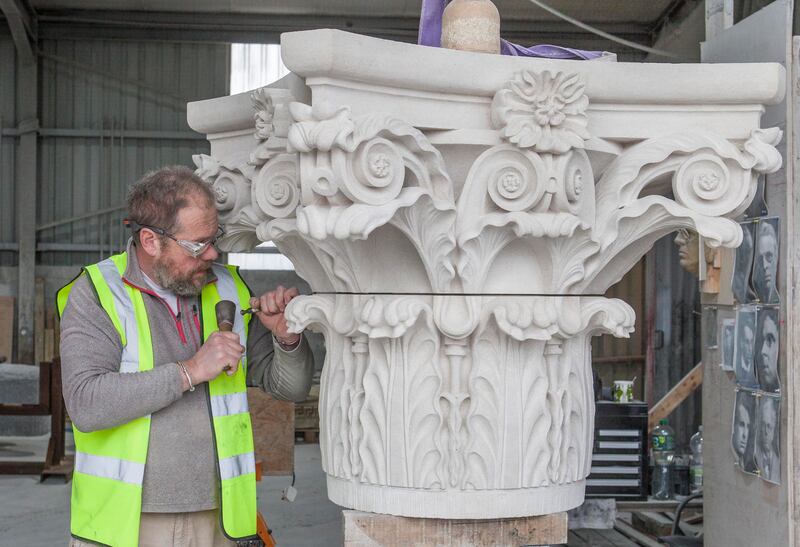
This daunting task was undertaken by the construction company PJ Hegarty and Irish Natural Stone, which is based in Co Clare. “We exhausted every type of technological survey to find cracks,” Keenan says. “Even capitals we thought were sound on site only revealed defects when they arrived in the workshop in Clare.”
“It was an incredibly rigorous process,” O’Connor says. “Unlike at the Notre-Dame restoration” – in Paris, much of the carving was replaced when the cathedral was restored after its fire of 2019 – “we endeavoured to retain as much of the original fabric as possible. In making the new capitals it was important for Ireland that we demonstrated a confidence that we could do this.”
Irish Natural Stone, the OPW and masons in England and Scotland carved trial capitals using both automated and traditional methods. The Irish company won the Europe-wide tender to undertake the Herculean carving of 22 of the 24 capitals, each consisting of two stones, overseen by its founder Frank McCormack.
“One of the greatest challenges was trying to understand the original mason’s intent,” he says. “So much detail had been lost through weathering, fire and damage over time. Rather than simply copying a single surviving capital, each one had to be carefully studied on its own merits before creating a final piece that was both unique and authentically faithful to the original craftsmanship.”
McCormack’s pride in steering the masonry team is palpable. “One of the key lessons was recognising the enormous educational value that major conservation works can provide. We’re immensely proud of the quality of craftsmanship the team achieved in our workshops in the Burren and visiting masons from the Compagnons du Devoir” − a French guild of craftsmen − “all learning and refining their skills.”

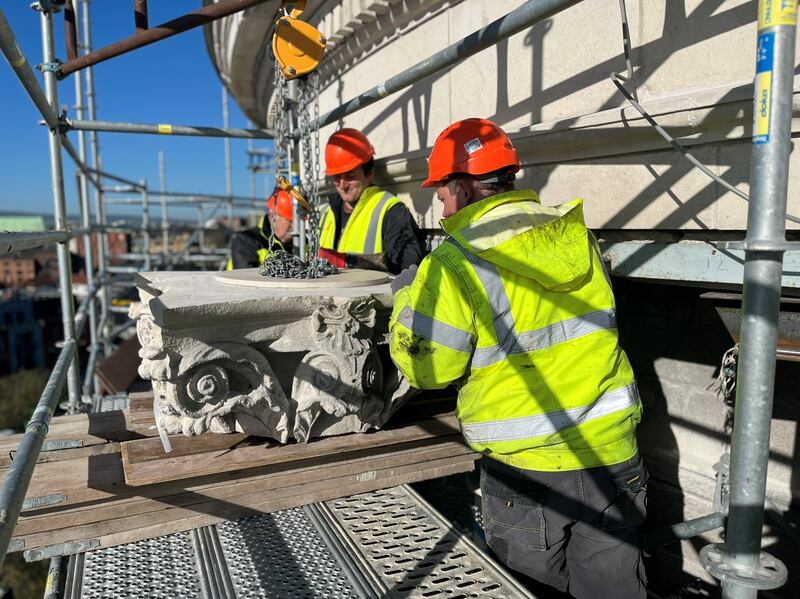


Above the capitals, Gandon’s carefully contrived Roman silhouette has been maintained through the replacement of the 1920s steel band with a new, stainless-steel version. This has been clad with L-shaped pieces of Portland stone, each shaped by hand into a gentle curve the entire way around the drum.
The bitumen slurry that coated the granite capstones has also been removed, restoring the original classical form.
Recent works have also extended to street level, conserving Gandon’s arcaded screens and triumphal arches and their 19th-century railings and gates.
The building’s setting has been significantly enhanced by Dublin City Council’s recent painting of the quayside balustrades in a matching Portland-stone colour.
Less edifying is the eye-poppingly horrendous array of ugly new antennae on the roof of the Courts Service’s own Áras Uí Dhálaigh building next door, which seriously compromise the Four Courts. If we have any respect for Gandon’s legacy, for the teams of craftspeople who have toiled to restore such beauty, and for the scenography of the Liffey, they should be removed with haste.
Indeed, what better location than outside the Four Courts to host a televised national concert of celebration, with leading music acts, fireworks and a light show centred on this magisterial public building, giving Dublin a much-needed shot in the arm?
The Four Courts is our capital’s enduring emblem. Its resurrection should be celebrated in grand style.
Graham Hickey is chief executive of Dublin Civic Trust