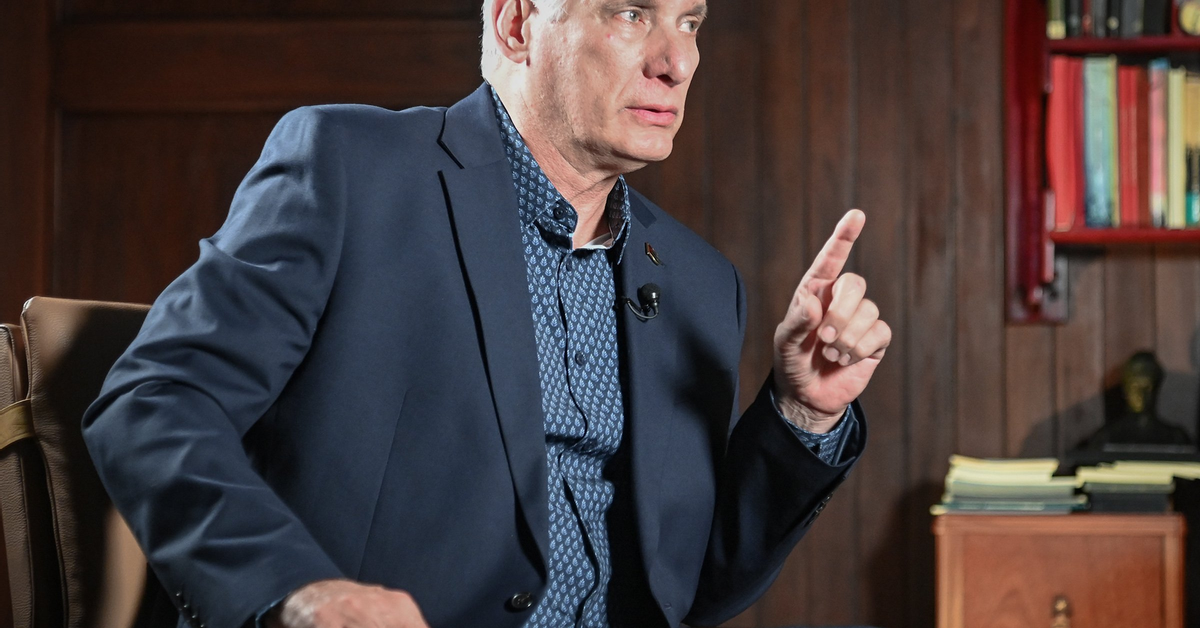
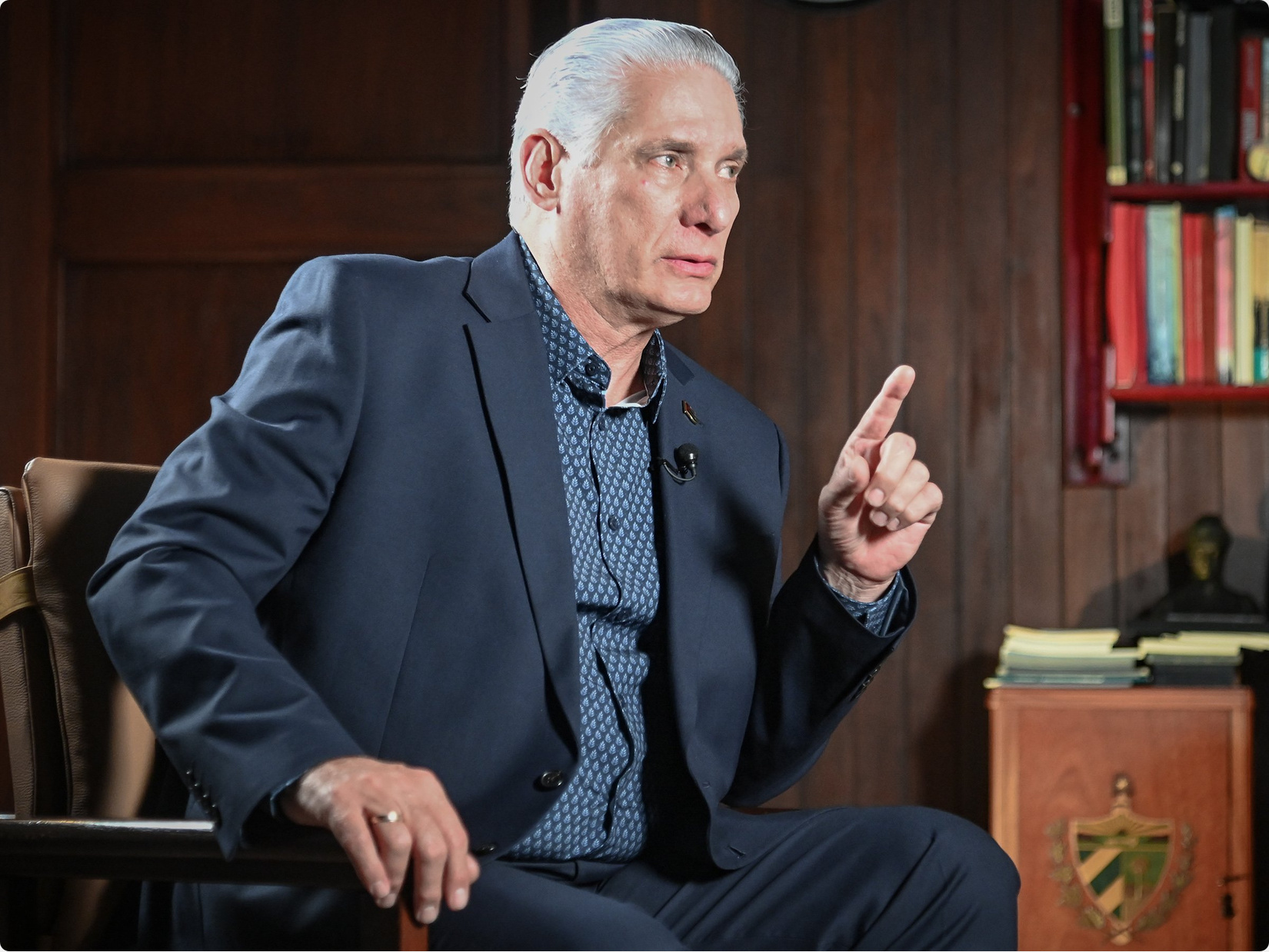
Madrid/Miguel Díaz-Canel rejected in an interview broadcast this Wednesday that the economic reforms he announced last week had been adopted due to pressure from the United States. “Trump does not rule in Cuba, nor does the North American Government rule in Cuba. Cuba is sovereign,” he told Cuban journalist Roberto Cavada, Telenoticias presenter in the Dominican Republic. However, the president admitted that the current “maximum pressure situation” “also leads us to speed up a bit, to decide faster, to have to do something.”
The epicenter of the interview were these reforms, to whose legitimization Díaz-Canel gave a long prologue. The president cited Fidel Castro’s dollarization in the 1990s and Raúl Castro’s guidelines in 2011 as other turning points in the Cuban economy. “Things were approved that seem very normal to us today, but that had a tremendous impact in those conditions,” he said. And, having laid that foundation, he was able to justify the current turn. “These are times of transformation.”
The president maintained, in case there were any doubts, that the inspiration has been China, but with the peculiarities that the sanctions on Cuba require. He also recalled that economists have been called and stressed that everything remains open to new contributions, in addition to the foundations that remain to be laid. This was evident when Cavada asked him about the guarantees that exist for potential investors. Díaz-Canel could only respond in generalities and ended up admitting that they have yet to be established. “It is one of the elements in which I believe we have to make more progress,” he explained. When asked about the legal framework, he said that it exists, but “it must be expanded in terms of concessions,” referring primarily to usufruct.
The president claimed to go even further with flexibility and incentives for investment by Cubans living abroad – Cavada himself emigrated from Ciego de Ávila to Havana and then to the Dominican Republic – and left for posterity a phrase that questions the policy of his predecessors, especially the most recent one. “If you support foreign investment, it makes no sense not to support the investment of your nationals in any of the modalities.”
“If you support foreign investment, it makes no sense not to support the investment of your nationals in any of the modalities”
Díaz-Canel also mentioned a core issue. The approved measures may clash with the limitations imposed from the United States, something that the independent economist Pavel Vidal agreed with in his most recent analysis for the Observatory of Currencies and Finance (OMFi). “The second executive order of May 1 limits which companies can trade with Cuba or which companies can do business with Cuba. And that part is never talked about,” he noted.
Cavada elaborated on the Washington issue and reminded the president that a few days ago Donald Trump’s deputy, JD Vance, indicated that there were conversations with the Cuban regime. “If they make smart decisions, we will have a much better relationship,” he said. Díaz-Canel questions a better understanding because, in his opinion, “they will never understand what we do nor will they ever accept what we do because what they aspire to is another Cuba. They aspire to a Cuba that is totally dependent on the United States and that is a totally privatized Cuba.”
However, he acknowledged again that there are conversations and an open communication channel – without new details – but insisted that there can be no pressure and that if he gave in to them, they would never stop. “There is a space for North American entities and businessmen to invest. There is every possibility of working on common issues in terms of cooperation,” he said.
Díaz-Canel did not show signs of contemplating, as a first option, an invasion, but he did admit that it is perfectly possible and cited two similar precedents – in time and political distance –: Venezuela, where the US interrupted talks to capture Maduro, and Iran, where negotiations were stopped with a bombing. “Here there is a whole combination of media warfare and psychological warfare trying to intimidate,” he argued, adding that Cuba is preparing not to attack – he highlighted – but to defend itself. In addition, he left a message, his rhetoric is not threatening, but “so that they respect us and so that they know the cost that a military adventure would have.”
Another extensive section of the interview was dedicated to the daily drama of the energy crisis. Díaz-Canel tried to combat the “myth” of subsidies. “They have said that we were refusing to pay for fuel and that we were begging for fuel. That is not true,” he introduced, and explained the barter mechanisms that Cuba has used with the Soviet Union – sugar for fuel, he said – and Venezuela – doctors. Later, due to the sanctions against Caracas, we had to “go out to the international market.” “And no one gave us fuel,” he repeated three times. Now, he regrets, those who sold to him are prohibited from doing so, he added before explaining that there have also been ships on their way to Cuba that were prevented from arriving.
He claimed, however, his work in renewables. “If that were not there, we would be living on a blackout in another because the system would be totally unstable, and during daylight hours it would not be able to provide energy to even 20% of the population,” he defended, despite the fact that the parks are underused, especially because the thermoelectric plants are so weak that the power of the photovoltaic must be restricted so as not to decompensate the system, as they themselves have explained.
Particularly striking was the mention he made of reserving national oil data, practically alluding to a matter of national security. “I’m not going to give data because I don’t want anyone to start making calculations out there about needs and how far we can or can’t go. But it is a crude oil that comes out, it has always been said that it was a heavy crude oil with a lot of sulfur content, but our thermoelectric plants in the special period were adapted to process it,” he said, asked about the quantity.
Díaz-Canel admitted that the companies that were working to drill wells and increase that crude oil or gas have had to leave due to the sanctions, in reference to the Canadian Sherritt and the Australian Melbana.
Díaz-Canel admitted that the companies that were working to drill wells and increase that crude oil or gas have had to leave due to the sanctions, in reference to the Canadian Sherritt and the Australian Melbana. And he swore that science has made it possible to refine Cuban extra-heavy crude oil and it is being used, but that the quantities are still smaller. Furthermore, and regarding the fuel imported by private parties, he said that no more than 40,000 tons have entered through that route, the equivalent of “one ship of the many ships that Cuba needs in a single month.”
Another mention of the United States was in the context of humanitarian aid. The president did give some concrete data in this section and said that of the initial three million, announced by Marco Rubio after the passage of Hurricane Melissa and distributed by Cáritas, between 2.6 and 2.8 million have been executed so far, reaching some 8,000 families. “Then they proposed an aid of six million that is now going to begin to be implemented,” he added.
Regarding the subsequent 100 million, Díaz-Canel questioned that, according to the State Department, they will begin to be distributed after September – “Why? We don’t know,” he said – and that food or medicine will not be included. “So, what is the help for? We will have to see why they have not defined it, they have not clearly said what it is for,” he protested, in addition to insisting that this cooperation is appreciated and accepted, but without failing to point out that it is “hypocritical.” “It means nothing compared to the damage that the blockade has caused to Cuba,” he reproached.